Friday, November 6, 2015

The 2015 NBW Blog Event: Filipino Librarians and the Essentials of Reading Books

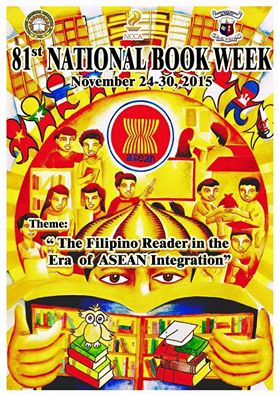
This write up is part of the  2015 NBW Blog Event aimed at celebrating and drumming up the 81st National Book Week happening on November 24-30, 2015. With the theme, the Filipino Reader in the Era of ASEAN Integration, guest bloggers write, share and ruminate on being a Filipino librarian and reader in this age of ASEAN Integration. 

Today's topic is about Filipino Librarians and the Essentials of Reading Books. Our guests bloggers are Igor Cabbab and Iyra Buenrostro. They approached the topic in a he says / she says format. Together, they lend insight and informed opinions on the shaping of the identity of Filipino Librarians, the relevance of knowing the interest of readers in the context of library services and their dreams of the ideal library in the Philippines.

Prof. Cabbab mentions a few websites where audiobooks can be downloaded. Take note of these recommendations, peruse them and if you find them worth your time, download!

    •    What/who is a Filipino librarian for you?

Iyra: This is somewhat related to a research problem I and Dean Kate Obille of UP SLIS raised in one of our ongoing papers on defining Philippine librarianship. If we look at the legislation and policy standards already in place as regards Philippine librarianship, and the qualifications and skill set that Filipino librarians must possess, these mostly entail the need to adhere to the internationally accepted practices in librarianship and assimilate or employ them in the Philippines by the Filipino librarians. There is absolutely nothing wrong with that kind of definition or characterization of what Philippine librarianship is or what a Filipino librarian should be. But I believe that there is more to Philippine librarianship or what a Filipino librarian can do than adhering to standards and own professional development. Alongside his/her own professional development as a librarian, a Filipino librarian must let him/herself grow with the library clients – be the library is a public, special, school or an academic one. A Filipino librarian can go back to his/her roots and serve a community that truly needs the help of a librarian. A Filipino librarian is the one who can serve the country, even in a simple way of promoting the value of reading through the use of Filipiniana literature. 

 Igor: I'm taking a different side to this. The usual definition revolves around the person with the corresponding skill set and citizenship, maybe we should also define based on other factors. For me it may not be about citizenship, since we're going global and all. I remember mixed martial artists of Filipino descent yet not of Philippine citizenship who proudly refer to themselves as Filipino and carry the flag in every battle.

    •    What do you feel Filipino librarians should know about their users and their reading interests?

Iyra: Filipino librarians should be aware that the reading interests of users are constantly changing. And since I really believe that going back to the roots is important, Filipino librarians can inject innovative ways of introducing books and other materials written by our own Filipino authors especially that most of the widely read books nowadays are foreign titles.

Igor: In terms of service, the client is changing. In terms of content, the audience is also changing. Together with preservation of local sources we must also look outward and consider global resources. Roots are important, so are leaves that touch the branches of other trees. Of note would be the obvious shift in attention and interest, this generation of users are visual more than textual, hence the probability of materials for them being more graphic and audio-visual than textual.

    •    What about your reading interests nowadays?

Iyra: My reading interests now are related to my dissertation…and I have no choice. Hahaha. But I’ve always interested reading about Philippine history and culture.

Igor: My reading has been related to my dissertation proposal too. Noooo escape. XD  I must admit, my  recreational reading is very low these past few months. Other than articles from FB links I barely read other stuff. Due to my hectic schedule I still find time to escape.  One time I found my way to several public domain audio resources,

http://www.thekatnisschronicles.com/
Unofficial audio drama rendition of the Hunger Games.

https://archive.org/details/IsaacAsimovFoundation6Of864kb
Isaac Asimov's Foundation Trilogy by BBC

https://librivox.org/collected-public-domain-works-of-h-p-lovecraft/
The Collected Public Domain Works of H. P. Lovecraft

https://archive.org/details/oldtimeradio
Old Time Radio Shows

So what I do is download Old Time Radio programs and audiobooks from archive.org and librivox.org and other sources and load 'em up on the car stereo on the way to work. So what I am trying to say, is… there will always be a way to learn. All Hail Cthulhu! XD

    •    In a perfect Philippines, how should things in a library be?

Iyra: I see Filipino librarians serving a community that actually reads. Filipiniana materials are widely circulated and more and more Filipinos are more aware of their own roots – their culture, history, and the story of their being as Filipinos. Love your own!

Igor: A community of service with no backbiters, no thick-headed self-serving people operating in the guise of “for the greater good”. So sorry, but that's how I really feel.


 Asst. Prof. Iyra S. Buenrostro (BLIS 2005, cl; MLIS 2010, specialization in Archival Studies) is a full time faculty member of the UP School of Library and Information Studies since 2006 and she teaches courses on Library and Information Science, Records Management and Archives Administration. She is currently on study leave while pursuing her PhD (Communication and Information) at Wee Kim Wee School of Communication and Information, Nanyang Technological University (Universiti Teknologi Nanyang) in Singapore.

Asst. Prof. Johann Frederick A. Cabbab (BLS 1994; MLS 1999, specialization in Information Systems, and Literature for Children and Young Adults) is a full time faculty member and former Dean of the UP School of Library and Information Studies. He is currently the Deputy Director of the Human Resources Development Office of the University of the Philippines Diliman Campus. He is also pursuing his Doctor of Literature and Philosophy in Information Science (DLitt et Phil) via distance mode at the University of South Africa (Universiteit van Suid-Afrika).

They are both members of PLAI, PATLS, SFA and SEAPAVAA. They last presented a paper together at the IFLA 2013 via “Reliving the Filipino classical music heritage: preservation and restoration of Philippine art music manuscripts of the University of the Philippines-Diliman College of Music“.


Thursday, November 5, 2015

The 2015 NBW Blog Event: Filipino Librarians and Their Reading Habits

Hey Jude! A book is a gift of friendship.
This write up is part of the  2015 NBW Blog Event aimed at celebrating and drumming up the 81st National Book Week happening on November 24-30, 2015. With the theme, the Filipino Reader in the Era of ASEAN Integration, guest bloggers write, share and ruminate on being a Filipino librarian and reader in this age of ASEAN Integration.

Today is my turn to write on the topic Filipino Librarians and Their Reading Habits. I am coming from a personal experience of reading as compared to Jing Hernandez's piece which shows a bigger picture on the topic. In her blog article, she describes the result of her mini-survey on what and why Filipino librarians read. Allow me now to focus on the personal impact of reading and how a book can develop and grow a friendship.

Two weeks ago I met Jude Gorospe at the FUSION 2015 Conference in Southville International School and Colleges. He had been on hiatus. Being in the FUSION 2015 Conference was his first public appearance as a resource speaker. At the conference, he talked about web based library services and best practices. It was good seeing Jude back in action. While we know each other in the profession, given that ours is a small one, we didn't really click immediately. But the mutual respect is palpable.

I admire him for his steadfast leadership and systematic way of thinking. Such qualities are evident in his decade long assignment as Miriam College's Head Librarian in the High School department and former president of PASLI.  He had his fill of activities in the PLAI National Book Week celebrations in the past years and it involved rounding up people and events all together. He has invited me as resource speaker and storyteller in many school librarian related functions. For this, I am grateful and humbled.

In August 2013, we attended the International Association of School Libraries (IASL) Conference in Bali, Indonesia. He was a paper presenter. I was there as workshop facilitator. Amazingly, our trips going there to Bali and back to Manila are the same schedule and flight. Conversing with Jude was like talking to a long lost brother. This former PASLI president is full of stories about his family and work life. His thoughts always wandered to his kids and wife during lull sessions in the conference. He is also a wonderer. Curious of new experiences and eager to partake in conversations with colleagues in the school librarianship network. He is a solid EdTech guy. He was on fanboy mode when we met Blanche Wools in the IASL Session on Guided Inquiry.

During our brief stay in Bali, I learned about the well-being collection he set up in the library. This was a perfect example of a Bibliotherapy Collection. Thus, I used it for my workshop. I also learned about his interest in pastoral care and how he used a book to help a colleague bounce back to life. That colleague survived the life crisis and went back to him, thanking him for recommending the book since it helped in the healing process. He told me about Leo Buscaglia's book, Living, Loving & Learning (Fawcett Columbine, 1982) and how this book made a dent in his life. Sadly, I am not in the position to tell. Perhaps I can invite Jude to write about it one of these days. Who knows? If his spirit is ready to share, then we are privileged to listen and respect his story.

To my surprise, Jude gave me his favorite book, the book that made a difference in his life, during the FUSION 2015 Conference. The context is that, I accepted an on-the-spot speaking engagement which he missed for some reason or another. Giving the book to me was his way of saying thank you. How precious! As a book lover, I know what it feels like to part with one's favorite book.

Upon reaching home, I opened the book randomly and in a page I read this:


 The paragraph spoke to me in volumes at a time when I am reflecting on how to take care of myself and my relationships. I think about love, friendship, couplehood and marriage, family life and communities. I wonder what Jude saw and experienced reading the book. I will read the book and I will definitely go back to Jude to tell him my experience of it. By doing so, his and my reading experience of the same book is enriched. We shall come out of the experience as richer persons. I now see Jude, not just a curios and thinking librarian but also as a friend who listens and reaches out, unselfishly sharing his talents and skills for others.

Books bring people together.

Reading amplifies this togetherness.

I think this is the call of the time. In the era of ASEAN Integration, librarians must come together to share common experiences and continuously learn from each other.

Tuesday, November 3, 2015

The 2015 NBW Blog Event: Filipino Librarians and Their Reading Habits

Photo source: PLAI and the NLP
The 2015 National Book Week Blog Event begins this week. We are starting off with the topic on:
Filipino Librarians and Their Reading Habits

Do Filipino Librarians read? If yes, what are they reading? If not, why? Why are they reading? What is their preferred reading format? Whom do they speak with about books they have read? Where do Filipino Librarians get their books?
Our guest blogger for today is Ma. Christine S. Hernandez.  Known as Jing to her family and friends, she is a librarian detailed at the College of Mass Communication Library, University of the Philippines Diliman. She loves to travel, to take a stroll in the beach and to go on a hike with her chums. She likes to grab some coffee shots partnered with a cookie or muffin. 

She writes about Filipino Librarians and the books they read. She conducted a survey among librarian friends in her learning community. She shares what she found out about them and their reading habits. Librarians read, of course! But... read on and find out for yourself!
 
Have you ever wondered what librarians do between coffee breaks and when they are at home? According to popular belief, librarians are the well-read people who are compensated to read. In the Philippines I wonder if this is true. So out of curiosity, I formulated a survey asking librarian friends questions about their reading habits. Luckily some of them responded and through a guided format, I was able to get answers. You would be amazed how witty and interesting their responses are.


As to my first question, all of them agreed that they read. Yes, Filipino librarians despite a tight schedule still find time to read. They listed down the materials or resources they are reading. They read the Bible, newspapers/featured articles, textbooks, novels, scholarly books, self-help/inspirational books, magazines, trivia books, scholarly journals, reference books, blogs (for librarians are techie nowadays), comics and even manga. That’s quite a list! Some of them prefer books on a given topic or interests like books about Philippine history, romance, librarianship (ahem!), archives, biographies/autobiographies, technology, food, health, gardening, philosophy and the opposite sex (because we are humans too).


In reference to what they’re reading, they cited reasons for reading. Most of the respondents read for entertainment and leisure. One librarian imaginatively expressed that it’s her way of escaping from this world. I now wonder what happened to the world, for others, reading is a stress reliever. Reading keeps them sane. Some librarians read out of curiosity on a given interest or topic. Some use it as a guide and find it as one of their favorite hobby. And due to the fast-paced world, librarians want to keep abreast of the new trends (be it in their profession or not), to increase their knowledge (both in librarianship and other fields), and be able to learn new things that they may apply in daily living.


Jing Hernandez sitting on a C at the College of MC, UP Diliman
I asked them as well as to the formats they prefer and itemized some of the formats. On the survey, majority prefer both formats. For clarity, 20 librarians prefer both formats, 4 prefer printed ones  and 4 on non-prints. But to top it all, almost all of them were well-versed to print and non-print formats.


In the survey, they were also asked if they speak about books they have read to someone who has read it as well. Majority shares it with friends, next to their colleagues, followed by members of their family, to library clientele/patron, then business partners and in online  forums. In some case, some respondents don’t speak about it to anyone. Some of the reasons why they share it to others is, first, they find someone they can relate it to. Another reason is that, the other party would benefit from it too. Based on experience, we Filipinos love to tell the gist of interesting stuff we read about.


For the final question, I asked them as to where they get the books they are reading or have read. Most of the librarians got it online. Then some of them read books from libraries where they work. Some are from bookstores bought  especially when it’s on sale! Others are from friends, given as gifts and lent by few good ones. They also get the books they read from book fairs and colleagues.


If there is one gift God bestowed upon humans, it is the ability to read. Not just the ability itself but also to construe and construct from what has been read. In an era where instant is the new frontier, Filipino librarians find ways to keep abreast on the trends of the profession and the world in general. Behind the office desk. While we lend out books for clients or answer their queries, between our wee breaks and packed lunches, on our way to home or on meeting a friend, we Filipino librarians read and think about what to read. And when we’re in our haven, we snuggle and let our imagination lead.

Yes, Filipino librarians read. In the age of ASEAN integration, reading is a tradition that is for keeps.

Book Review: Carry On by Rainbow Rowell

Carry On
Rainbow Rowell
St. Martin's Press, 2015

Rainbow Rowell is back with Carry On, a fascinating but sad depiction of magic and man's obsession with power. What struck me was Rowell's narrative on how one's choice of loving can lead to destruction or redemption. So this novel on magic and mayhem is, for me, in its many layers, a love story.

The story of Simon Snow, the Chosen One, and nemesis Basilton Grimm Pitch is tailored after the fantasy canons of old. There is a classical feel to this relationship. Think about the opposites and the good-evil characters of literature, old and new. Add a girl in the mix, Penelope Bunce, and there goes the triumvirate - Harry Potter once more. But, it isn't. It is a stand alone novel despite shades of Potter and Lev Grossman's The Magicians. Is it a combination of both? Rowell's take on the magical and fantasy troupes of this age?

As a fan, I felt Rowell was having fun writing the novel. I'm not saying or assuming that writing this novel had been easy for her. For who am I to say so? But I can tell from the way the characters speak to each other and the way the plot unraveled the secret of Simon Snow that this novel was not easy to tuck away in another novel as a technique to further enrich the story. It has to come out! And out it did! It hit me with a bang right through the heart. Because, apart from being a story of magic and power, of friendship, of desires big and small, it is a story of a mother's love and a father's duty to protect his child.

Carry On is another feather on Rowell's cap. A classic tale of creating something new out of a tried and tested canon. Adorable!

Rating: Four Bookmarks

Thursday, October 29, 2015

The 2015 Teens Top Ten Reads

Watch this video of the  popular top ten YA books of the year!
The official 2015 Teens’ Top Ten titles are as follows:
  1. The Shadow Throne by Jennifer A. Nielsen (Scholastic)
  2.  I Become Shadow by Joe Shine. (Soho Teen)
  3. To All the Boys I’ve Loved Before by Jenny Han. (Simon & Schuster)
  4. My Life with the Walter Boys by Ali Novak. (Sourcebooks)
  5. Heir of Fire by Sarah J. Maas. (Bloomsbury)
  6. The Bane Chronicles by Cassandra Clare. (Simon & Schuster/Margaret K. McElderry)
  7. The Young Elites by Marie Lu. (Penguin/G.P. Putnam's Sons)
  8. The Kiss of Deception by Mary E. Pearson. (Macmillan/ Henry Holt & Company)
  9. Since You’ve Been Gone by Morgan Matson. (Simon & Schuster)
  10. The Geography of You and Me by Jennifer E. Smith. (Hachette/Poppy)

Friday, October 23, 2015

Fusion 2015: BiblioCare and Info-edutainment in light of the ASEAN Integration

Here is my presentation for my session in Day 2 of the 2015 Fusion Conference at Southville International School and Colleges.


My session begins at 10AM. Wish me luck!

Thursday, October 22, 2015

Recommended Reads: Batang Historyador Series

Batang Historyador Series
Author: Augie Rivera
Publisher: Adarna House / UNICEF

Inspired by a query from Augie Ebreo on books and stories that can influence change, I searched for recommended reads on stories about people empowerment to extend this book service. My search led me to the The Batang Historyador series. The series has five books that show the lives of children across Philippine history as written by Augie Rivera and illustrated by Paolo Lim, Isabel Roxas, Jomike Tejido, Marcus Nada and Bryan Ballesteros. The first story begins during pre-colonial Philippines to the Spanish colonization, the American period to the Japanese Occupation during World War II and ends with a story of a boy who lost a brother during the Martial Law years. A work of fiction, yes, but the stories of childhood in each book has evidence of good research coupled with real life events that appear to have been taken from personal and oral histories. This later aspect of the book is something I wish to find out and validate.

Rivera writes with insight and revelation on issues that touch on children's rights. This is the strength of the series. How the author deftly tells the story, with respect and sensitivity to each child character being victims of slavery, exclusivity, racism, child labor, war and conflict either by chance, choice or by a bigger, more powerful force is a gift. There is a redeeming value at the end of each story. Central to the theme of the series is the implied message of hope rising from chaos and confusion. More than this, I am moved by the stories to think and wonder if we are really taking good care of our future, our children who will continue on. How are we nurturing and enriching our greatest resource?

It is tricky, as I think about it. To empower and influence change, one has to face the sensitive and "taboo" issues in one's life and in the wider, bigger society.

I segue to promoting the Ang INKFest on October 24, 2015 where Augie Rivera will talk about writing children's stories with sensitive issues. This will be in Fullybooked, Bonifacio Global City. It will start at 10.45AM. If you are in the area, go! If you have the time, attend! Speakers include, Tarie Sabido, PBBY President and May Tobia Papa, award winning writer and illustrator. Marcus Nada and Bru, Inkies all will talk as well.

Wednesday, October 21, 2015

FUSION 2014: Info-edutainment for Kids and Teens

This is the presentation I used last year during the FUSION 2014 Conference in Southville International School. This year, I will be speaking again about BiblioCare, otherwise known as Bibliotherapy, and Info-edutainment seen from an ASEAN perspective. Having been to the ASEAN School Librarains' Workshop in Bangkok last June, I have good news to share.

View last year's presentation and if you are attending this year's FUSION Conference, this would make a good reviewer.


See you in Southville!

Monday, October 19, 2015

Teen Read Week is October 18 - 24, 2015: Get Away @ your Library

Breaking the silence in the blog and coming from a hiatus, I begin this week with a post on Teen Read Week 2015. This year's theme for Teen Read Week is  Get Away @ your Library. Know more about this year's theme and get freebies, like posters, bookmarks and flyers. One interesting event that YALSA (Young Adult Library Services Association) sets up every year during Teen Read Week celebration is the Teens Top Ten. Visit their Facebook Page and find out past winners. There is voting of top ten lists this year and the deadline is on October 24, 2015.

The annual lists are my reference and catalog for selecting and acquiring titles for my teenage readers in school. I consider the list as my personal catalog of books to read as well. How I wish we have something like this in Manila. But, we need to strengthen the book making and content creation of young adult books in the locality.

Starting this week, I will be posting reviews of books I have read and movies I have watched that teens and the young at heart might enjoy. I will also be reminiscing the wonderful libraries I have been to and why these libraries have been places to get away to. Here is my list of book reviews to post:

a.  The Amulet Series
b.  Carry On
c.  We Were Liars
d.  The Maze Runner (the movie)
e.  Flipped (the movie)
f.  The Secret World of Arrietty (animation)
g. The Old ISM Library
h. The Old TJCC Library
i.  The PNU Library
j.  TK Park, Bangkok

What about you? What book or library have you read or been to that you consider as places to get away to? If not a library, maybe a bookstore?

Post a comment or send me a PM on FB.

Saturday, October 10, 2015

Workshops with Teachers and Librarians: Philippine Lit Fest, TeacherTraining Institute & AKLATAN 2015

Trash or Treasure: Turn these trash into teaching treasures!
I had the wonderful opportunity of working with teachers and librarians over the past months and recent weeks. My workshops with them were all about storytelling, books and reading, creative thinking and the use of technology for teaching and learning. Why I am still doing this after a decade or so affirms how important literacy development is in this day and age. I learn a lot from these workshops. I do design the modules I conduct and deliver, but the interaction I get from participants fuels me to further create.

Knowledge shared is knowledge gained.

In the Philippine Literary Festival, I was amazed at how thirsty we all are for authentic and genuine human connections. Stories and storytelling can quench that thirst. Weaving tales and stories is magical. In the Weavers of Magic workshop, we reaffirmed our commitment to pursue the magical path through the process of creating children's literature for young readers today. In the training I had with public school teachers of Estancia and Carles, Iloilo, we discovered how materials in our immediate environment can be used as instructional materials. What we deem as trash can actually be a treasure trove of instructional materials. All we really need is to look at our deepest needs and desires to surface the imaginative power that has been hidden with in ourselves for so long. After all, creativity is a natural talent. How it is nurtured is another story though.

Teachers read children's books. My favorite part of the workshop.
In the AKLATAN 2015 Conference of the PLAI - CLRLC, I realized that we all need to go back to books. Back to Books. Back to Basics. To fully understand why we are librarians, we need to take a closer look at why books, as a technology, is still around in this age of the digital divide. How does a technology, like the book, can magically bridge gaps, make connections and celebrate the human spirit in the age of smartphones and social media? Why do we need to talk about reading in the era of ASEAN Integration and how do books play a part in learning how to read? These thoughts came to mind as I conduct my workshop with the librarians of Central Luzon. While they make their own books, I reflect on the work that Filipino Librarians are challenged to do.

The work is plentiful but the workers are too few. I only know of one thing -- we shouldn't stop learning. And as we learn, we need to reflect on our actions; on our insights; on the next step of the journey.

Friday, October 9, 2015

A Big Sister Story: Grace and Mary Rose

Mary Rose Lagunsad is one of the five winners of my FB-micro blogging contest on our new book, Big Sister. Big Sister is mischievously and lovingly illustrated by Ruben "Totet" De Jesus and published by Lampara House. 

The contest had one question: what makes your "ate" special? Tell us and get a free copy of the book. The first four to comment gets a free signed copy. Below is Mary Rose's answer:

My Ate is special! She's a talented woman who acts, sings, emcees & plans events really well. She was Best in Deportment in Elementary. She won "Best Doña Victorina" in High School. Despite her being very emotional she's sensitive to the needs of others. She's a wonder girl who juggles her roles as mom, sales agent, tv&movie talent,to name just a few. We may have bad sister days but she makes an effort to turn things around. No wonder her name is Grace.

Mary Rose teaches kindergarten. She is a mom to Marjeorie and Matthew. A book lover since her grade school days, she believes that books can take her to many places and allow her to talk with many people faster than modern technology. Revisiting places and rekindling the moments spent speaking with the men and women of great thought and wisdom for free are but a few of the many rewards of reading books.

Thank you Mary Rose, for joining the book contest. I hope you enjoy the book!

Thursday, October 8, 2015

Teacher Storyteller: Michelle Agas

I was with Teacher Michelle Agas last May 2015 for a week long workshop in Bicol. We had a wonderful time working together along side Teacher Pam Razon in the literacy training of EDUCO and Adarna House. Last MIBF, she was at the Lampara Writing Workshop as participant. During the A Day with Weavers of Magic, she was one of the lead storytellers in the workshop.

Was it only yesterday when Teacher Michelle was a college student in Teacher Portia Padilla's class? It was there, in Prof. Padilla's class where I met her, an "Eduk" student of UP Diliman and I was the class's guest resource person on storytelling.

A few years after, Michelle joined the PBBY Salaysayan 2008 , a storytelling competition, where she won first place in the English Division. Read the link on the PBBY Salaysayan 2008 where I happened to be  judge. I was impressed at Teacher Michelle's performance. She was a revelation.  

I am proud at how far Teacher Michelle has grown as a storyteller since her college days. Aside from teacher training and reading tutorials, Teacher Michelle runs ReadingReady where storytelling services for schools, events and parties can be availed.

Cheers to you, Teacher Michelle! I look forward to more meet ups and workshops with you in the future. I still dream of doing a tandem telling performance with you!

Teacher Mich in action at the A Day with Weavers of Magic

Wednesday, October 7, 2015

Storytelling at the Philippine Literary Festival 2015

I stumbled upon this video of a participatory storytelling technique I used in my workshop during the Philippine Literary Festival last August 30, 2015 at the Raffles Hotel. Participants of the workshop were teachers and my co-facilitators were Audrey Anday and Darrel Marco.


Here, I enjoined participants to play roles in the storytelling of The Day Juan Went Off to Seek His Fortune. Thanks to Christian Paul for posting the video on YouTube.

Tuesday, October 6, 2015

Library Talk and Scavenger Hunt

Puzzle Time! Final round of the Scavenger Hunt
The Library Talk and Scavenger Hunt activities I had with grade 9 students last week was a good one. Both are regular activities by the library under its instructional program and the participation of a new batch of grade 9s made it different from the previous years. Students are the uncontrolled variables. Often, their context and experience make or break a learning encounter. This makes teaching really fun!

For the Library Talk, I simply provided students pointers on going about their research: what the task is; what information is needed to accomplish the task; how to go about seeking and locating for information to finish the task. There. The BIG 3 in the BIG 6 research process. These three pointers make up the crucial analytical steps of Information Literacy. I then re-introduced the library OPAC and basic online databases that the library subscribe to. I get a kick showing how cool the PDFs can get when you email it to yourself with annotations and citations.

The Scavenger Hunt on the one hand is a game where players use the basic search tools in the library. In the BIG 6 model, this is step 3: Location and Access. After the game, the CRe (Comparative Religion) teacher and I processed the experience. Students said:

- they were able to use the "websites" that the library has;
- they were able to locate information;
- they were able to see more of the library -- it is not just books;
- they got to save documents in World Book Online using My Research;
- they learned how to find books more efficiently;

The first term is about to end. While I am happy that this batch of grade 9 students have had three library visits with me, and that their respective teachers articulated the need to work with me to strengthen research skills, I hope to do more library encounters with them. We have only just begun.

Library Visitor from Domuschola International School

Judy Ann Emano, school librarian of Domuschula International School, visited us at the Beacon Academy last Friday, October 2, 2015. I gave her a tour of the school and we talked about what it is like to work in a school that implements the International Baccalaureate  program. We both agree that it is not a walk in the park.

Ms. Emano was fortunate to see me conduct my Library Talk, a session I provide students when they are tasked to do research work in the library. In the afternoon, she also sat in the Scavenger Hunt activity I had with the grade 9 students.

Ms. Emano sent us this email of her visit to the Academy:

The Beacon Academy library gives an exemplary service to the students, teachers, and parents keeping them engaged and intellectually stimulated, through the collaboration of teachers and the librarian.  I am honored to meet the people behind Beacon's continuous success.  I am grateful that the Beacon family warmly welcomed Domuschola International School to their campus and we also look forward having you in our school in the near future.

Monday, October 5, 2015

Blog Event for National Book Week 2015

Last September 26, 2015, I posted this call for volunteers in my FB page for Filipino Librarians to join a blog event for National Book Week 2015. Here is what I said:
Hi! I am gathering a group of librarians who can guest in my blog through posting an article about the book week theme for this year: The Filipino Reader in the Era of ASEAN Integration. The blog event will start on October 24, and will end on November 24.

It is simple to do. A sub-theme or question is assigned per week. Three librarians will write about the sub-theme or question of the week. Their articles/essays will be posted in my blog MWF. Participants are requested to post in their social media accounts the articles/essays via ‪#‎filipinolibrariansread‬ ‪#‎NBW2015‬ ‪#‎readinginASEANIntegration‬. 12 librarian volunteers are needed for the blog event.
The objective of the blog event is to drum up the NBW 2015 and campaign for books and reading. We are librarians but how many of us are bold and brazen enough to show the world our love for books and reading? Now is the time to actively and visibly advocate books and reading.
I was able to round up twenty two volunteers and invited librarians and friends. They are:

Roi Calilung, Darrel Marco, Ryan Joseph Balmaceda, Igor Cabbab, Michale John Tarronas, Martin Julius Perez, Elijah Dar Juan, MJ Tumamac, Rhea Apolinario, Willian San Andres, Audrey Anday, Candy May Schif, Cristina Villanueva, Jing Hernandez, LC Fernandez, Rochelle Silverio, Anne Grace Bansig, Iyra Buenrostro, Mia Diesta, Vine Degamo and Mennie Ruth Viray.

In the coming weeks you will be reading about what Filipino Librarians are reading, what reading means to them, who they think are their readers in the age of ASEAN Integration, and what role do books and libraries play in this economic convergence of South East Asian nations. The topics per week are:

Week 1 - October 24 - 31: Filipino Librarians and the Their Reading Habits
Do Filipino Librarians read? If yes, what are they reading? If not, why? Why are they reading? What is their preferred reading format? Whom do they speak with about books they have read? Where do Filipino Librarians get their books?

Five Filipino Librarians

Week 2 - November 1 - 7: Filipino Librarians and the Essentials of Reading Books
What is the perfect book?  What are the top ten best books you have read in your lifetime that have made an impact in your life? What are your recommended reads for other librarians? It can be books about librarianship or LIS, fiction or non-fiction.

Five Filipino Librarians

Week 3 - November 8 - 14: Filipino Librarians and Their Library Readers
Who are your readers in the library? Why do they read? What are they reading? How do they Read?

Six Filipino Librarians

Week 4 - November 15 - 24 - The Filipino Librarian on Books and Reading in the Era of ASEAN Integration
What role do books and libraries play in the era of ASEAN Integration?

Six Filipino Librarians

I will post the schedule of Filipino librarian guest bloggers and their articles soon!

Celebrate the Teacher With In! Happy World Teachers' Day! Part 2 of 2

The storytelling workshop I conducted during the A Day with Weavers of Magic wouldn't be a complete success if not for the participation of Michelle Agas, Miko Manalo and Jerson Capuyan. Once upon a time, I gave their class a mini-workshop on storytelling. Teacher Portia Padilla was their teacher then and I was a willing resource person. A few good years after, they graduated and are now professional teachers. All three led the breakout sessions to demo a storytelling style and technique of their own choosing.

Two librarian friends, Ann Grace Bansig and Darrel Marco, were storytellers too at the workshop. Both have education background since they took cognates in Reading in the UP REGALE program.

Teachers and librarians weave magic!


We were joined by teachers and librarians who volunteered to monitor and facilitate in the small group discussion and breakout sessions. Thank you very much to teachers MJ Tumamac, Amadeus Pagente and librarians Audrey Anday, Jing Hernandez and Mennie Ruth Viray. Your presence made the afternoon truly meaningful indeed.

I look back at this wonderful event where teachers and librarians come together to weave magic. On World Teachers' Day, I reflect and see more collaborative opportunities for librarians to work with teachers and for them to assume teaching roles.

Celebrate the Teacher With In! Happy World Teachers' Day! Part 1 of 2

L-R: Teacher Hazelle, Me, Miko, Jerson, Michelle and Teacher Portia
A week ago,  I was given the opportunity to train teachers and future teachers by conducting a storytelling workshop at the Benitez Hall, College of Education, UP Diliman. I was able to do this with the help of teacher friends from the UP Reading Education Area. Together with student led organizations, the said department and reading advocates sponsored the annual A Day with Weavers of Magic. This day of magic weaving is already a tradition in the UP "Eduk". What Lina Diaz de Rivera started back in the 90s lives on through the effort and zeal of teachers Portia Padilla, Hazelle Preclaro Ontengco and Maita Salvador. Their students and leaders of student organizations in the college lent valuable support and manpower.

During my workshop in the afternoon, I met teachers from different parts of the metro and nearby provinces. Students from the UP Reading Education Area were also in attendance. One of the teachers who attended the workshop, Mr. Norman Tabios, tagged and mentioned me in this Instagram post:

I had the pleasure to meet Zarah Gagatiga last Saturday during the seminar-workshop "A Day with Weavers of Magic" at UP Diliman College of Education.
I wish that our country have more teachers like her. Her love for teaching, reading, and writing is something that every teachers must emulate. Long live Ma'am Zarah Gagatiga!
Continue inspiring more teachers and students to love reading and learning. Mabuhay po kayo!
Mr. Tabios teaches at the Our Lady of Fatima University. In his return to the university, he immediately shared all the wonderful things he took away from the Weavers of Magic workshop. He shared the wonder of books, reading, writing, book making and storytelling to his students in the college level.

Thank you Mr. Tabios for the good wishes! Your response is truly heart warming. I am inspired to continue on!

To all the teachers who have inspired us and are continuing to help us become better persons, happy World Teachers' Day!

Sunday, October 4, 2015

School Librarian as Collaborative Teaching Partner

It is the eve of World Teacher’s Day and I write this — a short piece on the teaching role of a school librarian.

As a school librarian, I am honored to work side by side with teachers for the past twenty years — and counting. My experience working with them has been, in general, meaningful and lifer affirming. Providing co-teachers with resources they need in the classroom and giving them access to an array of instructional materials and information for professional growth activities has been the core of my role as a school librarian. Organising the library as a learning hub and creating a digital learning environment for teachers and their students come in second. This is another exciting part of my job and one where I find a creative outlet using technology. The most challenging role so far, to me at least, is that of a team teacher or assistant teacher of research and writing.

Experience has taught me that, while teachers welcome the assistance given to them to access useful information and helping them create learning environments for their classes, working in collaboration with a school librarian for instructional and teaching purposes is something new. What is new can be risky. New things mean change. Change can be a source of discomfort and fear. For one, collaboration requires a different mind set. It is founded on trust and respect.

School librarians who are willing to venture into collaborative working teams with teachers should be well prepared to be trusted and respected and to do the same with their partners. These things are earned through hard work over time.

So how does a school librarian prepare for this?

1. Be sure that you know how to teach research and writing. Start by practicing what you preach. Research and write. Write research papers. Research is as simple as asking a question and finding answers to the question — more on this in future posts.

2. Understand the language of teachers. Converse with them. Know what matters to them. Good teachers will always talk about their students’ welfare and well-being. Make this a common ground. Aren’t you interested to make students readers for life?

3. Know how to teach. If your LIS education did not prepare you for this, LEARN it! Check MOOCs on teaching, educational technology, Information Literacy and the like. Read up on books on education. Join a professional learning network of eductors Build a personal learning network. These two are different and I will discuss each in a future post. Attend seminars and conferences where teaching library skills, IL skills, research and writing are topics of conversations.

4. Seek support from leadership. If you haven’t join in any faculty meetings, request that you be included. Too shy to do this? Then you will never be able to collaborate with teachers. Your school library won’t get maximum use by students. How can you build the collection and develop a reading community if you are removed from the discussion hubs of teachers and school leaders?

5. Strategise and plan. Numbers 1-4 can be written down in a three year development plan of the library. While you are planning and strategising in preparation for teaching collaborations via the school library’s services and programs with you as the conduit to teachers, promote reading and the use of the library’s resources, technology included.

When school leaders see an eager school librarian stepping up to the role of a team teacher, support is given. Trust and respect will be earned.
Related Posts Plugin for WordPress, Blogger...