Thursday, November 30, 2017

Book Review: Issued to the Bride : One Marine (ARC)

Issued to the Bride One Marine (Brides of Chance Creek Book 4)Issued to the Bride One Marine by Cora Seton
My rating: 3 of 5 stars

Back at Chance Creek. Back to familiar grounds.

Seton is consistently good at keeping the romantic tropes in line with the theme of the series. It has become a predictable read. Nothing else surprised me but for the General’s imminent return to Two Willows.

Logan is the funniest of the four men, so far. That he built a reading room up in the attic for Lena earned him points in my book. As for Lena, she is the most interesting of the sisters, so far. So let’s see what Alice ad Jack has to offer!

View all my reviews

Monday, November 27, 2017

Days 2-3 of the 7th Rizal Library International Conference: Connecting Libraries, Information & Community Knowledge

Congratulations to the Rizal Library, to Dr. Vernon R. Totanes and his competent and dependable staff for a successful celebration of its 50th year! The celebration was indeed, golden!

They launched a time train exhibit highlighting innovations and innovators that set the Rizal Library as a modern academic portal with an efficient and professional staff that continuously relate to its learning community with a love and loyalty akin to Rizal's relationship with the Philippines. I thought I have seen a good looking library mascot in its arch rival school, but Rizal Library's "Pepe" has to be the better looking one. Sorry, Jolibee, I know you have cool dance moves, but a young Jose Rizal mascot is my choice at the end of the day.

They conducted the 7th Rizal Library International Conference with paper presenters from the US, Singapore, Indonesia, Barbados, Australia and of course, the Philippines. The cadre of keynote speakers, the majority of them are non-librarians, are true lovers of books, libraries and the written word.

Dr. Reina Reyes, Ph.D. dazzled! She glowed as she spoke about the stories that lie beneath big data and how librarians can mine them to its potential. She bubbled with joy and I wondered about the books she read as a child. Dr. Nikki Carsi Cruz, Ph.D. is a historian and she knew the power of stories and when to appropriately use them. A friend from the book industry, Christine Bellen, took participants, visitors and guests to Calamba and back to Manila in her musical, Batang Rizal. Respect to Jerry Respeto for the accessible music that delighted everyone in the room. My favorite, so far, is the Kuwento Rap with Monkey and Tortoise dancing about, enacting the famous Tagalog folktale that launched a thousand Filipino tales and storybooks for children.

Paper presenters were a mix of young and seasoned researchers, academicians, dreamers and visionaries. Where else can you find an interdisciplinary conference with an international appeal, but in the Rizal Library International Conference. Pioneered by Hon. Lourdes T. David, her former team of librarians stayed true to her mission and legacy of fostering academic research in Library and Information Science by staging a gathering of curious, critical and creative thinkers in one big hall. Only this time, the younger set of librarians in the Rizal Library showed more - magis, by crossing content and accepting research subjects that will enrich the practice of LIS and the production of research in the discipline.

In the process, the Rizal Library library and staff succeeded in creating a research community beyond Katipunan and Loyola Heights.

I came. I saw. I CLICKED. See you in the next Rizal Library International Conference!


Friday, November 24, 2017

Full Paper: Project LEARN Revisiting History and Creating New Narratives for Young Filipino Readers

Friday, November 17, 2017

Day 1 of the 7th Rizal Library International Conference

As I write this post, participants of the 7th Rizal Library International Conference (RLIC) are out in the garden at the back of the Social Science complex having their morning break. I am in Leong Hall blogging away.

Reina Reyes' presentation on Big Data X Information Science has just ended. More on her talk next blog post.

Now, for Day 1 of the RLIC, here are some reflections I wish to share.

- Big data is the name of the game and librarians are in a good position to mine, curate, analyze and develop a body of knowledge that impacts communities.

- There has been an expressed need for training and continuous professional development on data mining and analysis. Me thinks: begin with information literacy.

- Librarians conserve and preserve information, knowledge and media. They create them too.

- Media and technology are thinking tools which librarians can use in creating, communicating and conserving information. There are limitations in technology and media access and availability, but through partnerships and collaboration objectives can be met. An example is the Community Archiving Workshop and Valerie Clarke's oral history, preservation project in Barbados

- Opportunities to imagine and create abound in our libraries and the communities where we belong and serve patrons. You only need to look closely to make things happen and to solve problems.

Next post is Day 2 of the RLIC!


Tuesday, November 14, 2017

The 1st Wordless Picture Book Prize of the PBBY

Lifted from the PBBY website:

The Philippine Board on Books for Young People is now accepting entries for its Wordless Book Prize. 2018 will mark the first year that the PBBY will be awarding such a prize. The winner shall receive Twenty Thousand Pesos and a medal. Prizes shall be awarded at an appropriate ceremony to be held on National Children's Book Day, July 17, 2018.


DEADLINE

February 19, 2018 (5:00 PM)

CONTEST RULES

  1. The contest is open to all Filipino citizens except those who are related to any PBBY member up to the third degree of consanguinity.
  2. All entries must be e-mailed to pbbywordless@gmail.com. For this contest, all submissions must be in digital form, with each file clearly identifiable by a filename that is actually the pen name of the contestant.
  3. Entries may be in color or in black and white. They may be digitally rendered or traditionally done artwork that may or may not have been digitally enhanced. The submission format should be pdf. Entries should use the CMYK color space and should be at actual size format with resolution at 300dpi.
  4. Each entry should comprise the following:
    1. One clean comprehensive artwork of the cover spread design (includes both the front and back covers).

      Filenames for this file should include the initials CS.
      Example: PenName_CS.pdf
    2. Two clear comprehensive artworks of two spreads, rendered in the intended style and medium, and in the actual size format. The recommended spread size for a board book is 13 x 6.5 inches while the recommended size for a picture book is 14 x 9 inches.
      Filename should include SP01 for the first spread,
      and SP02 for the second spread.
      Example: PenName_SP01.pdf and PenName_SP02.pdf
    3. A detailed storyboard in line drawing (grayscale).
      Filename should include the initials SB.
      Example: PenName_SB.pdf
    The contestant also has the option to submit all files already collected in a 4-page pdf. Filename should be Penname_ALL.pdf.
    Entries should not contain any words, just the title and subtitles (if any) on the Cover spread (CS).
    Failure to observe file naming rules may affect judgment of entry.
  5. A contestant may send in more than one (1) entry.
  6. Entries may be collaborative, meaning a visual artist may collaborate with a writer to come up with the narrative for the entry.
  7. Each contestant should also email two documents:
    1. The first document should indicate the contestant's full name, address, telephone/cell phone numbers and email address.
    2. The second document should be a scan of a notarized certification from the author. (Download the format for the certification).
    If the entry is collaborative, there should be complete information for both contestants.
  8. Entries must be received by the PBBY Secretariat and time-stamped no later than 5:00 p.m., February 19, 2018.
  9. PBBY reserves the right of first refusal for the publication of all winning entries.
Winners will be announced no later than April 20, 2018.

For more details, interested parties may contact PBBY by calling 3526765 local 203 or emailing pbby [at] adarna.com.ph.

Friday, November 10, 2017

The Lighthouse Diary Entry 6: Works of Students As Part of the Library Collection

The International School Manila I know as a child has a Children's Media Center where I would visit during summer break. Of the many collections of books in the library, there was a special shelf for books made and written by students. Most of the books were short stories and collection of folktales, poetry and essays written in English class. The librarians and teachers in ISM value their students literacy journey that they included them in the library's collection.

As an eight year old reader, seeing books made by kids and reading them made a lasting impression. I discovered that shelf filled with books, bound by hand and some by a binding machine written by kids my age and older. There were stories similar to The Little Prince with towering trees and starry skies. There were books on folk tales jazzed up into crazy and contemporary versions from old motifs (this was in the 80s). I was in awe. I wanted to write too! So, I did by starting a journal. It was only years and years later that I gathered up the courage to write my own stories.

In Xavier School, while working as a school librarian in the Early Education unit, I teamed up with Nursery and Prep teachers for book projects. Our boys made picture books, wordless books, counting books and flash cards they can use for telling stories. I kept them in a special cabinet. Now I wonder if those books and storytelling flash cards are still in the EED Library.

Fast forward to where I am today.

Imagine my joy when I discovered a packet of zines on my table one morning!

The zines were made by our grade 10s and our English teacher donated them to the library. What precious additions to the library's collection! Apart from the Personal Projects and copies of Extended Essays, I am a proud curator and guardian of these "books" and student made projects. 

A few years ago, I was part of the team who organized the Early Readers Online Project. Our high school students made stories for readers in the early grades and these are all accessible on our school's website. The stories can be downloaded for free. Visit the Community and Service of the Beacon Academy.

Ah, a few of the many things I love about my job. - being a part of the creative process as well as designing structures for data and information access so knowledge can be derived from them thrills me to no end (I know I am geeking you out!) The best thing is, I get to curate, chronicle, and document these symbols and representations of thought and creativity. What a privilege!

I know so little. Yet, I am happy knowing only this much.

Thursday, November 9, 2017

Imagine! Play! Wonder! With Zarah C. Gagatiga

Here is the official poster of Imagine! Play! Wonder! A Storytelling Workshop with Zarah C. Gagatiga.

Curating SLIA Blog Posts: On Library Collection Development

What I have written so far about library collection development. Because, it's National Book Week and National Reading Month. Because, I get asked and consulted by peers and LIS students. Because, this part of what I do as a librarian.

Ins and Outs of Collection Development  (2010)

Ebook Collection Development 2012

Ebook Collection Development for School Libraries 2012

PPT on School Library Development 2012 - Throwback post for 2016

Developing Digital Collections 2011 - Insights on the topic as gleaned from a seminar I attended in Adamson Univeristy in 2011

Building a Picture Book Collection in a High School Library - Because Picture Books Are For Everyone!

Building a Graphic Novel Collection in the School Library - Because Graphic Novels Is Literature.

Striking the Balance on Collection Development - An AVR I produced for the PNULISSAA Annual Conference last May 2016.


Sunday, November 5, 2017

Storytelling Workshop: Imagine! Play! Wonder!

Imagine! Play! Wonder!
Storytelling for Growth and Healing
A Workshop in Developing Literacy Skills and Life Skills

Workshop Facilitator: 
Zarah C. Gagatiga

Blogger. Librarian. Author. Storyteller. Teacher.

 Date and Time:
 December 2, 2017
Saturday, 9AM - 3PM

Venue:
Lampara House Showroom
Sto. Domingo, Quezon City
Landmarks: Sto. Domingo Church and Angelicum College

WORSHOP DESCRIPTION:

Storytelling opens up opportunities that stretch the imagination,  the provision for play, and develops in the listener, a sense of wonder! It is through imagination, play and wonder  where children, even adults, learn at their best.  Imagination, play and wonder develop creativity and compassion.

The workshop is latched on three themes namely, Imagination, Play and Wonder. Three concepts on storytelling will further be taken up in relation to the three themes. These are:

a. Storytelling idea 1: Storytelling follows a sequence of order and organization.
b. Storytelling idea 2: Storytelling fosters dramatics and the performing arts.
c. Storytelling idea 3: Storytelling is creative learning!

A workshop kit and a storytelling starter packet will be given out to the participants of the workshop.

Participants: Open to all interested; students in Senior High School and College levels; Maximum of 50 pax, minimum of 30 pax.

Fee: 600 for adults; 400 for students

Contact information: lamparapublishinghouse@gmail.com / zarahg815@gmail.com

*This workshop is partly sponsored by Lampara Books.  To book Zarah Gagatiga for workshops, talks and consultancy, get in touch with her via zarah.gagatiga@gmail.com and/ or 09209672884.

Saturday, November 4, 2017

November is Literacy Month!

I have gathered events and activities that celebrate literacy this month. Here are posters and links to websites and social media pages.


National Reading Month 2017. From Adarna House’s FB Page: 

Maligayang Buwan ng Pagbasa! Ayon sa Kagawaran ng Edukasyon o Department of Education (DepEd), ang tema ng pagdiriwang ng Buwan ng Pagbasa ngayong Nobyembre 2017 ay "Nasa Pagbasa ang Pag-asa." 

Masayang nakikiisa ang Adarna House sa pagdiriwang ng Buwan ng Pagbasa ngayong Nobyembre! Bumisita lamang sa aming website (www.adarna.com.ph) at sa aming Facebook page (www.facebook.com/adarnahouseonline) upang makibalita sa aming mga gawain ngayong buwan.

Ilustrasyon mula sa "Digong Dilaw"
Kuwento ni Virgilio S. Almario
Guhit ni Nelson Cabrega


National Book Week 2017. Here is PLAI’s press release taken from their FB Page:

83rd National Book Week 
24-30 November 2017
Theme: "Libraries Take Action: Providing Access and Opportunity for All"
The Philippine Librarians Association, Inc. (PLAI) in partnership with the National Commission for Culture and Arts – National Committee on Library and Information Services (NCCA-NCLIS) and the National Library of the Philippines (NLP)

http://plai.org.ph/83rd-national-book-week/

Please Share, Repost, or Tag.


Picture Book of Month started a day early. The founders of this international literacy program and advocacy wrote loving remembrances to its founder, Dianne de Las Casas. She died in mid-August from a house fire. Read their letters to Dianne through this link : http://picturebookmonth.com/2017/10/letters-from-the-founders-of-picture-book-month/

Sunday, October 29, 2017

Joining Rizal Library's 50th Next Month


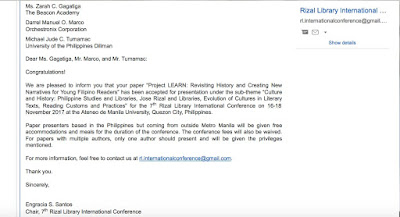
November 16-18, 2017 is the 7th Rizal Library International Conference. This year, I am presenting a paper I co-wrote with Darrel Marco and MJ "Xi Zuq" Tumamac. Our paper, “Project LEARN: Revisiting History and Creating New Narratives for Young Filipino Readers” has been accepted for presentation under the sub-theme “Culture and History: Philippine Studies and Libraries, Jose Rizal and Libraries, Evolution of Cultures in Literary Texts, Reading Customs and Practices”.

Below is the abstract:


Project LEARN: Revisiting History and Creating New Narratives for Young Filipino Readers

This paper describes the creative process that went through in revising a thirty-year-old series of illustrated children’s books by the Nutrition Council of the Philippines Publishing Corporation (NCPPC), the Bulilit Books. It is a series of books written in English and in Filipino for children age 0 - 12. The series tackles issues and concepts on physical and mental development, home and family life, art and culture, including stories from Philippine folklore and mythology.

The revision project is named Project LEARN: Linguahe ni Juan Para sa Kabataan and has three phases: (1) research and development; (2) production stage; and (3) post production, publishing, distribution, and marketing of the books. The project is already in stage 3 having published all three titles in Filipino, Cebuano and Hiligaynon in July 2017. Plans for distribution and marketing strategies are on-going.

The goal of the Bulilit Books was to improve the health and well-being of the child, however, the language use, prevailing political thought and socio-cultural climate of the 70s were evident in the stories. To simply reprint the originals would prove out of context for the young readers of the 21st century. Significant revisions include changing some elements of the story to create a narrative that is relevant to the experience of the new target readers; adding a guide for teachers and parents that address pedagogical methods; updating the language register and orthography and translating into other languages to cater to a larger audience of parents, educators, and learning communities; and providing new illustrations and design to reflect new trends and methods in illustrating and producing books for children.

Authors: Zarah C. Gagatiga, Darrel Marco, Michael Jude Tumamac

Topics: Culture and History: evolution of cultures in literary texts; reading customs and practices


Saturday, October 28, 2017

On Reading and Parenting

10. It takes a village to raise a child
    And so we come to the last talking point. I will say two things. First, what I presented above are “ideals”. In the real world, these ideals are tested. Often times, we commit epic failures. Well, that is part of learning. Therefore, admit that you, myself included, as parents, we need all the help we can get from members of the community. There are agencies and institutions who can help us raise readers and lifelong learners. Who are the people in your neighborhood? That is for you to find out!

    Second, let me end by recommending these books for your children. These are the winners of the 2016 National Children’s Book Awards as conferred by the National Book Development Board (NBDB) and the Philippine Board on Books for Young Readers. 

Caveat: these titles are starting points. Allow children and young adults to read non-fiction and subject area books also. Talk to your child’s teacher and consult your school’s librarian or librarian in the public library of your community.


 For emergent literacy, age 0-6: Dumaan si Butiki by Gigi Concepcion, illustrated by Ray Sunga (Adarna House, 2015)Haluhalby Eli Camacho (Adarna House, 2015) 


 For beginning readers, age 7-9: Mang Andoy's Signs by Mailin Paterno Locsin, illustrated by Isabel Roxas (Tahanan, 2015)SalusaloPara Kay Kuya by Ergoe Tinio, illustrated by JC Galang (Adarna House, 2015)


For middle grades, age 9-12: Supremo by Xi Zuq, illustrated by Al Estrella (Adarna House, 2015)

For Young Adult readers, age 13-18: Janus Silang at ang Tiyanak ng Tabon by Edgar Calabia Samar (Adarna House, 2014)
Despite our imperfections, let us strive to create a home where children feel valued. Let us work as a community in raising readers and lifelong learners. Let the children READ BOOKS!

 Sources:
Carandang, Ma. Lourdes and Quenna Lee-Chua. The Filipino Family Surviving the World, Anvil Publishing, 2008.
Fernandez, Karina Galang. Agenda for Hope Ideas for Inspiring the Youth: Connecting with today’s teens. ADMU Press, 2010.
Excerpt from Direct Instruction Reading, by D.W. Carnine, J. Silbert, E.J. Kame'enui, S. G. Tarver, 2004 edition, p. 13-15 . © ______ 2004.

Friday, October 27, 2017

On Reading and Parenting (2 of 2)

  1. The Stages of Reading Development by Jean Chall


    Jean Chall’s (1984) seminal research on the developmental stages of reading is used by many teachers as bases to facilitate activities and experiences for children who are learning how to read.
  2. Know your toddler: The Emergent Reader
Pre-reading stage - marked by rapid brain growth; use of spoken language.
Your baby or toddler would be needing a lot of oral and aural experiences to acquire language skills. These language skills contribute to their visual skills once they see letters and words as symbols representing speech and ideas.
  1. Know your child: The Beginning Reader
Initial reading stage - children learn the letters of the alphabet; phonetics; phonemic awareness; basic sentence structures; language learning peaks.
This is the ideal stage to introduce printed books!
  1. Know your pre-teen and teenager: The Transitional Reader
Reading for confirmation and fluency and Reading for learning the new - reading skills are used to gain knowledge, facts and information using varied texts and literature.
This is the stage where in readers have gained a level of independence in reading. But they still need support from peers and the adults they interact with on their choices of reading materials. This is a crucial stage where success and failure in reading happens. If the child gets the best reading instruction from parents and teachers in the pre-reading and initial reading stages, the quality teaching of reading skills MUST continue in the middle grades in in junior high school.
This is an ideal time to introduce different reading materials and media formats. This is also a good time to encourage readers to write and create their books and their media.
  1. Know your young adult: The Fluent Reader
Reading to comprehend multiple viewpoints - students read multiple viewpoints from varied texts and literature.
The reader has gained confidence, autonomy and independence in reading. Not only he or she makes sound reading choices, but also expresses a voice of informed opinions as a response to a reading experience. A deeper critical and creative thinking patterns occur in this stage of development. Readers are being prepared to fully join a community or a collective of thinkers and learners.
  1. READ to LIVE!
Construction and Reconstruction - highest stage of reading development; Reading to learn and construct new knowledge.
The child is now an adult who reads and uses this skill to learn, relearn and unlearn.
What’s amazing at this stage is that, the adult reader is capable of making a difference in the lives of others. He or she is a functional member of the society. He or she can contribute to the community and can join in a conversation and a discourse of varying views, opinions and feelings with peers and even elders of the community.
    Good job, parents!

Thursday, October 26, 2017

On Reading and Parenting (1 of 3)

Here is full transcript of my talking points on Reading and Parenting which I presented in the LibTalk Conference 2017. Parts 2 and 3 will be posted in the coming days, so watch out for it!

Reading and Parenting: 10 Talking Points

  1. The home is the child’s first school.
In the story Lizard’s Song, Bear learned from Lizard that knowing one’s identity is tied to a knowledge of one’s home. When you know who you are and where you come from, you will always find your way in the world. Should you get lost or confused, go back home and there, you will find yourself. Once the self is found again, a new cycle of living, loving and learning begins.

It is in the home, as nurtured by the family, where a child builds and forms his or her self worth and self concept. These are two important things that parents can provide and bestow in their children. Psychologist Dr. Honey Carandang, in her book, The Filipino Family Surviving the World (Anvil Publishing, 2008), emphasized the impact that parents and significant adults have on children when influencing and  modeling positive values. Positive self concept and self worth develop when children interact and engage with adults in their family circles. Their parents are their first teachers.

Where to begin then? It is essential to always respect the child’s personhood.(Carandang, 2008)

For my talk, I will focus on the child’s developmental contexts and the cognitive signs that are attributed to reading skills. We will use  two lenses. Lens number one is focused on the child’s reading growth. Lens number two looks at books and reading materials appropriate for his or her needs.

  1. Reading begins at home.
Dr. Quenna Lee Chua, co-author of the said book, conducted a study among scholars of the Ateneo De Manila University. It included their families and the variables that contribute to their academic success. This research was done back in 2005.

    Remarkable findings are as follows:    
  • The scholars are successful both in academics and in the application of life skills.
  • Their parents set goals and realistic disciplinary measures to meet them.
  • The parents are hands-on in helping them develop habits of learning.
  • Their parents believe in strong family bonds, self-reliance, and perseverance. Even before Angela Duckworth learned about grit, Dr. Quenna Lee Chua already discovered its relevance in lifelong learning.
  • The parents value learning and at home, it is encouraged among the children to apply and live out in their daily lives. Many of the parents who were interviewed prioritize two things from the family budget, food and books. Nourish the body and nurture the mind.
     
  1. Create an environment that promotes and fosters a genuine love for books and reading.
   
As a parent, how do you create a home environment that encourages learning?

My top five tips are as follows:

  1. Listen to your child. Hold your own truth lightly in your hands and focus on what your child is saying. You will understand him or her better when you put aside yourself, your own dreams for them and what you wish them to be. Your child is yours to take care and love, but they belong to the world.

  1. Talk to them as often as possible. Keep the lines of communication open at all times.

  1. Allow them to ask questions. Accommodate even the tough questions that you have no answer for. Discover these issues and questions your child have. Avoid put downs, labels and blocks to their thought processes. Learn from them too. One of the graces I discovered in being a parent is that, I grow and learn from my children.

  1. Develop a family reading time, model the reading habit and manage the use of technological gadgets. I think this would require another session all together since technology is another variable we have to understand. But, the important thing is, your children see you reading a book, food labels, social media pages, mobile phone messages, billboards, TV ads and teleradio announcements etc.

If you can teach your child how to read different media formats, well and good. If not, leave it to the formal instruction of teachers. Cooperate and collaborate with them. Teachers are your allies.

  1. Invest on books. And I mean the print book that children can touch, smell, turn the pages over and embrace. The print book has the physical landscape that enables the brain to remember more information. Memory plays an important role in learning.

A lot to do, yes! But this is what parenting is all about. It will be all worth it. Trust
the process. To quote Dr. Lee Chua, genuine learning requires reflection, patience  and perseverance. (Carandang, 2008)

Wednesday, October 25, 2017

LibTalk 2017: Reading as Socio-Cultural Equalizer

And here is another screen capture/recording of my presentation on Reading as Socio-Cultural Equalizer. The app I used for this capture is Screencastify which is downloadable as a Chrome extension. A videocam can be embedded in the screen so the audience can see the speaker when they watch the presentation.


LibTalk 2017: Reading and Parenting

Because I couldn't make it to the 2017 LibTalk in Pampanga, I made a recorded presentation with audio for the participants. Thank you to the organizers represented by Roi Calilung for the flexible arrangement.


Sunday, October 22, 2017

The 2017 Picture Book Month Is On!

We're at it again! I am reprising my role as web administrator of Picture Book Month this year. I am so happy to share this wonderful calendar to you all!

Each day, a Picture Book Month Champion is listed. Note that the theme for the day is included too. Check out the essay of each champion every day. We have a host of authors, illustrators, teachers and librarians as Champions this year. Having read their essays on the importance of picture books brought me to tears.

It is a time to create more art, more love for our children!

Designed by Elizabeth O. Dulemba

The 2017 Picture Book Month Champions are:

Arthur Levine, Bethany Hegedus, Betsy Bird, Brian Smith, Colby Sharp, David Catrow, Dianne White, Donna Janell Bowman, Edna Cabcabin Moran, Eliana de Las Casas, Elizabeth Dulemba, Emma Otheguy, Eric Ode, Gaia Cornwall, Gina Perry, Greg Pizzoli, Javaka Steptoe, John Couret, Joyce Wan, Julie Segal Walters, Kelly Starling Lyons, Kimberly Willis Holt, Laura J. Rennert, Laura Krauss Melmed, Lori Richmond, Marcie Colleen, Muriel Feldshuh, Peter McCleery, Ruth McNally Barshaw, Ruth Sanderson

What an awesome list of authors, illustrators, and movers & shakers in the kidlit industry!

Saturday, October 21, 2017

Filipino Librarian of the Month: Apolo Martinez Patron (2 of 2)

Here is part 2 of the Mr. Apolo Martinez Patron's blog interview where he gives tips for future exam takes and looks forward to learning more bout law, literature and life.

3. How did you prepare for LLE? Tips for LIS students to share? 

Read.

It all comes down to familiarization with the concepts, principles or scenarios that will be the basis of the board exam. Just like what Hon. Lourdes T. David said, the exam tests our mettle, our preparedness or awareness on what should be done, or what should we know about Library and Information Science. This is crucial to our performance as Librarians & Information Specialist.

I actually spent so much time reading than answering reviewers or quizzers given by review center (centers), previous test papers accumulated during our 4 years of studying, and those gathered online. The curriculum or the specification of terms of all the things Library and Information Science students must understand are quite easy to study. These are all given. We have resources for that and the years of accumulated previous board exam reviewers or materials given by my seniors helped in my preparation (which is why it helps to know the "ate and kuya: for tips like what I’m doing now).

What is difficult was guessing the trend of questions that will be asked or what part of librarianship will the Board focus on. Board for Librarians examiners are pillars of our profession, they’ve done a great work to Philippine Librarianship and they know a great deal compared to us newly graduates and the re-takers facing the LLE (Librarians Licensure Exam). This is why I never limit the scope of materials I’m studying, reading or reviewing to those accumulated inside the class lectures. It does help yes, because it is the basic, and you have to be learned enough on the primer before advancing to more complex and confusing materials. I used various resources both local and foreign. You never know what might be asked so everything must not be taken for granted. I’m used to creating my own set of data bank of trivial facts. I write them all down.

Writing also reinforced the retention of what I’ve read as well as going over and over them just like my favorite novels read countless of times. Read till you drop. Drop Everything And Read (DEAR). Don’t even antagonize reading - but rest and reward yourself as well to ease the tension. Just like the usual tips, eat healthy, sleep well and prepare not only your mind, your body, your will and most important your spirit through prayers to slay the dragon which the board exam is.

4. Is being a male librarian in a female dominated profession an issue to you? Why or why not? 

Time magazine had a recent issue about great women who contributed a lot to the world significantly to the US and one of the featured women there is the 14th Librarian of Congress, Carla Hayden. The first woman and Black American to hold the position, since from the start, it was given to men.

Admit it or not, being a man in this profession is a big deal. Our professors do share anecdotes of how their previous students, our "kuyas" who are easily hired or asked by schools or institution because it is quite “rare” to this profession of ours to find a man working as a librarian. Time said it is one of the 4 womanized professions, and there’s no denying about that.  Starting back to Melville Kosouth Dewey and other proponents, men are typically mentioned or upheld. I will confess that I would sometimes fanboy whenever I meet or read somewhere that Mr. this or Sr. that is a librarian of this institution, or an officer of a certain librarian association or have done something great for the betterment of our profession.

Nevertheless, I never disregard the huge contribution women did and continuously doing for librarianship. It is quite fitting that Carla Hayden is now the Librarian of the US Library of Congress, the most coveted position and the most known library in the world. It only shows that in a patriarchal society, everyone matters. Women, people of color and even gay people. It is not about who or what you are anyway because it is about what you can do to help your patrons, to the profession, to the betterment of society. 

5. From here on, where are you going next to? 

This year is quite eventful for me. Which is why I might go “lowkey” for quite some time, but one thing I’m surely doing is BLOGGING! Which is why I’m dazzled at the how timely this interview is, I’ve been curious to know about the tricks of the trade when it comes to creating and sustaining a blog for quite a while now.

Continuing Professional Development or Education is something I’ll take seriously, and now that I’ll have means to get myself to study those I want,like Law or Literature. I’m thinking of taking Master of Library and Information science in UP. I also would like to take the April PhiLSAT next year for Law School. I will trust God’s will to put me in the most perfect or right path for me. All these things I could do or will do is all for His glory that is why I’m pretty confident the next part, the next chapter of my life will be better, more challenging and surely be exciting.

I might try reading more adult fictions this time because I’ve dabbled Children and Young-Adult since from the start. Try to gain some maturity, because I still see myself as “adulting* in this big scary world. Try other things I haven’t tried before due to lack of time or means for it like going to places or learning new hobbies aside from reading for hours or watching for hours.

Thanks once again Ms. Zarah Gagatiga! Hope to see you again on another literary event or just casual librarian to librarian tee-a-tee!
Related Posts Plugin for WordPress, Blogger...