Friday, March 23, 2018

Filipino Librarian of the Month: Mariquit “Kit” Pedrasa

The Filipino Librarian of the Month is Ms. Mariquit "Kit" Pedrasa, licensed librarian of Lyceum, Calamba Laguna. She is the 2018 Outstanding Librarian conferred by the Consortium of the South. In this interview, Ms. Pedrasa shares with us a slice of her life as a researcher and licensed librarian.

What was your approach and attitude during the panel interview?

During the panel interview, I shared my experiences to describe the background of my activities such as the organization of the National Commission of Indigenous Peoples (NCIP) Library, writing a paper about it, and presenting it to an international conference, and some other activities which presented the range of skills I have which I think validated the submitted documents. 

I considered the interview as mere conversation with colleagues so I will not feel nervous. 

What has been the best thing that has happened to you since you became a licensed librarian?

There were numerous remarkable things happened to me since I became a license librarian

It includes writing papers, leading a team in organizing the NCIP Library, oral presentations, etc., but the most memorable for me is the experience of mingling with colleagues in an international event who listened to my paper presentation.

We exchanged ideas, which made me motivate to write more papers about our profession, present them locally and internationally to share whatever knowledge or learnings I have. 

Where do you place yourself in the bigger scheme of Library and Information Science (LIS) in the Philippines?

As of now, I still consider myself as newbie or novice in the profession who still has to learn the motion, but at the same time I would like to be governess to young LIS learners by sharing whatever learnings I earn while learning and mastering the waves.

 Tell us something about your research on Indigenous Peoples in the Philippines.

The research describes the challenges and opportunities in organizing an Indigenous Peoples Library. The challenges includes the classification, organization, and digitization of IP reading materials, and other artefacts, establishing library services, generating reports, installing a library system. 

These challenges were all addressed through an approved Library Operations Plan which served as the guide in implementing the innovations. The opportunities include the commission considered a job order for a full time licensed librarian to manage and sustain the implemented innovations, counting the NCIP Library in the commission's budget proposal, and the linkages with other agencies to strengthen its resource network.

What do you wish to see in the LIS profession today?

In the near future, I would like the LIS profession to become dynamic leaders not only in their library organization but to their mother institution as well, actively engaging in research and community services to make an impact to the society. 

Tuesday, March 20, 2018

Filipino Librarians in the South of Manila

I have had the pleasure of attending three wonderful librarian events in the past three weeks: 1) the conversation with peers on the decision to award the Outstanding Librarian and Library Staff of the Consortium of the South; 2) the Reading Conference at Southville International Schools and Colleges; and 3) the MUNPARLAS Librarians’ Association Incorporated’s (MLAI) Librarians Walk for a Cause, a modelling stint where librarians walked with kids and teens with disabilities. Needless to say, these events are indicative of the active growth and movement of  school librarians in the south of Manila.


Librarians from the Consortium of the South, composed of schools and colleges in Pasay, Muntinlupa, Parañaque, Las Piñas and Laguna, organized the search for the Outstanding Librarian and Library Staff of the year. This is to recognise librarians and staff who have made valuable contributions to their learning communities. Reading and examining the documents of each candidate, I conclude that these librarians and library staff are of consequence to their learning communities because they are self-starters consciously aware to develop their personal skills and professional competence. During the interview, their confidence in themselves was shinning through and their gratitude to their mother institutions was heart felt. It was one of the toughest judging job I had in a while!


On March 2, I gave a short lecture on digital learning and how the library play an important role in support of digital learners. Organized by the librarians of Southville International School and Colleges, the conference was another experience of professional growth. I may have been the group’s guest speaker, but interacting with participants and organizers was a learning experience for me too. To educate and form learners of the future, we all need to work together. Each of us playing a role and making contributions big and small for the growth  of the profession.


Lastly, the MLAI’s Librarians’ Walk for A Cause was a well received event by librarians and “non-librarians” whom MLAI have partnered with. The fashion show benefits the education if teens with disabilities from the Cradle of Joy Learning Center in Quezon City. Kids and teens walked down the cat walk and the librarians who joined them were all fully dressed in their smart casuals with a smile!


Cheers to everyone! Looking forward to more
events and activities that foster compassion, friendly competition and collaboration!

Sunday, March 18, 2018

Alternative Storytelling Strategies: Out of the Books Storytelling

The image that comes to mind with the word storytelling is that of an elder, a parent, a teacher, an “ate” or a “kuya” holding an open book to a listening child or to a group of young people. The story is read aloud from the book of choice that has illustrations aiding the storyteller in the dramatic narration of the story. The storyteller would then add body movements, a chant or a song, and would use the given space for theatrical effects. All of these efforts by the storyteller are directed to achieve engagement and interaction with the audience. 


This storytelling technique is known as Book-Based Storytelling, a hybrid of storytelling and reading aloud. Thank you to the ingenious Filipino storyteller for this invention. Book-Based Storytelling as a means to promote the book and to model the reading habit, deriving entertainment or the element of fun in the process is here to stay. In recent years, Book-Based Storytelling has been the norm in many activities that promote reading and in events that campaign for literacy development. In storytelling contests in schools, libraries and book fairs, adult and child contestants hold a book while telling a story. This technique has indeed become an accepted practice, however, there are teachers and librarians who argue that it is reading aloud and not storytelling.

Storytelling is rooted from the oral tradition. It is a living art. Natural. Spontaneous. Unscripted. A Read Aloud is reading a story from a book loud enough for a listening child or a group of kids to hear the story. Storytelling is a way to preserve oral history and personal stories of peoples. A Read Aloud celebrates the written word and the dynamics of language structures. Storytelling is a performance art not limited to the narration of stories but inclusive of music, dance and theatre arts. A Read Aloud is a good technique to teach children how to read and to love the printed book at an early age. Each has a purpose and a function. A storyteller should be wise enough to know when to use one from the other.

Nonetheless, who are we to stop Filipino storytellers adept at combining both techniques in an experience that is educational and entertaining? Then again, here is a caveat. The frequent use of Book-Based Storytelling may lead the storyteller into complacency leaving the listener bored and disengaged. Instead of inspiring the listener to imagine, to create and to play with words and visuals that the mind can conjure, the storyteller’s execution of the storytelling becomes a canned production. 


Storytellers are also artists who share the responsibility of keeping humanity’s sense of wonder alive and well. 

I believe that Book-Based Storytelling has its benefits, but using a variety of styles and different manner of communicating a story, especially to children, is good for the soul. Allow me to share a selection of “out of the books” storytelling techniques. I learned them from storytellers I have met in festivals, conferences and book fairs here and overseas. 

They are called “out of the books” because the techniques do not use printed books in storytelling. These techniques trace their origin in oral tradition, in folklore and in traditional games that children from around the world play and enjoy.
 
Storyknifing or Draw and Tell

A story knife is a blunt piece of wood used by young Eskimo girls to draw on the mud while talking about their drawings to friends around a story circle. Young Native American Indians use a knife to carve images on barks of trees that narrate their adventures and experiences in the fields or during hunting trips. In modern day classrooms, teachers use chalk or whiteboard markers on the blackboard or whiteboard to draw ideas and concepts that are too big or difficult to express in words. 

Storyknifing or Draw and Tell is the technique where a storyteller draws while he or she tells a story. There are many patterns that can be used and these are available online. One Draw and Tell story I remember to this day is Bingo, the Dog. (Attached is the drawing and the accompanying story or text)

Cut and Tell 

This technique makes use of paper, scissors and a story. For younger audiences, the storyteller can use his or her hands to tear away parts of the paper when telling. My favorite Cut and Tell story is Joseph and His Overcoat. I learned this story and technique from a dear friend, Fil-Am storyteller, Dianne de Las Casas (+) 

Kamishibai 

Kami is Japanese for paper and shibai means play or drama. Kamishibai storytelling is the use of flashcards, 12-20 pieces inside a box known as Kamishibai Theatre box. The storyteller pulls out each card as he or she narrates the story. This style of storytelling was a fad in Japan in the 1920s but soon diminished as the tradition of visual storytelling using picture cards was replaced by television and video games. 


Parents and early grades teachers can easily create story flashcards by first selecting a story for the listening child or for the class. Five to ten flashcards are a good starting point. Divide the story accordingly to the number of flashcards. Illustrate or draw each part of the story and color them. Many Kamishibai have story guides at the back. The idea, however, is for the storyteller to fluidly tell the story using the flashcards and the theatre box without looking at the guide written at the back of each card.

Use of props like handkerchief and malong
Remember the many folding games we played using handkerchiefs when we were children? Cat’s cradle. A bandana. A table napkin that looks like a candle. A folded boy or person which can be turned into a puppet. These can all be used in telling stories. 

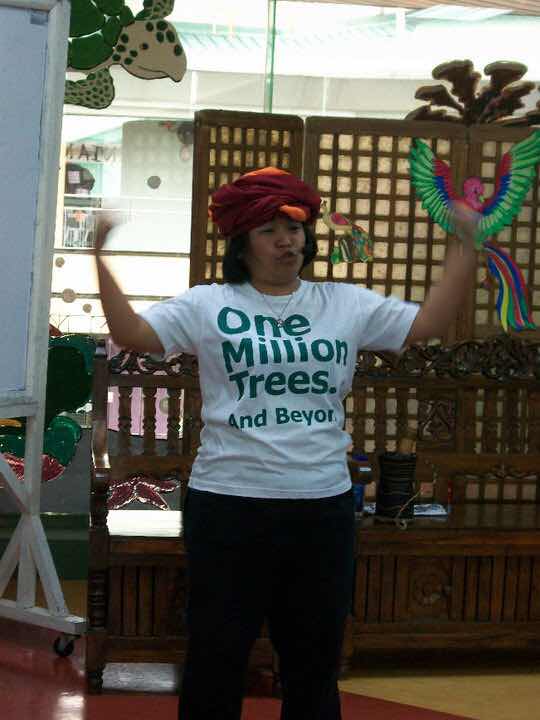
The malong is another tool for storytelling. Wrap it around your head as a cap or crown. Wear it around your body as clothes. Tie both ends and carry it like a bag. Place the malong around your waist like a skirt. Use them all to tell stories, especially those that come from Mindanao. 


Use of hands and Finger Plays

When storytellers narrate a story, it is inevitable that they use their hands, arms and even shoulders. Body parts are props. The entire body is a tool for telling and communicating stories. Make use of your hands and fingers in the classroom or at home when telling stories. A well loved storytelling and Finger Play technique I use in my sessions is Mr. Wiggle and Mr. Waggle. (See the illustrations/directions with accompanying story and text.)

    
These five “out of the books” storytelling are but a few of the many techniques available out there for use by teachers, parents and librarians during story time. Knowing different strategies keep the creative juices flowing. But, knowing your audience and the appropriate time, event or occasion to use these techniques can also spell the success of a storytelling session. Have fun! 

References:

de Las Casas, Dianne. Handmade Tales: Stories to Make and Take. Connecticut: Libraries Unlimited, 2008.

Feldman, Jean. Best of Dr. Jean Feldman Puppets & Storytime: More Than 100 Delightful, Skill Building Ideas and Activities for Early Learners. New York: Scholastic, 2005.

Saturday, March 17, 2018

Book Project Preview: A birthday and a video game console

Here are two studies from new book project that I have been working on with a librarian-artist. 


Can you guess who the artist is?


Can you guess what the story is all about?

Friday, March 16, 2018

Creating a Wordless Picture Book

With Bernadette and friends, Peanuts Pañares and Totet de JesusOn Saturday, March 24, 2018 Bernadette Solina-Wolf’s rendition of the story I wrote, Sparrow Makes A Home (Lampara Books, 2014)  in a wordless picture book will be on exhibit at the Cultural Center of the Philippines. Her illustrations (and I hope the manuacript too) on Sparrow Makes A Home is part of the art exhibit Peek-A-Book Children’s Book Illustrations by 13 Women Artists. In this interview, my dear friend Bernadette, shares her creative process in illustrating a a wordless picture book and tells her origin story in becoming an illustrator of children’s books.

1. How did you approach illustrating Sparrow Makes A Home since it was conceptualized as a wordless picture book?

 I imagined it like a comic book without the thought bubbles.

2. What makes it different from illustrating a children’s picture book or storybook with words? 

I really found it more challenging since I had to fill out all the gaps visually.  You see, in a storybook with words, there is more a give and take of the words/narrative of the author and images of the illustrator.  In a storybook with words,the writer can make make the transitions from page to page and the illustrator just makes sure the attention of the reader is captured and then supplements the text. In a wordless piicture book, the illustrator has all the responsibility to made a story/idea cohesive and yet visually exciting.


Sparrow Makes A Home is one of fhe 12 books in the Start Right Reading Series (STARS) for Kindergarten. The learning package includes a teacher’s guide and a parent’s manual. The STARS series is published by Lampara Books.

3. How long have you been illustrating books for kids? What changes in the industry have you observed that have made an impact on women illustrators?

I had the opportunity to illustrate children's books since the 1990's. 

Actually, when you now speak of gender...I can only speak for myself.  I got married and since then I stopped illustrating for children's books. To keep myself honed somewhat in my art, I would make Christmas and birthday cards and we would send them to my parents-in-law in Germany.  It took me another 10 years to find myself back to illustrating.  It was my mother-in-law who told my husband I had a a gift for drawing expressive people and she would always send me art materials. It didn't make a dent in me until...I made a trip to Megamall. Power Books had still a huge store there.  I was in awe.  A huge section of the store had  dedicated itself to Philippine children's books!!! I was nearly in tears!  (Philippine children's books have been recognized!)  Most of them were books illustrated by Beth Parrocha and Jason Moss! By then I said to myself, I'm going back to illustration. So, if your question if for "women illustrator", this woman illustrator saw the "light" in that moment. 


There is a Picture Book Making Workshop on March 24, 2018 before the Opening Ceremonies. It will be conducted by Frances Alvarez. On April 28, 2018, Liza Flores will be conducting a paper-cut art workshop in the morning and Adarna House will launch books in the afternoon. The Peek-A-Book exhibit will run from March 24, 2018 till May 6, 2018.

It’s Women’s Month and Mother’s Day is in May. Celebrate it by viewing artworks made by Filipino women artists!

Tuesday, March 13, 2018

Effective School Librarianship: Successful Professional Practice From Librarians Around the World

Three years ago, I had the pleasure of meeting Dr. Patrick Lo in Osaka, Japan for the IAFOR (International Academic Forum) Conference. We were both paper presenters on school libraries, school librarians and leadership. At the time, he was working on a manuscript on comparative librarianship. Dr. Lo moderated the session where I presented my paper on School Librarians as Literacy Leaders. From there on, we had regular conversations on school librarianship in the region. This conversations led to my participation in his book project.

The good news is, the book is already published and can be bought online since December 2017!

Effective School Librarianship: Successful Professional Practice From Librarians Around the World is published by Apple Academic Press. Check the link for information on the book's price, content and reviews.

Here is one review by Dr. Helen Boelens, of the International Association of School Librarians, Special Interest Group (SIG)

“Fascinating reading . . . The authors have collected interviews from school librarians throughout the world. Some of these people work under very difficult circumstances. Interviewees have mentioned a multitude of “secrets” of their successful work. . . . It is my hope that, after reading this book, educators, teachers, and librarians and also members of the general public will have a better understanding of school librarianship across the world and that they will be inspired to cooperate with each other in many different ways, assisting those who desperately need help and support. This would be in the best interest of the children whom they serve and relates to their duty of care as educators.” 

—From the Foreword by Dr. Helen Boelens, International school library researcher and consultant; Former Chair, IASL Research SIG, The Netherlands
The book is described as:

The school librarians’ best practices cover innovative ways to encourage students to (1) read voluntarily for pleasure and for information; (2) to gain basic information literacy skills for the navigation, evaluation and use of information; (3) and to develop competence as independent learners—a key factor for successful enquiry-based learning.

The books are jam-packed with information that can be used by school librarians, teachers, school administrators and others in a variety of ways. Readers can borrow best practices from the experiences presented in the book, and the volumes can also serve as a strong voice for the practicing school librarians and the profession, through expanding the opportunities for professional sharing in the international school librarian community.


There are fourteen school librarians and teacher librarians in Asia in PART 2 of the book and I am honoured to be one of them. Most of all, I am very much interested to get a copy of the book to read the stories of colleagues from outside the Philippines, their best practices and success stories, how they hurdle road blocks and break down walls. 

What we think is unique to us may actually be something we share in common to colleagues from outside the shores of this archipelago. 


Friday, March 9, 2018

Teen Tech Week 2018: Student Made Website

Because it is Teen Tech Week, I am sharing this project of one of our students in the Academy.

Darwin Angelo "Drake" Velasco is one of our avid readers in the library. He is in grade 11 and previous to the Academy, he went to Don Bosco Technical College. Of the many exciting things Drake experienced at the beginning of the year was the library's collection. It is in a small room full of books -- and more!

During the first semester, Drake borrowed and read books like there was no tomorrow. Inspired by all the readings he made, he asked if I can be his supervisor for a Creative Action and Service (CAS) project. His project is a website of books and his reviews. Of course, I said yes.

Below is the main page of Drake's website which he named Beacon Academy Library Spotlight.


Since Drake asked for comments, I sent him the following feedback.

On Authorship and Content
You can be more specific by using Web Administrator and Book Reviewer instead of Author.

You have a sample synopsis for The Outsiders and it's in your recommended list. I was expecting to read a short review of the book written by you. Many websites provide info and summary on books and readers get the same stuff. A book review changes that. A book review makes the book more interesting because a reader talks about it from his/her experience of engaging with the text, the book's author and creative team. Be it a good review or not, it helps readers decide for themselves whether they will read the book or go for the next recommended read (this is how Amazon and publishing houses earn!). Having said this, let me go to the next comment: PURPOSE.

Go back to your WHY. You love to read. You love books. You discovered reading treasures in the BA Library. You want to share this love and this joyful discovery. Your platform in sharing this love and discovery is a  website. Through the website, you communicate the books you found as awesome, books that others may enjoy too, or at the very least, may lead to inquiry and reflection. Ask yourself: does the entire look of the website and its content show that love and joy? Does your writing reflect Drake, the reader and book enthusiast?

Cite and include references as necessary, especially in your synopsis. What is your source for the opening quote: the journey of a lifetime begins with the turning of the page?

On the WEBSITE design
Please use BA Library photos and for this, get in touch with Mr. Flynn and ask for help.

Please include the BA Library OPAC link so your readers can get the Call no. making the location of the book easier for them to know. Also, at first glance, a full bibliographic data below the photo cover of the book is a MUST. I call them the fantastic five: author/illustrator, title, publisher, place of publication, year published/copyright.
Did you ask permission from the school's communications associate on the use of the BA logo?

On sustainability and continuity
Can you manage a weekly post of five to six books? Consider your academic work load.
Share the website with friends, BA and non-BA, and ask them for feedback to. When they give back comments, know which ones are worthy of consideration to help you improve the website's content and over all design. A criteria can help you decide on the feedback to keep and the disregard. We can sit down on this or, you may start looking at website criteria online. Just make sure your sources are credible and valid.
You may consult your teachers too, like your English or Filipino teachers and your friends who also love to read. They can give feedback especially on content, design and functionality of the website.

Good luck!

Wednesday, March 7, 2018

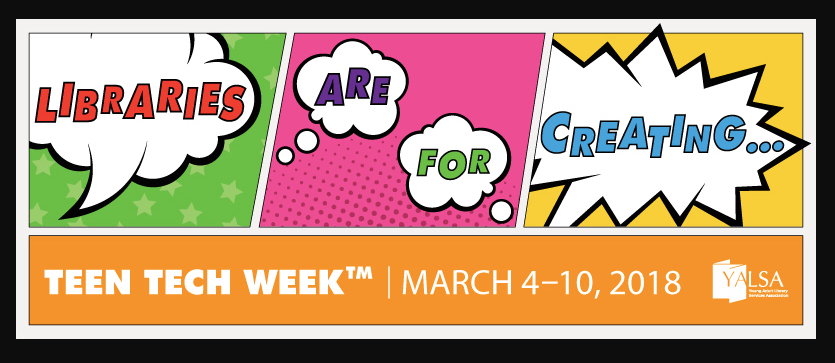
Teen Tech Week 2018: Libraries Are for Creating


Teen Teck Week Sources and Activities - where you can get and download free plans, logos and PDFs of brochures and activities.

The American Library Association supports Teen Tech Week - where you can read a brief but substantial description on Teen Tech Week.

Top Ten Books for Teens - where you can read reviews and get lists of top ten books that the Young Adult Library Services Association  (YALSA) releases every year.

Teen Book Finder - this is a database, so this is where you can find books for the young adult reader.

Thursday, March 1, 2018

Priming Session: Supporting Digital Learners Through Library Programs & Services

Hi friends!

If you are a participant to Southville International School and Colleges' 1st Reading Forum, please do the activities below.

FIRST: Answer this survey. It is very important that you do this because much of our talk will depend on the result of the survey. Deadline for answering and getting of responses is at 1PM, March 2, 2018.


SECOND: Watch these videos.

Engage Me!


Pay Attention


THIRD: Think through these questions.

a. What struck you from the video, Engage Me? It can be the message or the media in which the message was communicated. It can be a personal experience that is also present in the video. Write it down and have these insights, responses and reflections ready for our session tomorrow.

b. What did you PAY ATTENTION to in the second video? Why did "it" catch your attention? Look or review aspects and factors of that "it" that made your attention linger on it.

If you are not a participant of in the forum, you can still do the activities and share your comments below. You can also send me an email or a PM over at Messenger. Let us continue the conversation!

See you soon!

Wednesday, February 28, 2018

Thoughts on Research in the High School Level

How do we define research? Does it need definition since it is, for most part a thinking skill that is made visible through a written output? Or something tangible like a project, a module, an art work... I think what I need is to ground the idea or the concept of research into statements or beliefs.

1. Research is asking questions ans finding answers. 

2. Research is a process that entails collaboration - not just cooperation and coordination.

3. Research is a conversation.

4. Research is an invitation for you to stand on the shoulders of giants. And this is both an honor and a privilege.

I wonder how my colleagues see research and, in the practice of teaching ATLs, how would a belief or thesis statement on research factor in effective pedadgogy.  

Tuesday, February 27, 2018

Be Weave: Librarians Walk for a Cause

At the beginning of February, the MUNPARLAS Library Association gathered around fifty librarians for a benefit modeling gig. 

You read it right! 


Filipino Librarians will walk down a runaway along with special children and teens with disablities. Dubbed as the Be Weave Special Collection, the benefit modeling event is for the Cradle of Learners, a school specializing in the education of kids and teens with special needs and disabilities.


As one of the fifty volunteer librarians, what we had last February 3 was a practice walk with our teen/child partners. You have no idea how good we were at the catwalk especially the Filipino male librarians present! So, I enjoin you to support MUNPARLAS and the leadership of its officers. Come watch your friends let their hair down and be confidently beautiful with a heart!


Tickets are priced at Php 250.00. The Be Weave Special Collection is on March 4, 2018, at the Bahay ng Alumni, UP Diliman. Fashion show begins at 6pm.

Photo: Be Weave poster courtesy of Audrey Anday

Lecture: Supporting Our Digital Learners: The Library’s Role


Sunday, February 25, 2018

Book Display: Paws for Reading

PAWS for READING
It was Chinese New Year last February 16, 2018! Because it is the Year of the Dog, my staff, Flynn, set up this book display to highlight library books about dogs and the canines we love.

My personal favorites from the recommended books on display are Laika and Stargazing Dog, graphic novels that show man's relationship with his best friend, the loyal dog.

In Stargazing Dog (Takashi Murakami), an old man retreats from the world and dies in a field of sunflowers. He is survived by his pet dog, who stayed with him until his last breath. Laika (Nick Abadzis), is a historical fiction about the first living creature sent into outer space by the Soviet Union during the space race. Issues on animal rights and the ethics behind scientific experiments are subtly discussed in the graphic novel.

We got good comments from members of the community who are dog lovers. Here's hoping they pick up the books on display.

In and Out of the Belly of the Big Bad Wolf Book Sale

My trip to the Big Bad Wolf Book Sale last week was what I expected it to be. It is big and really, really bad. For where else can a reader find hard bound books as low as Php 100.00 pesos with a 2016 copyright but in this book bonanza. I couldn't help but wonder how the organizers and business people behind this sale successfully staged it all. I think of the writers and the creative team who published these books and their royalties.


If anything, Filipino readers with book budget allocations per year benefited a lot from the sale. The selections of titles and how the books were categorized address readers in a very personal way. Fiction books are grouped together occupying more than half of the entire World Trade Center hall. From Young Adult (YA) novels, romance, graphic novels and children's books in various formats and presentations, readers can rummage through the tables to their heart's content. As a school librarian, it was the children's books, YA books and graphic novels areas that enthralled me! A day's visit is not enough.

The Non-Fiction books are likewise geared towards the personal interest of readers as these were arranged according to travel, cookery, hobbies and crafts, history, biography, business and references. Topics that would appeal to individual readers  It does not have the academic arrangement of the Manila International Book Fair. Of course. What was I thinking? This is not to say that librarians and teachers did not benefit from the sale. I met a friends from the profession that day I went and they were happy to acquire 10-15 books for a book budget of 3-5 thousand pesos.


The Big Bad Wolf Book Sale is on its last day today, Sunday, February 25. It is the 32nd anniversary of the People Power Revolution. If you have not been to this book sale, go visit and buy a book or two. If you and I can still buy books we want to read, then there is still freedom to be had.

Read and take flight!

Friday, February 23, 2018

Book Review: Being Chief And Confidently Able With A Heart

Being Chief & Confidently Able With A Heart
By Roderick Baturi Ramos
Self Published Ebook, 2017

I received a free copy of Roderick “Eric” Ramos’ ebook, Being Chief & Confidently Able With A Heart for an honest review. Here are my thoughts.

1. The intent of the ebook is laudable as it chronicles the journey of a Filipino librarian and his milieu. I think we need to hear more voices and a variety of perspectives from Library and Information Science (LIS) practitoners so we can have a grasp of the authentic events and movements in the profession.

2. The ebook’s content was taken from the author’s blog. As to purpsose, he achieved two things: to blog and to have its content published in an ebook format. Here we see how one medium can be transformed into another. The contents remain the same but looking at the medium on how information was communicated changes the way readers can understand Mr. Ramos’ message to the world. It helped that he started with a study and analysis of his blog’s content and readership.

3. The content and materials are relevant to its intended readers who are LIS Professionals. For the newbie, it offers a glimpse of what the LIS workplace and landscape look like. For the seasoned LIS professional, it will push and move him or her to get a closer look at existing practices on library management, technology use in the library, human relations and dynamics in the workplace and the LIS curriculum. One of my questions on this matter is, how does it prepare LIS students for real life productive work? 

4. Given these good points, what I found challenging to me, as a reader, is the use of language by the author. I found the syntax and sentence structure difficult to understand. It still needs editing and revision. Should Mr. Ramos take on thos recommendation, his book can be a “paper” that may qualify for a national or international conference.

Rating: 3/5 bookmarks

There is a New LIS College in Town


Sunday, February 18, 2018

Book Giving Day 2018

A few days before International Book Giving Day, a colleague and friend at work told me how her daughter loved one of my books, My Daddy, My One and Only (Gagatiga & Tejido, Lampara Books 2013). They had a wonderful time reading the book together and her daughter worked on all the activities that were included in the book. My colleague was bright eyed narrating how she received the Parent Award that her daughter filled out. Needless to say, parent and daughter were engaged.


Imagine my joy that day to hear feedback from my readers! So, on February 14, I gave them another book, Big Sister (Gagatigas & de Jesus, Lampara Books 2015) which was one of the Top Ten Kids’ Choice of 2016. I am hoping this would lead to more creative engagement between parent and child as I told my colleague and friend that she can start encouraging her daughter to draw, write and tell her own stories.

Sharing with you this IG exchange on the experience.


Saturday, February 17, 2018

Book Review: Hero at the Fall

Hero at the Fall (Rebel of the Sands, #3)Hero at the Fall by Alwyn Hamilton
My rating: 5 of 5 stars

In Hero at the Fall, we (fans of the series) will come to the end of Amani and Jin's journey. They cross the desert with their skeleton crew and venture into places that are spoken only in myths and legends to save Ahmed and the rest of the Rebellion's key people. The world that Alwyn Hamilton built from the first book to the second and this last instalment ends with the message on the power of stories and storytelling; that there are limits in our knowledge and in the safe keeping of our memories; and that love, in whatever shape and form, is a force that can make or break humanity.

This is a closure. A period. A full stop to Amani's story arc. It is a well thought out narrative from her point of view. The backdrop and setting of the third book is so rich that the myths and legends introduced in Traitor to the Throne is the beginning. The first, Rebel of the Sands, is a prequel or an introduction for readers to fully enjoy and understand the land of Miraji and its inhabitants. Amani's turn as hero of the series truly began in the second book. I was so enthralled into her world until the culmination of the war where finally, all my questions from previous books were answered.

I did miss Jin a lot in books 2 and 3, but seeing how Amani's character grew from obscurity to bandit, to hero, Jin slipping in the background is reasonable. The series' film rights have been bought and I just hope that the Western-steampunk texturing, middle-Eastern-fantasy tones and the romantic themes of the series be kept intact. Demanding, I know. But this is such a wonderfully written series!


View all my reviews

Tuesday, February 13, 2018

Call for Submissions: Papers, Panels, Talks, and Workshops for the 9th Philippine International Literary Festival (PILF) ​

Reposting this from the NBDB FB Page:

The National Book Development Board (NBDB), the government agency mandated to develop and support the Philippine book industry, is conducting the 9th Philippine International Literary Festival (PILF). The event is a landmark project of the NBDB that celebrates literature and promotes best practices through discourse on issues of authorship and readership shaping the book industry.

The Philippine International Literary Festival shall be held on April 19-20, 2018 at the Cultural Center of the Philippines, Pasay City, Philippines as part of the Buwan ng Panitikan (National Literature Month) celebration.

In line with this, we welcome submissions of proposals from individuals and organizations for breakout sessions that are of professional interest to our attendees (book lovers, writers, illustrators, book designers, librarians, publishers, etc.).

Session topics must hew to the theme “(AUTHOR)ITIES,” underscoring the power and voice that come with creation. Sessions may also revolve around innovative ideas or unique research on any of the following topics:

• Reading
• Libraries
• Storytelling
• Book talks
• Ethnography
• Community outreach
• Book programs for differently abled
• Literary adaptations (book to film, book to games/apps, etc.)
• Technology
• Gaming
• Social media
• Rights acquisition


Submission guidelines:

• Proposals for papers, panels, talks, or workshops must include an abstract (200-250 words) written in a style that is accessible to a variety of readers, including the general public. The session may be in Filipino or English. Abstracts must be submitted in English or be accompanied by an English translation.
• Proposals must indicate your chosen type of presentation (paper, panel, talk, or workshop) and its duration. We welcome 10-15-minute presentations for talks and papers and 30-60-minute presentations for panels. Workshops may be longer than 60 minutes. (Some talks and paper presentations may be merged by the NBDB in one session depending on the topic.)
• Proposals for panels must include a panel abstract and paper abstracts.
• Proposals for workshops must include a 3- to 4-sentence summary for the session.
• All proposals must be sent by filling out this form: https://goo.gl/forms/WtZqK2kxlCQEk0Jo2

All presenters are responsible for handouts and other materials required for their session. Successful applicants will receive priority registration to the festival and complimentary luncheons. Each presenter is responsible for their travel and accommodations.

Deadline for submissions is February 18, 2018. Notice of acceptance of proposals will be emailed by February 28, 2018.

For further information, please contact Ms. Debbie Nieto at oed@nbdb.gov.ph (cc: litfest@nbdb.gov.ph) or at (632) 929 3887 loc. 804.

More information about previous festivals may be found on the NBDB website at booksphilippines.gov.ph.

The Big Bad Wolf Book Sale Huffs and Puffs Into Town!

Big Bad Wolf Book Sale Opens at World Trade Center on February 16
24-hour book sale with 2 million books at 60% - 80% off


The Big Bad Wolf Book Sale, dubbed as the world’s biggest, is coming to Manila
for the first time this February 2018. Offering two million books across various
genres, the sale features brand new English books at discounts ranging from 60% to 80%
for customers to enjoy. The book sale will be open 24 hours a day and run for 231 hours non-stop,
beginning from February 16 until February 25 at the World Trade Center Metro Manila
in Pasay City.  Admission is free.


“Children’s literature, fiction, non-fiction, and novels will be available at affordable prices,”
Miguel Mercado, Big Bad Wolf Marketing Head, said. “Physical books are here to stay
as they stimulate deep reading and engage the readers more,” Mercado added.  


“Big Bad Wolf Books wants to do its part in improving literacy by making it
accessible and affordable for people to buy books,” Mercado said. Mark your calendars
and get ready for the book hunt of a lifetime this month at the
Big Bad Wolf Book Sale: www.facebook.com/bbwbooksphilippines.


Big Bad Wolf Book Sale

Known as the world’s biggest book sale, the Big Bad Wolf Book Sale specializes in providing the widest
selection of books possible at the lowest possible prices. It features brand new books at up to 80% off in
24-hour non-stop events. The primary aim of the book sale is to encourage people of all ages
to discover the joys of affordable, accessible reading.


The book sale features a wide range of books across all genres, including fiction and non-fiction
bestsellers, young adult fiction, as well as an extensive collection of children’s books.


The Sale, the brainchild of BookXcess founders Andrew Yap and Jacqueline Ng,
has been a trademark event in Malaysia since 2009. It has also started extending
its footprint across cities in Indonesia, Thailand and Sri Lanka, and is arriving in the Philippines
for the first time in 2018.


Wednesday, February 7, 2018

International Book Giving Day 2018

It’s #bookgivingday on February 14!

International Book Giving Day is a 100% volunteer initiative aimed at increasing children’s access to, and enthusiasm for, books.

Now in its sixth year, International Book Giving Day continues to grow from strength to strength, reaching places such as Nepal, India, Canada, South Africa, UK, France, Germany, Australia, New Zealand, Italy, Nigeria, Fiji, Czech Republic, USA, Cambodia, Hungary, Philippines, and Romania.

On February 14, participants are encouraged to give books to children. This can take many forms, the only limit is the imagination! Books have been sent to child refugees in Calais, France; a new library was created in Cape Town, South Africa; in Uganda the Mpambara-Cox Foundation gifted books to children, for many it was the first time they had been given a book of their own. In 2014, Scholastic Australia went to the Melbourne Children’s Hospital and gifted a book to every child. People continue to be creative in so many different ways, all keen to share the love of books.


International Book Giving Day’s focus is on encouraging people worldwide to give a book to a child on February 14. We invite individuals to . . .

1) gift a book to a friend or family member,
2) leave a book in a waiting room for children to read,
3) or donate a gently used book to a local library, hospital, shelter, or organization that distributes used books to children in need.

In addition, we encourage people to support the work of nonprofit organizations that work year round to give books to children.

Lifted from Tarie Sabido’s FB Timeline.

Tuesday, February 6, 2018

Too Many Public Libraries But Licensed Librarians Are So Few

Read this link.  QC eyes more libraries Congratulations to the Quezon City Public Library on the new building, online services and book launching! 

Here is news to be happy about but it ends with a sad note. Quezon City LGU is aiming to have more public libraries and barangay reading centers but Mayor Herbert Bautista has a problem. 

“The mayor acknowledged that the lack of vacant spaces and number of licensed librarians in the barangays pose problems.”

This is my issue on RA 9246. 

We can always assert its worth and value, of course. For us lucky ones who passed the board exam for librarians, we only need to comply with CPD points and renew our license regularly. We go back to work and be the best licensed librarian our learning community can be proud of. But, reality tells us that there are only 1000 plus licensed librarians and the numbers are not enough to fill in positions. How many LIS schools are there? How many LIS graduates do these schools generate? Do LIS graduates take the board exam and pass? After getting their license, are they practicing licensed librarians? How many licensed librarians are not practicing the profession? 

We are not even talking about the plight of public school libraries yet. Oh boy... don’t get me started.

Complain and take action if need be. But, setting things to rights does not end there. 

If you have reached this far reading this long post (which I rarely do) and you are a licensed librarian or a nonlibrarian assigned, appointed and employed in a public library most especially, I suggest it’s about time to sit and think through these things with peers and colleagues in the profession: 

Have you visited communities, especially in the provinces with very little human and financial resources to run and man libraries? Have you listened to colleagues in the private and public sectors about their real life  stories in their libraries? You might find more significant info there compared to reports and statistics posted on websites.

What about revisiting the LIS Curriculum through our colleagues in PATLS? What current research will inform us that RA 9246 needs review and revision? How can we advocate LIS as a profession? How can we support those who cannot afford to attend seminars for CPD points?

Not all nonlibrarians we find in our midst are political appointees or assigned in the library by a president we dislike. Some of them are manning libraries because there is a shortage of licensed librarians. While waiting for one who is qualified, these nonlibrarians do us good and they make their learning communities proud. A few I know are way better in work efficiency and output compared to licensed librarians. There are even nonlibrarians who were so inspired by licensed librarians, they pursued further studies, passed the board exam, became
licensed librarians and are now leaders in professional library  organizations, if not, directors of esteemed academic and university libraries. 

In light of the current controversy that has befallen Philipine librarians, let us take a step back and broaden our perspective.

Life, in general, is not a spray of blacks and whites. There are many different colors in between. Gray areas we don’t wish to look nor dwell in because what we might find there will make us uncomfortable. There are rainbows too, which fascinates and lent mirth. Let us be open and be kind especially to people who are so unlike us. 

This is not easy, I know, but the feeling of isolation shall slowly dissipate when you do. This can be the beginning of knowing how to truly love. 

Related Posts Plugin for WordPress, Blogger...