Showing posts with label Scholastic Asian Book Award. Show all posts

Sunday, April 4, 2021

Author of the Month: Joel Donato Jacob (2 of 2)

Here is part two of the blog interview with Mr. Joel Donato Jacob. He is the author of the 2018 Scholastic Asian Book Award winning novel Wing of the Locust and the Best Asian Short Stories 2019 Editor’s Choice, Artifacts from the Parent. He lives in Bay, Laguna with his mother and dogs. He enjoys the outdoors, cooking, and fitness.

3. What was the most challenging experience (doubts, blocks, dead ends) you had when writing Wing of the Locust?

I need space to write, the home space and the workplace is distracting. So I needed to quit work and spend 6 weeks in a resort to finish the manuscript. Quite a few people think that researching about the setting must have been hard work, but that was fun and exciting! Poring through books to rebuild an image of a Tagalog civilization was fun. But life gets in the way, having the financial liberty to walk away from life to create art is not a privilege I have now, I had it once but with a lot of support from institutions, family and friends. I am looking for grants and residencies so I can focus on writing again.

4.   Name five books that gave you hope or healing.

Peter S. Beagle’s The Last Unicorn; what it means to be kind/a hero. 

Ted Chiang’s Stories of Your Life; what it means to love. 

Haruki Murakami’s Wild Sheep Chase; what it means to be a self-absorbed jerk. 

J. D. Salinger’s Catcher in the Rye; what it means to be a pretentious fake. 

Doreen Gamboa Fernandez’ Tikim; and what it means to be a post-colonial cultural re-/creator.
5. I look forward to your future works and projects. What have you been busy with since the launch of Wing of the Locust? Please share about them and the advocacies you are a part of.

I am writing the sequel to Wing of the Locust; It’s only been a few months since it came out last December 202 but quite a few people read the first book and were asking for the second. Please look forward to that. But you can read a prequel here: https://drive.google.com/file/d/1-A_Qk7U8g32xZRl43YsG_Rqq2wAf4SoS/view?usp=sharing it is an anthology of LGBTQIA+ SFF stories from South East Asia produced/funded by the ASEAN SOGIE Caucus https://aseansogiecaucus.org.

BookBed https://bookbed.org is a reading and writing community that has helped me in the past with writing exercises and a safe space to be read and receive feedback.

I volunteer as a Community Based HIV Screening Motivator and Counselor for LoveYourself https://loveyourself.ph

I will be mentoring for the GlobalGrace Artists in Residence program (https://www.facebook.com/YMCARINALIORG/posts/493475065363722)

I will try to sit in with the Palihang LIRA more often this year. Everyone is encouraged to apply, Filipino Literature educators and poets. (https://www.facebook.com/PalihangLIRA/posts/4166298836722621)

I will be part of the ClarionWest workshop this year, so please send prayers (or money/groceries hahaha) (https://www.clarionwest.org/2021/02/24/announcing-the-clarion-west-class-of-2021/) I will be both exhausted and poor hahaha, but I wanted this.

Please buy my book Wing of the Locust:

https://dearbooks.ph/

https://www.fullybookedonline.com/

I contributed to these anthologies:

Buy Best Asian Short Stories 2019 https://singapore.kinokuniya.com/bw/9789811435393

Ombak is free to download: http://www.ombak.org/

    Outsiders Within: https://www.amazon.com/Outsiders-Within-Dave-Higgins/dp/1912674122/ref=sr_1_2?dchild=1&keywords=outsiders+within&qid=1616552557&sr=8-2


     All Worlds Wayfarer: Through Other Eyes:
https://www.amazon.com/Through-Other-Eyes-experience-Anthologies-ebook/dp/B08Q5YT2XB/ref=sr_1_1?dchild=1&keywords=all+worlds+wayfarer+through&qid=1616552581&sr=8-1


     Fantasy!:  https://press.up.edu.ph/store/books/view_item/693


   Let us continue supporting our Filipino authors, dear parents, teachers and librarians! 

   This list of resources, projects and advocacy, and stories by Mr. Joel Donato Jacob is worth 

    your time. 

Wednesday, March 31, 2021

Author of the Month: Joel Donato Jacob (1 of 2)

The blog's featured author for the month of April is Mr. Joel Donato Jacob. He is the author of the 2018 Scholastic Asian Book Award winning novel Wing of the Locust and the Best Asian Short Stories 2019 Editor’s Choice, Artifacts from the Parent. He lives in Bay, Laguna with his mother and dogs. He enjoys the outdoors, cooking, and fitness.

In this interview, he shares titles of books he wished he had written, what gaps the Philippine book industry have and the challenges he experienced writing Wing of the Locust. If you have not read his award winning work yet and would need to read up in reviews, go to the Blog Tour: Wing of the Locust that we had last year. You can buy or reserve a copy from Dear Books

1.  What is the book or novel you wish you had written? 

I was reading two books at the same time and they were serendipitously linked: Haruki Murakami’s Hardboiled Wonderland and the End of the World; and Alan Lightman’s Einstein’s Dreams. They both talked about a concept of moving perpendicular to time. 

In Hardboiled, Murakami describes a grain of rice where you assign one tip as 0 and the other tip as 1. You then assign a number for each letter and punctuation mark and space using numbers. You can now draw a point on the grain of rice corresponding to everything that could possibly be written in the universe. From your name to the Holy Bible… and so on. Then the analogy continues to time, from say, point of birth to point if death, our mind moves perpendicular to the progress of time, we might explore past memories or future aspirations but when our mind does, it cannot affect either directly. And this is a fantasy suspense book! The protagonists escape their pursuers using this concept. Then in Einstein’s Dreams, Lightman describes how a town behaves in response to various time anomalies. Say what if life begins in one spot and ends in another and we can move freely from point A to point B?

I will have to mention Kurt Vonnegut’s Slaughterhouse 5! Each chapter of Einstein’s Dreams talks of a different way to perceive time. So sorry three books. But the reason is the same, it’s when an author can use a complex concept and put it in fiction in a way that inspires the reader and evokes imagination and wonder. That was exactly what I wanted to do for the civilization if Ma’I in Wing of the Locust.

2.   What are the gaps and spaces in the Philippine book industry that must be filled or bridged?

Book production and food security have very similar challenges in making their products and getting those products to the consumer. First, both industries are rely profit, otherwise you have individuals who have to rely on passion projects, meaning they are expected to produce at a loss, breakeven is a vague aspiration. We can aspire for a time when writers (all artists, actually) and farmers (and most laborers too, like carpenters, masons) can be given universal basic pay so they can have subsistence that does not rely on the sale of the production. At the moment, writers in write as a side hustle. Many writers are academics or creatives in other fields, like advertising or web development, because writing does not pay a livable wage. Our farmers have it worse of course. Then we have access, are these products getting to the consumers?  Food is seasonal and we have both seasons of immense food waste and lean months because post-harvest practices do not support our farmers in distributing their goods. Farm to market roads/railways, preservation (flash-freezing, canning) could bridge those periods where we have too much to times when we have too little.

Wing of the Locust by Joel Donato Jacob, 2020

Similarly, book development and production have both lean and overproducing markets, that fail to meet. The academic book publishers are producing books because they have the funds with little regard to profit. Mainstream book producers prefer the bottom line profit to quality. Neither seem to willing to budge. We call out the academe for gatekeeping, they have access to wealth, and use that wealth to perpetuate established (colonial) writing traditions; not that mainstream book makers are not themselves patterned to global markets of book production (penny horror, erotica/romance)—but there is a resistance there to criticism and even proofreading and editing. One editor for big publisher of romance novels tells me the horrors of authors unwilling to revise their manuscripts! They go into print grammar problems and all! 

Art should be a conversation, the academe should recognize that mainstream literature IS literature; but mainstream literature producers must also be willing to see where criticism is not an attack on their work but a survey of where the foundations and pillars of craft are weaker, in order to build a stronger text.

Visit the blog next week for the second part of Mr. Jacob's interview.


Sunday, December 13, 2020

Book Blog Tour: Wing of the Locust Week 1 Roundup

Our Book Blog Tour for Wing of the Locust is on-going. Book bloggers are warming up to the book. The past week, our bloggers' socmed sites have been active about it! These are the initial responses they have on Joel Donato Ching Jacob's masterpiece.

Gerald the Bookworm book talks about Wing of the Locust and looks forward to finishing up the novel by the end of the year. Below is an IG post of Yna the Moodreader on IG.


Like Xi Zuq, I am currently reading the book and so far, it has been an interesting journey with Tuan who is continuously finding his place in the community. Set against the backdrop of pre-colonial Philippines, this gives color and texture to Tuan's discovery of the self and the world around him.   

I will be posting full reviews and recommended activities in the coming weeks for Donato's engaging novel. It has a place in the classroom and in libraries for virtual book discussions. Exciting! 

Thursday, August 18, 2016

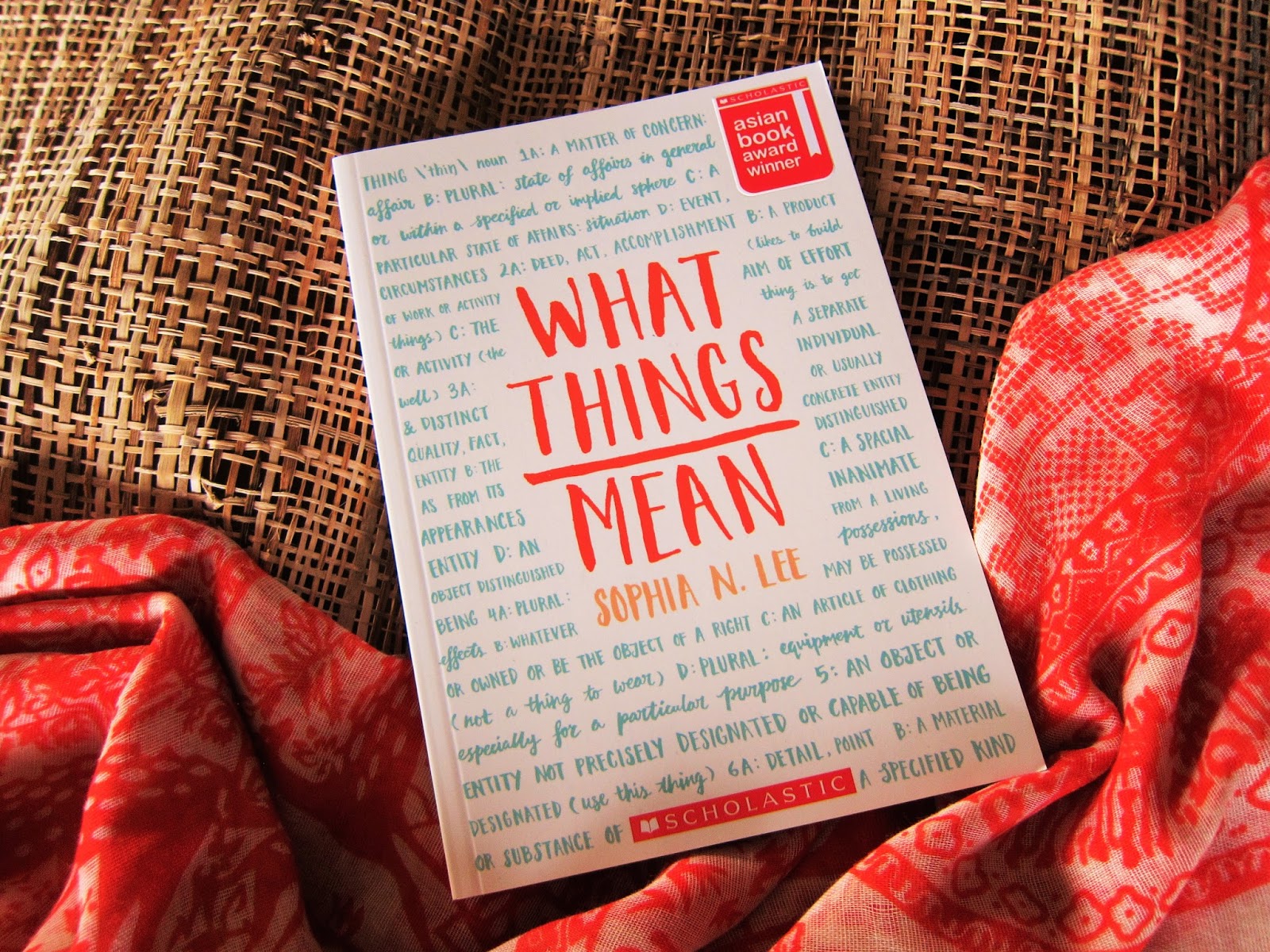
Book Review: What Things Mean

What Things Mean
By Sophia N. Lee
Scholastic, Singapore 2016

I am trying to remember when I first met Sophia N. Lee. Was it in a KUTING workshop or during the PBBY Kabanata Workshop? I couldn't recall anymore. What I remember is reading the three chapters of a novel that Sophia N. Lee was working with at the time. It had a narrative voice that was sensitive, introspective and curiously delightful to read. I was intrigued at the format she was trying to experiment with. Each chapter began with a word and what followed were definitions of it. I immediately warmed up to the fledgeling novel.

One of my hobbies when I was in my tweens, and up to my teenage years, was that I collected words, quotes and paragraphs that strike me as powerful, subtle, poignant, riveting and mind boggling. During those wonder years, I had no awareness of the purpose of collecting such "stuff". I loved to read (I still do) and words fascinated me (still). So, I jotted down in a notebook, all the words, quotes and paragraphs I could find that piqued my fancy. Some words I remember. Others I forgot. I realized I needed to use them. I did so by keeping a diary. My curated words and quotes, lines of poetry and paragraphs finally found another home, another life. I grew up, of course, and started collecting other things.

But that childhood memory remains. It is one of those memories that make me ask myself, to this day, why I did that when my friends were interested in something more exciting than collecting words. That's why, when I first read Sophia N. Lee's drafts, I saw my fourteen year old self: a word collector trying to find the meaning of things.

I have connected one dot to another.

What Worked

What Things Mean is about Olive who sees herself a little different from her cousins and her classmates. It bothers her, a lot, but Sophia N. Lee approaches this personal issue with a nuanced narration of stories from her quirky uncles, her cousins, her aunts, her grandmother and her mother who has her own unique style of evading the truths that Olive wishes to discover.  Her journey towards self discovery is a quiet one; subtle and insightful. Thank you, Ms. Lee, for this portrayal of the un-emo teenager.


I am so tired of the big drama and the loud characterization of obnoxious teens, especially in mainstream telenovelas and kalyeserye. In real life, some can be overly dramatic and annoying. True. There are those who suffer in silence and somehow, turn out fine later on. To me, this teenager was given a voice through Olive.

I enjoyed her conversations with her uncles the most. Her aunts, her grandmother and her mother are all strong women characters. Each is presented with a personal battle and could hold their own in the midst of their internal conflicts. Yet, it is the male characters whom I found to be giving more sensible advice to Olive. While the women in the novel are always there for each other, most times, she feels isolated in their midst. But, don't we all feel this way in our own family sometimes? The thing is, the uncles and her father are either often away or missing, however, the men in this novel made a bigger impact on me.

I cried when Uncle Ricky had to leave again. I cried when Uncle Sol's postcards are left unappreciated. I cried when Olive finally met her father. I cried for their wives and their daughters who must cope, endure and accept that taking leave is part of life.

The truth is not an easy pill to swallow. But, it sets us free. Olive's journey to this new found freedom has just begun.

What did not work

There is no sequel.

So I won't know how Olive's relationship with her father progressed. I am left with a hole full of questions. Only my imagination could fill in the gap for answers. Which, if you think about it, isn't that bad at all.

I read this book at a time in my life when I am battling with my own issues of detachment. I couldn't thank Ms. Lee enough for getting in touch with me. I am glad I accepted to review this book because once again, I realized that the gaps, the spaces and the lacunas in our lives are necessary to complete us and make us whole again.

I am honored and privileged to have witnessed the life cycles of Olive, the novel's turn about into a published book, and that of Ms. Sophia N. Lee, Filipina and writer.

Recommended for readers age 13 and up!

Saturday, August 6, 2016

Author Interview: Sophia N. Lee

The blog features Ms. Sophia N. Lee, author of What Things Mean (Scholastic 2016). It is her first book intended for young adult readers.

What Things Mean is the winner of the Scholastic Asian Book Award. 

In this interview, Ms. Lee talks about her favorite Filipino writers, the YA novels she loves to read, and her dreams for herself as a writer and Filipino creative. She has some interesting ideas on marketing Filipino books and Filipino writers. While she addresses publishers and book stores to take these ideas with a grain of salt, libraries and librarians need to listen up as well. Our schools are communities where children and young people spend most of their time in. Libraries are places, in Ms. Lee's words, where a community of readers is nurtured. 

a. What is your favorite YA book?

I don’t think I could narrow it down to just one, because the more I discover, the more my love for this genre goes. There are just too many titles that I love!

The ones that are top of mind right now are So B. It by Sarah Weeks and Eleanor & Park by Rainbow Rowell – these two books are just so beautifully written for me. Whenever I come across them, I have to resist the urge to highlight whole passages of text that I wish I myself had written. Reading Eleanor and Park always makes me breathless – it reminds me of how all-consuming it can be to fall into these fictional worlds.  

There are some old, old titles that I loved from when I was a younger reader. I love Nancy Drew, of course – especially the ones ghostwritten by Mildred Wirt Benson. There was this one Sweet Dreams book that I kept on rereading – Love Match by Janet Quin-Harkin. I loved it because the main character was wonderful – Joanna was this tomboy/late bloomer who was falling in love for the first time. But what made the book more special was that she had such a crazy, funny family too, and their humor made the book such a fun, memorable read. 

b. Who are your favorite YA authors?

Rainbow Rowell and Sarah Weeks have to figure in this answer too – I feel like I would happily pick up any book written by them, because I love their style of writing. I also really like Laurie Halse Anderson. For me, it’s so amazing how these writers are able to bring truth and light and heartbreaking humor in their depictions of grim situations – highlighting abuse in Eleanor and Park, rape in Anderson’s Speak, and mental disability in So B. It.

There are those who don’t write YA specifically, but who have created some really wonderful YA protagonists – I love Nicole Krauss’s Alma Singer in her book The History of Love. I love how Anna Quindlen created the character Maggie Scanlan in her book Object Lessons. I am in awe of how Ursula Hegi built her young unnamed female protagonist in her short story The End of All Sadness.

I’m just discovering so many Filipino authors that I love too – I love everything by Kerima Polotan and Katrina Tuvera, Susan Lara and Cristina Pantoja-Hidalgo. I love the writing voice of Ian Rosales Casocot and Dean Francis Alfar. I have just discovered Nikki Alfar, Andrea Pasion-Flores, and Romina Gonzales. I love the humor and style of Luis Katigbak. Like I said – I don’t think I can commit to just one. The list of favorites just keeps growing!


The launch of What Things Mean is today at 2PM at National Book Store Glorietta, Makati City

c. Is your book, What Things Mean, autobiographical?

What Things Mean is a work of fiction. None of the people or events in the book are based on real life. That being said, I would say that I imbued my main character, Olive, with a lot of traits, quirks, and yearnings that I myself had as a younger girl. I felt that was the most intuitive way of creating a young adult protagonist that would come across as fully fleshed out. 

I am similar in that we both have dark skin and curly hair, we both are rather quiet, and have a tendency to retreat into the world of books. Like me, Olive is very much into looking for the meaning of things too. 

But we are also very different. She is probably a more patient, forgiving person than I am. I think that she’s deeper and more mature than I was at that age too. I like how, as the writing of the story progressed, she became this person that was different from what I initially imagined she would be.  She was stronger than I first imagined. She handled her obstacles more gracefully than I did at that age. 


d. Where do you see yourself as a writer five-ten years from now?

I see myself still writing. I would love to be teaching too, and talking to a lot more people in the hope that it will convince them to write their own stories too. 

e. What does PH publishing need to do to support YA writers and the growth of YA lit in the country?

I think it would be great if our publishers invested in marketing our books more. There are so many great titles already out there, but they go undiscovered by many because we aren’t talking about them enough – and I believe that readers here will want to talk about them. My own experience trying to promote my book is still pretty limited -- I just launched my book in Singapore last May, and I’m launching What Things Mean in Manila on August 6, but when I come across readers and book bloggers here, I find that they are always excited to talk to me about my book, and to promote new Filipino authors and stories. 

We need to find new ways of reaching and interacting with the readers too. I think it’s so great what our local romance authors are doing, led by the very capable Mina V. Esguerra. I’m a fan of their work, and I think it’s so awesome how they are constantly creating new ways for their readers to connect with them. They’ve done so many exciting things – from podcasts, live theatrical readings, blog tours, and even whole-day events called #feelsdays that immerse readers and would-be readers into the worlds they’ve created. I think that’s what YA authors and publishers need to do too – we need to nurture the community of readers and make them excited to immerse themselves in the worlds of our stories. 


Related Posts Plugin for WordPress, Blogger...