Showing posts with label Francis Jim Tuscano. Show all posts

Sunday, July 5, 2020

empowerEd Live: Breathing Life Into Texts: Developing Effective Text-Based Learning Resources for Distance Learning

Once again, I had the pleasure of guesting in Francis Jim Tuscano's empowerED LIVE last Saturday, July 4, 2020. This episode is in part an opening salvo to the celebration of National Children's Book Day (NCBD) 2020. Many thanks to Jim Tuscano for this partnership made possible with the Philippine Board on Books for Young People (PBBY). I along with Mr. Eric Perez of the Reading Association of the Philippines (RAP) and Ms. Liza Flores of Ang Illustrador ng Kabataan (Ang INK) had an interesting discussion on the development of text based learning materials as hosted and facilitated by Jim Tuscano himself. 


If you missed the live telecast over at Facebook or YouTube yesterday, you can still view it through these links:


Previous to the live telecast, I made some notes. Posting them here in the blog since the discussion online covered a variety of topics and concerns. My notes focus on the writing of content and texts.

1. Texts can be expository, factual or informational and fiction. Each is written in a different way, approach and tone. What ever form of text or literature you are writing, researching on topics you are writing about is important. Research is part of pre-writing. Having said this, the writing of texts, stories and literature involves a process.

There are four basic steps in writing namely, pre-writing, writing the draft, revision and editing, and publishing and sharing. This means, you can schedule your writing of text based learning materials and that, you need a reader to give you feedback on your work. From there, you can revise, make changes and edit your materials. In some cases, a kid-test is called for, especially if the material developed consists of complex steps. In my experience as a children's writer, the Mother Tongue Based learning materials we published in 2017 proved valuable to students in Cebu, Iloilo and Bacolod because our writing team got feedback from the teachers based in those provinces and comments from selected students in the selected schools.

Now here is a caveat. In writing, as a general principle, nothing is craved in stone. Texts and literary pieces all undergo changes, revisions and improvements as dictated by needs and developments of readers and communities who engage with the materials.

2. Know what form of text or genre of literature you are writing. It is helpful that you read samples and exemplars of the text and the literature you want to write. You can do your own searching and documentation but asking for help and seeking assistance from allies in the profession lessens the burden. Besides, writing is not done in isolation.

3. Of primary importance in the effective use of learning materials is the child reader or the learner who will encounter and engage in the text and its contents. Know who you are writing for. The child reader's developmental stages is at the front, back and center of the creation of the module or the learning material. Pedagogy and curriculum, as well as principles in the discipline of educational technology all come into play. In the midst of it all is the child or the learner.

4. Work closely with the illustrator, designer, technology specialist and editor of the learning materials. The logistics and operational work flows can be set early on but a shared vision binds the team together. Collaboration is key.

5. Observe academic honesty. For this topic, I will have another blog post that will tackle issues in plagiarism, intellectual property and copyright. These are all for now. Do visit the blog for updates on topics we care about, school librarianship, children's literature, reading and literacy, teaching and learning and even the simplest act of creation and reflection. Happy National Children's Book Day!

Saturday, July 4, 2020

Teacher on Center Stage: Francis Jim Tuscano (2 of 2)

Here is part 2 of the interview with Francis Jim Tuscano. He has five tips for teachers and school leaders who are moving into the new normal in the field of education.

2. There seems to be a mad scramble to get things in order, to be ready and to transition to Blended Learning. What are five important key concepts that school leaders and teachers need to be aware of when applying the BL approach?

So, to answer this, I just want to make a clarification. Blended learning approach can be understood in two ways: first, as an instructional approach where there is a combination of face-to-face learning and independent use of technology in the classroom (physical); and second as a modality to deliver remote learning, which means that there are certain days when students and teachers are in the physical classroom and the rest of the days of the week are meant for home-based (online or print-based) distance learning. 

I certainly believe that blended learning might be the new normal. We think of this as when teachers and students are now flexible enough and possess adaptability skills to switch from one mode of learning to another, especially when new waves of pandemic arise that can cause prolonged school closures. To enable this, I have the following main principles for blended learning:

a. Ensure equitable access to learning devices and Internet among students and teachers. Adoption of Edtech should always be anchored on the idea of equity so that everyone gets to enjoy and reap the benefits of tech integration. To do this, understand the context of students and teachers, whether they have learning devices or reliable internet connection at home. 

b. Prepare the students and teachers. Teachers will need to learn new digital skills to teach with technology. There should be relevant and meaningful professional development to ensure that they are well equipped to design, implement, and sustain a class with Edtech integration. We also need to make sure that the student are equipped with enough digital skills to navigate an online learning environment. Orienting them as well as teaching them with the needed ICT skills can greatly help. For parents of young students, involving parents is important so that they can extend guidance and support for their children in using technology tools

c. Sound pedagogy before technology as the main principle in designing learning experiences. Teachers should anchor pedagogy on student-centered or student-driven learning. The use of technology should enable or support the achievement of the learning goals. Educators should not design a learning experience around a technology. 

d. Digital citizenship matters more that ever because students are now moving in an online learning environment. Students must be taught how to safeguard themselves from digital threats such as cyberbullying, digital identity theft, and many more. Moreover digital citizenship also reminds students to practice self-discipline and control as they balance the use of technology for studying, leisure, entertainment, or even family connection. Schools must always ensure that there is a digital citizenship program that teachers and students can implement and follow.

3. What should classroom teachers look out for on the first day of school under the the ”new normal”?

Before starting any academic activity or learning experience, I would recommend that teachers get to know their students first so that they can start building an online community. Build a sense of trust and belonging with students. Build class routines and “rituals” that would make students feel comfortable and familiar with one another. It really matters that teachers understand the context of their students even before starting their class. 


4. What keeps Jim Tuscano awake at night? 

Right now, I will not deny that I am undergoing and experiencing episodes of anxiety due to the pandemic. I think of work to be done while at home, but I also fear for my safety and of my family’s well-being, too. So, it is challenging to focus but I try to acknowledge these challenges so that I can better face them. I take time breath and rest so I can also recharge myself. But I am also excited to see how things would unravel in the are of education as well as think of how I can continue contributing to the bigger education system. 

Jim Tuscano is the host of empowerED, an online show that talks about matters pertaining to teaching and learning in this day and age. To quote from the FB Page, empowerED seeks to elevate the teaching profession, celebrate the Filipino teacher, and guide teachers to become agents of change. More specifically, empowerED aims to: Provide relevant professional learning opportunities that focus on teaching skill development and well-being Share inspiring stories of the most innovative and dedicated teacher to the world Guide teachers in designing sustainable education projects for the school, community, and society. 

To know more about empowerED, go here: https://www.facebook.com/empowerEDwithJimTuscano

Thursday, July 2, 2020

Teacher on Center Stage: Francis Jim Tuscano (1 of 2)

Francis Jim Tuscano is an EdTech advocate too!
The blog is glad to have this interview with Global Teacher and Distinguished Apple Educator, Francis Jim Tuscano. He talks about technology in education, makes a distinction on Blended Learning as approach and modality, and shares strategies for teachers who will be teaching remotely in this coming school year.

1. All of a sudden, Educational Technology and Instructional Design are thrown into the forefront of education. What do you think of this phenomenon given the circumstances and how is PH education responding to the change and challenges in teaching and instruction?

What’s happening right now is definitely and undeniably accelerating the adoption of technology in teaching and learning. Before the pandemic, a lot of schools did not see Edtech as a priority because we have never imagined the possibility of school closures that will not allow face to face teaching and learning. It was a very remote scenario that a lot of us never considered in our wildest dreams. But unfortunately, we are in a public health emergency right now and distance education or remote learning is the only viable option to continue learning and teaching, aside from homeschooling. The accelerated adoption is so obvious right now as seen in the rapid adoption and purchase of learning management systems and the rise of webinar workshops or talks on technology integration. 

Personally, I am excited with this because people now realise the importance of technology, its possibilities in elevating or raising the bar of learning. For now, my fear is that schools and educators overlook their core reason for adoption. I mean, right now, the core reason is to answer the negative effects of the pandemic but that can be very short-sighted. I hope that despite the quick transition that is happening in many schools right now, they see, invest, and hope to sustain with a long-term vision. It is not something that you invest now and then terminate once the pandemic ends. The investment on infrastructures, devices, and professional development of teachers cost much, so it is important that school leaders are able envision technology and embed it naturally in their vision and mission as a school community. They should have a bigger why that will guide their tech adoption even beyond the pandemic. 

In terms of its adoption then, the current situation in the Philippine education system show us the haves and have nots, the digital divide which has been present before. The pandemic has just made it more obvious and this is the case in a lot of countries. So, we are again playing catch up, accelerating things, racing against time to put more devices in the hands of teachers, partnering with local government units for donations of devices to students who do not have access, and training teachers to learn more ICT skills. There was a big misconception that online learning was the way to go and I would like to temper this. 

Despite being an advocate for Edtech, I always cautioned educators and school leaders to be more careful in making decisions regarding Edtech or online learning adoption. While we want to push the agenda for better ICT access and infrastructure in the country, such quick decisions right now puts families, parents, and students in a very difficult situation. Context of the learner should always be considered. If there is inequitable access, then do not at all adopt online distance learning. ICT or Edtech should always be a tools to bridge the gap in education, as envisioned by UNESCO. But, reality has shown us that it is a two-edge sword. It can bridge and widen the gap at the same time. In the end, we do not want Edtech adoption especially in school communities with equity issues to be the wall that bars students from accessing education. 

Sunday, May 3, 2020

empowerEd Podcast Channel: Fostering Literacy in Times of School Closures

Yay! I got the news from Francis Jim Tuscano that the podcast where he and I talked about literacy and learning in the time of pandemic is up. He has this post in his Facebook Page.
This new empowerED Podcast episode is for parents out there! How can we foster literacy at this time of school closures and learning from home period?  
Thank you, Zarah Gagatiga, for joining me in this episode. Zarah also touches on digital literacy and how parents can safeguard their children from digital threats as access to social media increases during lockdowns. Listen on Apple Podcasts: https://apple.co/2kHX53u or Spotify: https://spoti.fi/2kEpabQ.
#remotelearning #distancelearning #edchat #appleeduchat #pedagogy #teachersmatter #edtech #literacy #edleadership
Have a look at this promotional video of the episode. It is my first guest appearance in a podcast channel so, super thanks to Jim for this opportunity!


And before you go, dear readers, go back to these links as I chart the journey of this experience participating in a conversation on topics close to my heart.

Part 1 - Meeting Jim Tuscano in person in the Reading Association of the Philippines' DemoFest in Iloilo (October 2019)
Part 2 - What I prepared for the podcast guest appearance

Tuesday, April 28, 2020

Learning Goes On in the Time of COVID-19

Here are my answers to the questions that Mr. Francis Jim Tuscano sent over. This is in preparation for the podcast about literacy and learning through and during the pandemic. The interview can be listened at when you tune in to Jim's empowerEd Podcast channel. The links are at the end of this blog post so have a look and listen to more podcast of thought leaders in education today. 

What challenges in terms of literacy are we seeing or anticipating at this time of school closure?

Literacy has many kinds, so allow me to identify five kinds of literacy that are relevant to have in the time of COVID-19. These are Family Literacy, Digital Literacy, Financial Literacy, Media and Information Literacy (MIL) and Cultural Literacy. At the core of these kinds of literacy is critical thinking. So I think, the question we can ask ourselves as parents and teachers is, how can we learn and harness critical thinking skills especially in children?

So, for the purpose of discussion, I will focus on Family Literacy, MIL and Digital Literacy as the most challenged literacy skills today.

It is important that families know how they learn, individually and collectively. It is in the family where creative and productive habits of using media and digital technology begin. Conversations and experiences in language grow and develop at home. Parents are the first teachers of the child, so an awareness of how each members of the family learn and grow is the beginning of learning at home.

Today, parents are challenged to provide a learning environment for their kids at home. What routines are in place to help and assist children in learning about themselves and the immediate environment? How are children using technology at home? What models of reading and learning habits do children take after from their parents. I think these are challenging times for parents and they do need support.

How can teachers continue to foster literacy despite school closure?

Teachers need to communicate well with parents. As many schools move to remote and online distance learning, schools must support teachers and parents in the transition. A big expectation is set for teachers to do an efficient job at this. The design of learning and instruction that is age appropriate and creative is of utmost importance. All these changes has to be relayed to parents in clear and meaningful ways.

How can the home help in ensuring that kids continue to love and appreciate reading?

I think it is important to strike a balance the use of digital technology and exposure to media. As a librarian, I do a lot of paring, deconstructing and unpacking of information found online. Metadata is not easy for children to understand and make meaning all in one go. Some symbols, signs and context can be lost especially when children engage in the news and when they receive an influx of information from social media.

So, for parents, I recommend that they take time listening to their children. Be aware of the questions children ask. Entertain their curiosities and wonderment. Tell each other stories. I am big on storytelling and this is an experience where children can acquire language and literacy skills. take advantage of the time spent at home. This is also a good time to learn and develop life skills.   

What have been the most important learnings that you got at this moment? 

I think it is really important for us all to work together. This health crisis can break us apart or it can bring us together. I prefer the later one.
 
Follow these links to know more about empowerED Podcast Channel, you may visit our channel on Apple Podcasts: https://apple.co/2kHX53u or Spotify: https://spoti.fi/2kEpabQ. Our empowerED Podcast is produced and distributed for FREE to educators globally. 

Wednesday, April 22, 2020

empowerEd Podcast Channel: "Global Voices: Pondering Over Education and the COVID-19 Pandemic,"

I just had an interview with Francis Jim Tuscano for an episode in his podcast channel, empowerED. The theme for this season is "Global Voices: Pondering Over Education and the COVID-19 Pandemic".  It aims to tell the stories of educators around the world at this time of the pandemic- challenges, hopes, and reflections. 

I am honored to be a guest in his podcast channel. This is my first podcast recording with a distinguished educator such as Mr. Tuscano. I first met him through a paper he wrote on integrating information technology and finally, shaking his hand and seeing him face to face last year in the Reading Association of the Philipines DemoFest and Mid-Year Conference in Iloilo. Our paths crossed in a field of discipline that I often traverse outside Library and Information Science. We also share the Xavier School experience since he is a faculty member and I, a former librarian in the Greenhills, San Juan campus. 


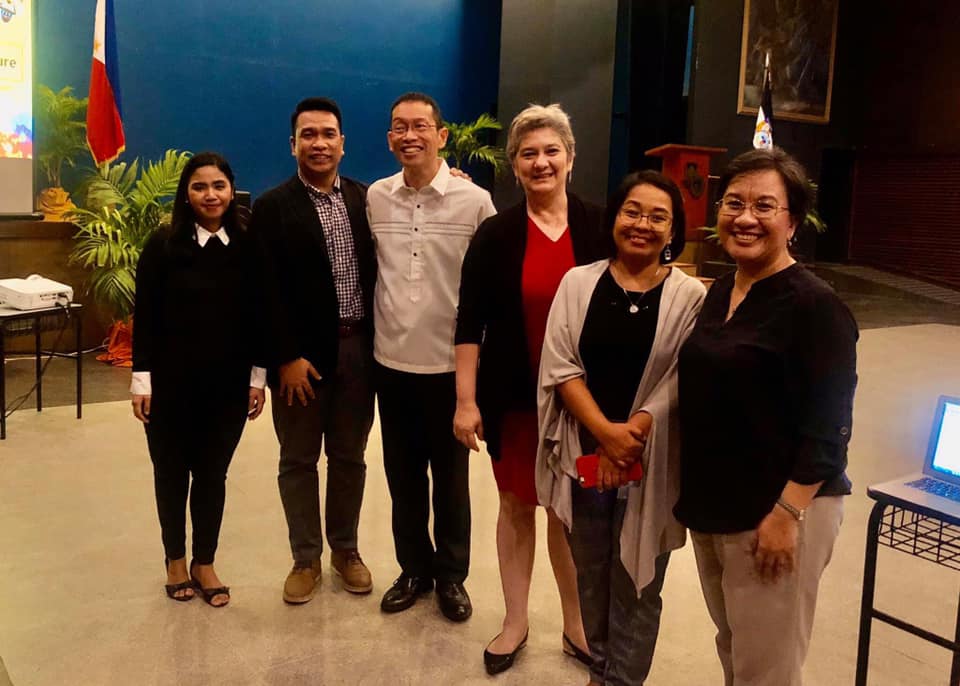
Jim Tuscano (second from left) with RAPpers in Iloilo City
Life is indeed strange and beautiful!

For the interview, Mr. Tuscano sent me these guide questions:


What challenges in terms of literacy are we seeing or anticipating at this time of school closure?
How can teachers continue to foster literacy despite school closure?How can the home help in ensuring that kids continue to love and appreciate reading?What have been the most important learnings that you got at this moment? 

I have notes as answers to his questions but the interview didn't turn out the way I thought it would - which is pretty cool. I will post my answers to the questions for the blog, but I do encourage you to visit Mr. Tuscano's podcast channel not just on the day of my interview, but right now. The ideas, insights and sharing of experiences among professionals and practitioners in the field of educational technology in empowerEd are awesome sauce. Also, issues on teaching and pedagogy are discussed. 

Follow these links  To know more about empowerED Podcast Channel, you may visit our channel on Apple Podcasts: https://apple.co/2kHX53u or Spotify: https://spoti.fi/2kEpabQ. Our empowerED Podcast is produced and distributed for FREE to educators globally. 
Related Posts Plugin for WordPress, Blogger...