Showing posts with label Skill Tree. Show all posts

Monday, March 22, 2021

BA Library Online: Thinking Skills and The Learning Scientist

This month in the Academy, we have been busy trying out the Skill Tree. What we found from our small group discussions is the interconnection of skills across subjects. Take for example, the skills in reflection and remembering or retrieval are essential in writing big and small research papers or essays. Some teachers have the strategy to teach this. What research is telling us is that new strategies can be employed to help learners become better thinkers.

As a response to my colleagues' questions and needs, I re-posted the thinking skills and strategies from The Learning Scientist. I am putting it up in the blog to share with you, my dear readers.

The Learning Scientist has rich resources to guide students, teachers, and parents in studying and in the development of thinking skills. Of the varied materials that are posted in the website, the Six Strategies for Effective Learning is acclaimed as the most practical and beneficial based on decades of research in Cognitive Psychology. The Six Strategies are Elaboration, Concrete, Examples, Dual Coding, Retrieval Practice, Spaced Practice and Interleaving. Try setting them up as routines to discipline the mind and to train the brain to think clearly.

As teachers, we can use the strategies to break content into bite size pieces making it easier to understand. We can match the thinking strategies with our favourite graphic organisers. Conversation between teacher and student when using a graphic organiser becomes more meaningful. For example, we can ask students to elaborate on the relationships or similarities of ideas, concepts, elements or issues that they identified in their Venn Diagram. By using dual coding (drawing and writing), cognitive skills like long term memory and the retrieval process are strengthened. Thus, making infographics, mind maps and doodling a big hit to learners.

The strategies can also be taken as skills that students can apply during study hall, group work, study groups and independent study. Once the strategies are introduced and modelled, becoming a part of classroom teaching in synchronous and asynchronous learning environments, students are more likely to follow through. Feel free to download the files and do visit the Learning Scientist website for articles, new books, podcasts, tips for parents and sharing of learning strategies that work!


Wednesday, March 10, 2021

The Lighthouse Diary Entry #28: The Research Skill Tree

This week at the Academy, we learned about the Skill Tree. A Skill Tree is a series of skills that programmers use to create games. Needless to say, we are learning how to incorporate gamification in teaching and instruction. Here is what I made for the library's instructional program for research skills.


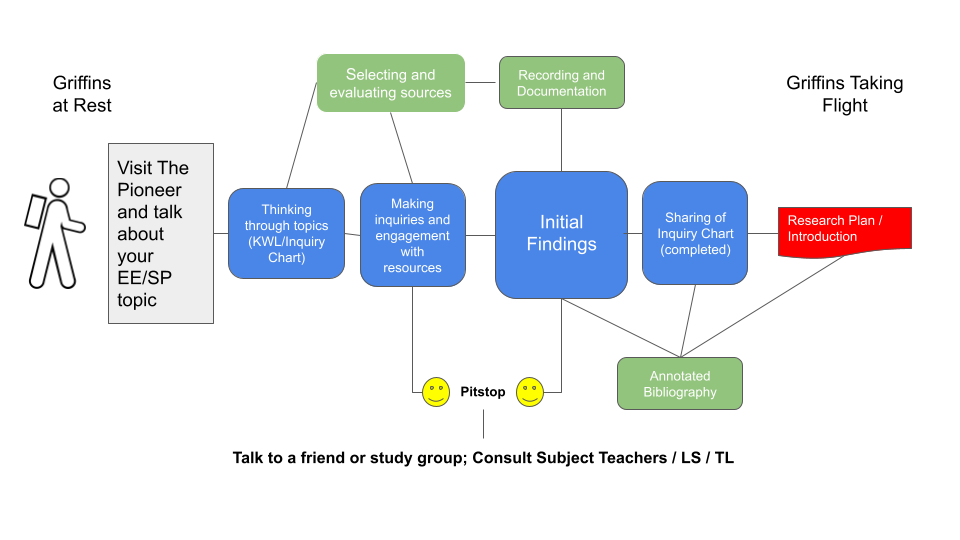
There are two sets of Skill Trees. The first one is for the student who wants to learn about research and acquire skills in general. The second tree is made for the Grade 11 who is about to begin the Extended Essay. I used Joseph Campbell's Heroic Journey as basis for the two Skill Trees.


Skill Tree 1 begins with knowing the results of research skills assessment that students take at the beginning of the academic year. Through The Pioneer, I help them identify their goal and objectives using the assessment results. From there, students are offered to choose any of the three Cornerstones of Research Skills. Each cornerstone contains activities on research skills building. Since I am adapting principles in gamification, I plan to include tokens and badges, earning talismans and knowing different characters that will help them achieve a heart. Blue for Strength. Green for Courage. Gray for Hope.

Skill Tree 2 begins with a conversation at The Pioneer, where students will read about research. They will schedule a meeting with me. We will talk about topics that the student are interested in exploring. Using the KWL chart or the Inquiry Chart, students begin their research. In this phase of the research, students find out what gaps exist in their topics or subjects of inquiry recording and documenting their findings along the way. Teachers and the Teacher Librarian come in to lend clarity or direction to their inquiry through scheduled meetings. At the end, the Inquiry Chart has been accomplished and the student can make a decision or discover of the subject/topic of research is worth pursuing.

In essence, the Skill Tree helps me in improving the library's instructional program particularly on research skills. My next task is to put together the materials and content. Then, I will revise The Pioneer since it is the platform for the Skill Trees. 
Related Posts Plugin for WordPress, Blogger...