Showing posts with label reading campaigns. Show all posts

Saturday, October 20, 2018

Reading Advocacy: Masbate’s Tabang Kariton

The blog is featuring Tabang Kariton’s reading advocacy and book campaign programs in Masbate. Thank you to Mr. Jonathan Morano, teacher and radio show host, for agreeing to do this feature and guest post. Read on and discover the history and initiatives of Mr. Morano in building a community of reades in Masbate. 

Inspired by Efren Peńaflorida’s advocacy to offer alternative education to street children through his pushcart, Jonathan Morano launched his own project “Kariton Edukasyon” when he was still working as the principal of Liceo de Masbate in 2010. During that time, the Citizens’ Army Training was abolished, and instead of military instructions, he proposed that the students should render service through teaching good values to children of poor communities. They adopted Espinosa Elementary School at Brgy. Espinosa, Masbate City for their outreach program and the result was overwhelming since Mr. Morano had seen that both the volunteer students and the community benefitted from the different activities they organized.
Liceo de Masbate is a Catholic School and needless to say that the spiritual being of an individual is the school’s primary goal and this was indeed achieved when students realized that helping others was a way for them to become good Christians. It was also observed that they became socially aware of the fact that poverty affected the lives of young children such as of those who were recipients of the program.  But the realization that it made a big difference to children and the community was what really caught the attention of Mr. Morano. While watching how eager those children were, how the thought that someone cared for them made them smile, he had come to a realization that if only people would give time to help and somehow touch the lives of others, the world would become a better place to live in.
From then on, Mr. Morano envisioned a dream that to others might had been too large to fulfill. As a teacher, he realized that he was not building edifices of stone and cement but he was molding lives. As an individual, he started to believe that he had a responsibility to the society and be part of its desire to change for the better. As a Masbateńo, he should care. And so, instead of complying with a mere requirement of a syllabus, his ‘kariton’ continued its journey…


On August 18, 2012, he initiated “Tabang Kariton”- a community service project which its purpose was to reach out to the core of a person’s need to be assisted in terms of knowledge skills, moral and social consciousness. By then, he was already a teacher of Masbate National Comprehensive High School. He decided to change the project’s name since he wanted to bring it closer to the hearts of his fellow Masbateńos. ‘Tabang’ is a local term for help and up to this day the community service project offers programs such as; Dagdag Dunong for literacy, skills, health education and  values formation and Sumpay Kapalibutan for environmental awareness.
What makes “Tabang Kariton” stand out from among other known community service projects is it is initiated with the help of various partners both from government and private sectors.
The initiator believes in the goodness of a man’s heart and he has learned that everyone has his desire to help others but sometimes there are factors that prevent him from trying. For this, the initiator offers that person his chance. If the person has resources, particularly with financial capacity, yet has no time to organize an activity to share his good fortune, Mr. Morano would willingly step in and offer him a chance to become a partner of “Tabang Kariton”. On the other hand, if a person has without funds but is willing to offer his service to people, “Tabang Kariton” is always open for volunteers.
Tabang Kariton is a community service which offers the programs Dagdag Dunong (Literacy, Skills and Values Formation) and Sumpay Kapalibutan (Environmental Awareness)

Wednesday, September 12, 2018

Book Review: Dialogue and Humble Inquiry

Every month, I send out our library's list of new titles or acquisitions. There are many ways to promote new books, but I still prefer to use email to inform and communicate with the community of our current books and resources. 

Our featured new books for the month of September
From the list, here are my top two recommended reads.

In Dialogue and the Art of Thinking Together (Currency and Doubleday, NY 1999), William Issacs brings readers back to the flow of meaning present in conversations. He writes, "most people living today do not know how to create meaningful conversations" and traces the etymology of the word from the classics. He defines dialogue as a conversation with a center, not sides. A way of taking energy of people's differences and channeling it into a new creation. The aim of dialogue is to avoid and, in time, remove us out of polarizations, he adds.

What follows are stories and examples of men and women in the sciences, engineering, military and business who all have succeeded and made a difference in their chosen field because they have recognized the power, aesthetics and flow of meaning in dialogue. Contents include capacity building for effective conversations in the workplace, enhancing relationships through dialogue, an examination of the ecology of thought and the role of dialogue in organizational management, the new economy and today's fragile democracy.

Consider Edgar H. Schein's book, Humble Inquiry The Gentle Art of Asking Instead of Telling ( BK Publishers, CA 2013) as a companion to Isaacs' Dialogue because, the former is written to build positive relationships and better organizations. It is only seven chapters long but it's a powerful read. It explains the value of humility as key to achieving personal goals and professional success by communicating with people we admire, respect and even dislike. It challenges readers to recognize one's limitations and that, the admission to be helped by another is a path towards establishing a positive working culture.

Chapters 2 and 3 deal with strategies on the humble act of asking people, case studies and practical activities to apply the asking vs. telling strategy. In the succeeding chapters, Schein discusses the culture of "do and tell", how we value "doing" more than "relating", the misinterpretation that "doing is relating", and how humility dissipates as people climb up the ladder of power and authority. The book ends with real life examples on the difficulty and challenges of being humble in these modern times as Schein provides ways and means to keep a small and grateful heart. 

Sunday, February 14, 2016

Give Your Books A Second Chance


Monday, January 18, 2016

Looking Back at IBGD Activities

Because it is International Book Giving Day (IBGD) on February 14, I look back at the books I gave away and who got them.

In 2013, I gave away Filipiniana and some picture books . The picture books were given to grade one students of Loma Elementary School. At the time, I was part of the team of volunteers who came every afternoon for tutorial sessions. The kids were suprised to be given books! To this day, many Filipino children still have limited access to books and libraries. This is the reason why I believe in the goals and activities of International Book Giving Day. One reader can share the gift of reading and literacy to others. Sometimes, it is the little acts of kindness that makes a difference in the life of another. As for the Filipiniana books I gave away, they ended up in the school's faculty lounge and in the hands of co-teachers.

In 2014, I gave away my books! I gave a copy of Tales From the 7,000 Isles: Filipino Folk Stories to my co-teacher, Mr. Joseph De Santo, who has a daughter growing up in an inter-racial family. My colleagues' son, Sam, got a copy of My Daddy, My One and Only!

Sadly, in 2015, all I was able to do was post the e-poster of IBGD. I think I was busy with something else that year. A trip to Japan! So, this year, I am going to participate again. What books will I give away? Who will get them?

For more information, visit the IBGD website. There you can download free posters, bookmarks and book plates that are all artistically designed. These book stuff are lovely. And it is free! IBGD stays true to its simple goal of book giving. If you are going to participate in the book giving, please use #bookgivingday when you post photos and news about it in your social media accounts.

Tuesday, November 3, 2015

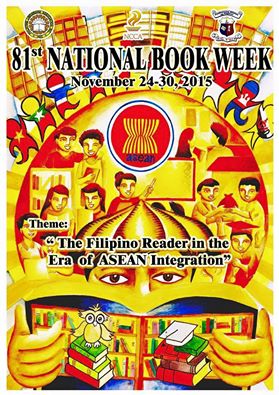
The 2015 NBW Blog Event: Filipino Librarians and Their Reading Habits

Photo source: PLAI and the NLP
The 2015 National Book Week Blog Event begins this week. We are starting off with the topic on:
Filipino Librarians and Their Reading Habits

Do Filipino Librarians read? If yes, what are they reading? If not, why? Why are they reading? What is their preferred reading format? Whom do they speak with about books they have read? Where do Filipino Librarians get their books?
Our guest blogger for today is Ma. Christine S. Hernandez.  Known as Jing to her family and friends, she is a librarian detailed at the College of Mass Communication Library, University of the Philippines Diliman. She loves to travel, to take a stroll in the beach and to go on a hike with her chums. She likes to grab some coffee shots partnered with a cookie or muffin

She writes about Filipino Librarians and the books they read. She conducted a survey among librarian friends in her learning community. She shares what she found out about them and their reading habits. Librarians read, of course! But... read on and find out for yourself!
 
Have you ever wondered what librarians do between coffee breaks and when they are at home? According to popular belief, librarians are the well-read people who are compensated to read. In the Philippines I wonder if this is true. So out of curiosity, I formulated a survey asking librarian friends questions about their reading habits. Luckily some of them responded and through a guided format, I was able to get answers. You would be amazed how witty and interesting their responses are.


As to my first question, all of them agreed that they read. Yes, Filipino librarians despite a tight schedule still find time to read. They listed down the materials or resources they are reading. They read the Bible, newspapers/featured articles, textbooks, novels, scholarly books, self-help/inspirational books, magazines, trivia books, scholarly journals, reference books, blogs (for librarians are techie nowadays), comics and even manga. That’s quite a list! Some of them prefer books on a given topic or interests like books about Philippine history, romance, librarianship (ahem!), archives, biographies/autobiographies, technology, food, health, gardening, philosophy and the opposite sex (because we are humans too).


In reference to what they’re reading, they cited reasons for reading. Most of the respondents read for entertainment and leisure. One librarian imaginatively expressed that it’s her way of escaping from this world. I now wonder what happened to the world, for others, reading is a stress reliever. Reading keeps them sane. Some librarians read out of curiosity on a given interest or topic. Some use it as a guide and find it as one of their favorite hobby. And due to the fast-paced world, librarians want to keep abreast of the new trends (be it in their profession or not), to increase their knowledge (both in librarianship and other fields), and be able to learn new things that they may apply in daily living.


Jing Hernandez sitting on a C at the College of MC, UP Diliman
I asked them as well as to the formats they prefer and itemized some of the formats. On the survey, majority prefer both formats. For clarity, 20 librarians prefer both formats, 4 prefer printed ones  and 4 on non-prints. But to top it all, almost all of them were well-versed to print and non-print formats.


In the survey, they were also asked if they speak about books they have read to someone who has read it as well. Majority shares it with friends, next to their colleagues, followed by members of their family, to library clientele/patron, then business partners and in online  forums. In some case, some respondents don’t speak about it to anyone. Some of the reasons why they share it to others is, first, they find someone they can relate it to. Another reason is that, the other party would benefit from it too. Based on experience, we Filipinos love to tell the gist of interesting stuff we read about.


For the final question, I asked them as to where they get the books they are reading or have read. Most of the librarians got it online. Then some of them read books from libraries where they work. Some are from bookstores bought  especially when it’s on sale! Others are from friends, given as gifts and lent by few good ones. They also get the books they read from book fairs and colleagues.


If there is one gift God bestowed upon humans, it is the ability to read. Not just the ability itself but also to construe and construct from what has been read. In an era where instant is the new frontier, Filipino librarians find ways to keep abreast on the trends of the profession and the world in general. Behind the office desk. While we lend out books for clients or answer their queries, between our wee breaks and packed lunches, on our way to home or on meeting a friend, we Filipino librarians read and think about what to read. And when we’re in our haven, we snuggle and let our imagination lead.

Yes, Filipino librarians read. In the age of ASEAN integration, reading is a tradition that is for keeps.

Monday, June 15, 2015

Father's Day Blog Contest

Three simple ways to join:

1. Send a short review of my book, My Daddy! My One and Only! via email (zarah.gagatiga@gmail.com) or a PM over at Facebook;

2. Send a photo essay showing a read aloud of my book, My Daddy! My One and Only via email (zarah.gagatiga@gmail.com) or a PM over at Facebook;

3.  Send a photo of the Parent Award that is attached at the end of the book, dully filled out and accomplished, showing your parent getting this award. Send it via email (zarah.gagatiga@gmail.com) or a PM over at Facebook.

The first three people to send any of the three photos will get a FREE autographed copy of My Daddy! My One and Only! and will be featured in the blog too!

Wednesday, May 27, 2015

Adarna House Brings Books Closer to Young Readers

Books bring people together!

Adarna House celebrates its 35th year anniversary with a slew of activities for kids of all ages. One activity I was fortunate to partake in was the Reading Camp in Brgy. Janusa, Talim Island, Binangonan, Rizal. Read on the press release of the activity by heading on to the Adarna House blog.


Needless to say, Darrel Marco and I had loads of fun telling stories with the kids, playing games with them and helping them write stories about their families. Seeing them read books was like seeing them open gifts on Christmas Day. What I find remarkable about the experience was the look of wonder painted on their faces when they saw the Adarna books all splayed out for their choosing. And when they started reading, some did picture reading, a few merely looked at the illustrations, there was engagement and connection. The kids' eyes would narrow and widen; some would smile; a few would stare at drawings and touch the pages with hands dirty from play. What joy to hear them read aloud!

My only hope is that a repeat of such an experience would happen soon. Access to books is the first step to literacy and reading development. As a librarian, I am humbled to be a part of this development in the community at Talim Island.

Wednesday, April 22, 2015

DIY School Library Bulletin Board

Here is a sneak peak on a handout and content on my forth coming workshop for Adarna House and Intervida next month. I will be giving a session on library improvement for teachers, librarians and cultural workers in Bicol.

Monday, December 1, 2014

Tuesday, March 4, 2014

Book Spine Poetry January 2014: Judge's Review (1 of 4)

Last February, I invited Beverly "Bebang" Siy and Ronald "Poy" Verzo to judge entries in the Book Spine Poetry Contest that we're running in the library. The poems were entries for the month of January but judging transpired in February, National Arts Month. Serendipitous? Probably.
I will be posting their reviews in several parts.  Here is the first part of Bebang's review.

Ngayong National Arts Month, kakaibang patimpalak sa tula ang aking nilahukan bilang isang hurado. Pinamagatan itong Book Spine Poetry Contest na nilahukan ng mga estudyante ng Grades 9-12 ng Beacon Academy at inorganisa ng kanilang librarian na si Bb. Zarah C. Gagatiga.

Lahat ng kalahok ay kailangang makagawa ng isang tula gamit ang iba’t ibang pamagat ng aklat, na nakalimbag sa spine ng aklat. Ang isang spine ay katumbas ng isang taludtod. 
Dito ay hindi ako nagbago ng criteria sa ginawa kong paghusga sa mga kalahok. Ang ginawa ko ay katulad din ng paghusga ko sa karaniwang patimpalak sa tula. 
Bakit? 

Sapagkat ang proseso lamang ng paglikha ng tula ang naiiba rito. Ang Book Spine Poetry ay isang halimbawa ng Found Poetry. Ito ‘yong uri ng tula na binubuo ng mga salita o pariralang basta na lamang natagpuan. Malabo ba? Ganito, halimbawa ay ang tula na gawa sa ilang headline ng ilang diyaryo. O kaya ay ang  tula na gawa sa unang pariralang matatagpuan sa unang pahina ng unang sampung libro na madadampot sa isang aklatan. Ibig sabihin, pre-selected ang (mga) salita na siyang titindig bilang isang taludtod. Walang babaguhin ang sinumang nais gumawa ng tula mula sa mga natagpuan niyang salita o parirala. Ang maaari lamang baguhin (depende na sa makata) ay ang pagkakasunod-sunod ng taludtod at/o ang mga bantas na nakapaloob sa mga ito.

Kumbaga, hindi kailangang likhain mula sa bula ang isang taludtod. Sa patimpalak na ito ng Beacon Academy, nariyan ang mga spine ng aklat, nariyan ang salita o parirala sa bawat spine na siyang bubuo sa taludtod. Kailangang piliin ang mga ito at ayusin ang pagkakasunod-sunod para makalikha ng isang tula.

At dahil tula pa rin ito, inaasahang matatagpuan pa rin dito ang mga elemento ng nasabing anyong pampanitikan.

Narito ang ilan sa palagay ko na dapat taglayin ng isang tula (in no particular order po!):

1. Mapaglarong gamit ng wika
-ito ang dahilan kung bakit nagiging manunulat ang isang karaniwang tao. Nagbabago ang simpleng salita dahil sa mapaglarong gamit niya rito. Nagbabago ito ng anyo, ng kulay, ng hugis, ng amoy, ng lasa, ng tunog dahil sa masining na paggamit ng isang manunulat. 
Sa kaso ng mga spine bilang taludtod, maaaring nagbabago ang kahulugan ng orihinal na pamagat sa spine dahil sa mapaglaro at masining na pagkakasunod-sunod ng bawat spine. Nalalaro niya ang mga salita, at ang kahulugan at tunog nito batay sa pagkakasunod-sunod ng spine.

2. Talinghaga
Ito raw ay pinagsanib na dalawang salita: nakataling hiwaga. Walang eksaktong salin sa Ingles ang salitang talinghaga. Ayon sa UP Diksiyonaryong  Filipino, ito ay mapagbuong simulain ng isang akda, lalo na kaugnay ng malikhaing pangangasiwa sa tayutay at retorika. 
Ito ‘yong bagay sa loob ng tula na kapag naaninag  mo, ikaw ay mapapa-“aaa… iyon pala!” Maaaring maipahayag  ang talinghaga sa pamamagitan ng paggamit ng tayutay tulad ng simile, metaphor, irony, personification at marami pa. Maaari din namang ang talinghaga ay ang bagay na siyang hindi ipinapahayag sa isang tula. 

3. Mapaglarong gamit ng taludtod
Dahil sa patimpalak na ito, pre-selected ang (mga) salita sa isang spine o taludtod, ang kailangang bantayan ay kung paanong nagagamit ang pagkakaputol ng mga salita at diwa ng bawat spine. Nakakapagdagdag ba ito sa mensaheng nais iparating ng tula? Nakakapagdagdag ba ito para lalong maging interesting ang talinghaga sa tula? Dahil ba sa huling salita ng piniling spine ay nadagdagan ang pananabik para basahin ang susunod na spine? Ika nga ay, page turner ba ang huling salita ng bawat spine?

4. Persona
Ang persona ay ang mata na pinagmumulan ng isang tula. Kaninong mata ang nakakakita ng karanasan na nasa tula? Sa isang bata ba? Sa isang teenager o sa isang matanda? Sa isang mayaman ba, mahirap o middle class? Sa isang tao ba noong unang panahon o ngayong modernong panahon? Paalala: hindi kailangang tao ang may ari ng mga mata na ito. Maaaring maging mata ito ng isang yelo o kaya ng isang penguin.  Puwede ring mata ng isang buong bansa na naghihikahos. O kaya ng isang bansang gustong manakop ng ibang bansa. Kahit anong persona ay posible, walang hanggan ang posibilidad na mapagpipilian ng sinumang gustong tumula.

5. Mensahe at Tema
Bilang hurado, mahalaga rin sa akin ang tema o mensahe, hindi lang ang paraan kung paanong nilalaro ang mga salita o kung paanong ibinabaon sa mga salita ang isang talinghaga o kung paanong nayayari ang isang taludtod. Aanhin natin ang tulang napakahusay sa mga teknikalidad na nabanggit ngunit ampaw naman ang mensahe o di naman makabuluhan ang tema? 


Napakahirap gumawa ng tula ngunit sa kasawiang-palad, ang tula ay isa lamang messenger. Mas importante pa rin ang message na dala-dala ng messenger. Ang pogi nga ng messenger, wala namang kuwenta ang message niya, wala rin, di ba? Sayang lang ang panahon ng nakatanggap ng message. Kaya para sa akin, mahalagang nagbibigay ng angkop at makabuluhang mensahe ang isang tula o ang anumang pampanitikang akda. 

Monday, March 3, 2014

WRAD 2014: Raising Our Voices Blogging Challenge Week 3

Week 3: February 24 - March 2
A Snapshot of My Reading Life
Post a photo that gives readers a glimpse into your reading life. This could be your favorite place to read, your bookshelf, your library, your classroom, a book from childhood that you still re-read today, your favorite person to read with. Anything that brings joy to your reading life will work!
 
Below the photo share a short narrative explaining why this picture is meaningful to you. 

These are my favorite books to read aloud to kids because it brings me and the listeners lots of joy!

Top to Bottom: Xilef; Chenelyn! Chenelyn! Sandosenang Spaatos,
Ang Pambihirang Buhok ni Raquel, Sundalong Patpat


Top to Bottom: Officer Buckle & Gloria, Stella Luna, Library Mouse, Swimmy
TUESDAY, The Rainbow Fish, Here We All Are, HUG

Top to Bottom: Lizard's Song, Clifford, The Cat in the Hat, Love You Forever
The Carrot Seed, Chika Chika Boom Boom, Mooncake, The Very Hungry Caterpillar


Monday, February 10, 2014

WRAD 2014: Raising Our Voices Blogging Challenge Week 1

WRAD Raising Our Voices Blogging Challenge: Week 1: February 10 - 16
What is your earliest or fondest memory in which someone read aloud to you?
Your first mission is to answer this question. We are using this prompt to bring awareness to the impact reading aloud and the act of being read to has on readers of all ages. Consider it an opportunity to connect with others through the shared experience of hearing stories read aloud. 
More prompts: How you plan to celebrate WRAD on March 5? Who will you celebrate with? Where will you be? If you have celebrated WRAD in the past, what activities brought you and those you celebrated with the most joy? 
Growing up in the mid-70s, reading aloud was my alternative to watching TV because my parents controlled my viewing hours. There was Sesame Street and Electric Company to see in the morning while old Filipino movies and Japanese anime were my TV fodder in the late afternoon. This media experience did not drive me away from books. My mother read aloud to me. I loved the way the words slide out of her mouth and into my ears as she read from a book. The pictures in the books did not move when my mom read aloud to me, but the pictures I conjure in my head as she read aloud came alive. Those images were mine.

The words were strung together by the author. The pictures were illustrated by an artists. And yet, I have my own version of words and pictures put together. That is the power of the spoken word. Reading aloud enabled me to dream; to imagine; and to create. I did not know it then, but this is probably the reason why I became a school librarian. That love affair with books sealed my fate. Thanks a lot, Mom!

In the past WRAD celebrations, I had videos of book talks posted in the blog. I once did a read aloud of Lizard's Song. It is a joy to do this: talk about books and read aloud even if only it is done in this blog. This year, I'll celebrate WRAD 2014 by completing this blogging challenge.

I've done the first post for Week 1. On to the next!

Sunday, February 9, 2014

World Read Aloud Day: Raising Our Voices Blogging Challenge

I am joining in this blog challenge initiated by Matthew Winner for World Read ALoud Day 2014 (WRAD 2014). The theme for WRAD 2014 is Raising Our Voices. As librarian and literacy advocate, I will use this blog as platform to raise the voice for books, reading and literacy.


I have lifted this post on WRAD 2014 Raising Our Voices Blogging Challenge from Matthew Winner, The Busy Librarian.
The World Read Aloud Day "Raising Our Voices" Blogging Challenge begins February 10 and runs through March 9. If you choose to take the challenge, each week you will be asked to write a post in response to a prompt or question (outlined below), for a total of 4 posts counting down to World Read Aloud Day. 
Each of the prompts addresses the WRAD theme "Raising Our Voices." Raising Our Voices encapsulates that simple yet effective way we show the world's children we support their future: that they have the right to read, to write, and to share their words to change the world. 
WRAD Raising Our Voices Blogging Challenge: Weekly Outline 
Week 1: February 10 - 16
What is your earliest or fondest memory in which someone read aloud to you?
Your first mission is to answer this question. We are using this prompt to bring awareness to the impact reading aloud and the act of being read to has on readers of all ages. Consider it an opportunity to connect with others through the shared experience of hearing stories read aloud.
 
After answering the prompt, share a short description of how you plan to celebrate WRAD on March 5. Who will you celebrate with? Where will you be? If you have celebrated WRAD in the past, what activities brought you and those you celebrated with the most joy? If you haven't finalized plans, of if this will be your first WRAD celebration, use this space to share your brainstorming process, and direct your readers to litworld.org/worldreadaloudday for activities and recommendations.
Week 2: February 17 - 23
Adult & Child
Answering the following questions with a child. The child can be a student or your own. Age does not matter. Make sure to exchange and enjoy answers with one another before sharing them with us.
1. I think everyone in the world should read…
Me:
Child:
(repeat this format for the remaining questions)
2. If I could listen to anyone in the world read aloud to me it would be…
3. When I read aloud, my favorite character to impersonate is…
4. The genre or author that takes up the most room on my bookshelf (or e-reader) is…
5. My favorite part about reading aloud or being read to is... 
Week 3: February 24 - March 2
A Snapshot of My Reading Life
Post a photo that gives readers a glimpse into your reading life. This could be your favorite place to read, your bookshelf, your library, your classroom, a book from childhood that you still re-read today, your favorite person to read with. Anything that brings joy to your reading life will work!
Below the photo share a short narrative explaining why this picture is meaningful to you. 
Week 4: March 3 - 9
Raising Our Voices
It's time to read aloud! Select a favorite text, or a personal story that you love to share out loud, and make a video. If you don't have a webcam, are having technical difficulties, or prefer not to be on camera, you can also translate this challenge into a written post. Share what you will be reading on World Read Aloud Day, and why you chose this particular piece to read aloud.

If you choose to take up the WRAD Raising Our Voices blogging challenge, make sure to tweet your weekly posts to @litworldsays and use the hashtag #WRAD14 so that we can retweet your wonderful read aloud stories! Happy blogging!


Book Spine Poetry December 2013: Judge's Review (2 of 2)

Here is the second part of Rhandee Garlitos' review on the poems that made it to the finals in the library's Book Spine Poetry Contest. Part one can be read here.

Therefore, these three best entries captured not only the essence of being a poem built on a stack of found titles.  I see this exercise somewhat done before by the American writer Annie Dillard, making something out of newspaper and magazine articles, creating poems from an obsolete almanac in the 1920s, putting together lines by obliterating the unnecessary weeds and hedges.

The third place winner captivates me with its premise – that there could be fun in poetry despite its serious messages.  Its humor is natural and appealing to the young with its premise on the oldest subject in the world, the monkey on every normal student’s back – Maths (When no one understands / Maths 1001 / Academic anxiety / A Game of Groans)

A few more editing touches, and if the last line was used instead as a title, it would be a very potent haiku on the subject, like this:

A Game of Groans

When no one understands
Maths 1001 —
Academic anxiety

The second prize winner had the strength of a strong message.  It speaks of the need for restraint in order to achieve atonement, and it cuts both ways, too.  It could be like a gentle advice to go easy as one passes by an offended elemental, or a stern warning to be careful not to disrespect the boundaries set by a higher being, sort of like the traditional Filipino superstition of “Tabi, tabi po”.  Although it suffers slightly from the natural lack of a preposition (If whispers call for / atonement), it impresses me with its brevity.  A few more tweaks and fine-tuning and this would have gotten my two thumbs-up.

Walk softly, Rachel, 
if whispers call 
atonement 
by the river.

If properly edited, this would read like

By the river
walk slowly, Rachel,
if whispers call (for)
atonement.

The first prize winner stands out above others simply because its author (or I would prefer to call “recreator”) knew how to piece together a four-line poetry that is cohesive in thought and message.

In the country of men,
Things fall apart.
Funny how things change
As I lay dying.

The first two lines join together seamlessly and conjure the image of disarray brought in by what would have been expected as a warranted chaos.  To me it speaks of a world where men destroy each other in quest for power and command of fear above others, and the world collapses because of their whims.  It also speaks of how someone who lays victim to this chaos speaks of it with a casual, almost cold, demeanor.  Then again, it may be a stoic response by someone finally gasping his last ounce of breath.  It is for this reason that its imagery, along with a powerful message, causes this poem to stand out above all others and deserve a much needed applause for its precision and careful marriage of irony and imagery.


Rhandee Garlítos (aka Raymund Magno Garlítos) is an award-winning poet and children’s book author in English and Filipino.  He has received four times the prestigious Carlos Palanca Memorial Awards (the Philippines’ premier literary contest); the Salanga Prize given by the Philippine Board on Books for Young People or PBBY; and the Gintong Aklat Award for his body of work.  He has published 12 children’s books, with his most recent being “Ang Bonggang Bonggang Batang Beki (The Fierce and Fabulous Boy in Pink)”, “Lauan, The Seed that Wanted to Fly” and “The Cat and the Bat and Other Fables.”  He edits and writes for the monthly travel magazine Cruising #Going Places, where he also edits its literary section.  He is currently based in Quezon City where he lives with his daughter, a sizable number of cats, and a house full of books.

Tuesday, February 4, 2014

Update on the 2014 Reading Challenge

One of the four teachers participating in the 2014 Reading Challenge has turned in her book review. 

The Elegance of the Hedgehogby Muriel Barbery 
I had heard about this book quite a bit in the past, so I was quite happy to have pulled it out of my book "can" before the long weekend.  
I have to admit, it took me a while to warm up to this story of a young girl and a concierge who live in a luxurious apartment building in Paris. I initially found both protagonists pretentious and perfect dictionary examples of reverse snobs.  
There was a bit of decent philosophical discussion happening in between their stories, which will make for fun pondering if you're into TOK. But otherwise, I only only began to enjoy this book when their mysterious Japanese neighbour arrives and you see another side to both women.  
The chapters are as light as a freshly baked croissant and are easily read over a plane ride or before visiting your dreams at night. It's also the kind of story that makes for fun discussions with others who've read it as well. 
As for me, I still have to read Bag of Bones by Stephen King as recommended by a grade 12 student. I'm in between two books now (on top of writing projects and library advocacy duties, I push myself to read fiction) so, I'll finish both then move on to Bag of Bones. To fulfill my promise, here's what the library is giving away for students who recommended books and for teachers who wrote a book review.


Monday, December 2, 2013

Book Spine Poetry

I discovered this at the high school library of Miriam College:


It's Book Spine Poetry! Books were stacked on top of each other, arranged in an order where the reader can read the titles as lines to a poem. This one reads: I am an emotional creature / Use your anger / Our voices / Help for hard times / Healing together. There are five lines to the poem but only four books lay on the table. I suppose the book on top has been borrowed as I saw the books on a table placed in the middle of the reading area very near the circulation counter.

I found the idea so cool that I made one myself --


Coming back to me
Breathless
The sailor who fell from grace with the sea
To the lighthouse
Where we belong

Thanks to librarian friends from Miriam College High School Library for allowing me to take a photo of their book and reading promotion activity. I'll be trying this out in our school library and wait for results.

Friday, November 8, 2013

Filipino Friday (5): What do Readers Want?

It's the last Friday of Filipino Friday 2013 and these are the questions of the day:

What’s your favorite genre/reading material?
Who is your favorite author (local or foreign)?
What kinds of books would you like to see more of from local authors or publishers?
What is your favorite book from a Filipino author?

I prefer reading speculative fiction, fantasy especially. But in my line of work, I have learned to read genres I do not like. Reading has allowed me to accommodate and tolerate different world views and constructs. This is a humbling experience and it's awesome. Knowledge is out there. My respect for the reality and expertise of others grow in every reading journey. Of late, I find myself reading essays and non-fiction. This interest was actually spurred by reading fiction the past few years. Sometimes I think about the thin line that divide fiction from non-fiction. A crafty writer can turn fiction into reality and non-fiction into something wonderful and magical.

This is why I love Gaiman. And Rowling. I've started reading Nicholas Carr's The Shallows this week. His storytelling skill is amazing!

Among friends in the local Children's Literature industry, I hold Augie Rivera, Dr. Luis Gatmaitan and Rhandee Garlitos with great respect for their integrity, prolific writing and passionate advocacy to promote the industry. I am charmed by the works of Robert Magnuson, Jomike Tejido and Russell Molina. I am grateful that every year, the anthology, Philippine Speculative Fiction by the Lit Critters core group is published. Dean Alfar's short story, The Kite of Stars, is my definitive Pinoy speculative fiction. I await for Trese 6 by Budjette Tan and Kajo Baldisimo. Still, it has been an interesting experience scouting and picking up new Filipiniana published by local publishers. Eliza Victoria's A Bottle of Storm Clouds surprised me. Bebang Siy's It's a Mens World had me in stitches. Allan Derain's Ang Banal na Aklat ng mga Kumag made me reflect on the morals of myths.

As far as children's books and young adult literature in the country is concerned, I wish to see more of the later and a continued growth of the former. Format is not an issue personally, but print is still important especially for beginning readers. Why? The answer to that question is for another blog post.

My all time favorite book by a Filipino author is Manila, My Manila by Nick Joaquin. I lost my copy years ago and learned recently that the book is out of print.
Related Posts Plugin for WordPress, Blogger...