Showing posts with label Young Adult Library Services. Show all posts

Sunday, November 2, 2025

The Lighthouse Diary #80: Inquiry and the Library

The 2nd term is the shortest of the four terms in a school year. It also has the most number of school-wide activities and holidays. With midyear exams in December, it is a packed calendar that tests everyone's mettle. We take this in stride in the Academy, but we are fully aware of the timetable and how to make the most of class days amid class suspensions. In light of the tight schedule, teachers still find time to bring their students to the library. It's been a busy term and we're not complaining!

As we move toward the end-of-term exams in three weeks, I'm sharing two stories of our library engagement that made us smile and realize we are doing our part.

PEEL – Point, Evidence, Exploration, Link

Our Grade 8 students explored the structure of an academic essay at the beginning of the term. The English teacher gave them two periods to do research in the library. Prior to this library session, the teacher had explained the task: each student would develop a topic to write about using the PEEL (Point, Evidence, Exploration, Link) framework. To do this, students had to read three printed sources and two online or digital sources.

Armed with their knowledge of using the library’s OPAC, the students worked through the task as my staff and I assisted and supervised. It was interesting to see how they worked, each at his or her own pace and approach. Some were faster than others, while a few needed guidance in searching and selecting sources. The bottom line is, students made full use of the library, from the OPAC to the collection and the staff.

To Smoke or To Vape

A few weeks later, the same class came to the library to develop their PEEL paragraphs. One student was looking for sources on vaping and vapers: what influences them to keep the habit despite its harmful effects on health. Sadly, we had none.

Leading the student to the World Book Encyclopedia and the books we have on smoking, he wondered how these could help him. Our conversation went like this:

Me: What is the difference between smoking and vaping?
Student: They are the same, Miss. The tools are different though, and so is the environment a smoker or vaper builds around himself or herself.
Me: What is the focus of your inquiry?
Student: I want to explore how and why vapers refuse to change.
Me: So it is the nature of addiction that you want to explore.

He nodded. I opened one of the books on smoking and showed him the table of contents.

Me: Can you check and read a chapter that tells you about addiction, behavior, and the habits of smokers? Because if the tools are the only difference between vaping and smoking, you may establish a similarity between the two. And in research, that’s close to what we call a correlation.

It was an aha! moment for the student as he found two chapters on the subtopic in question. 

The next Lighthouse Diary entry will be about our AI journey!


Friday, August 9, 2024

The Lighthouse Diary #55: BA Library Fundamentals Students Version

And we kicked off the first week of the Academic Year! Here is what I sent the members of the community from our experiences with the students during Foundation Days.


This week’s library orientations and classes in our new location have given us valuable insights into user traffic and interaction dynamics. To better accommodate our growing number of students and expand our collection of books and resources, we will be making some adjustments to our physical arrangements. Stay tuned for announcements about new book additions that you can integrate into your classroom.

In our Library User Education segment, we successfully conducted orientations with our grades 7, 8, and 9 students, all of whom have since borrowed books from the library. We also held additional sessions for grades 9 and 10 to evaluate students' understanding of reference sources, search strategies, and reading comprehension. We plan to launch reading campaigns and library promotional activities this term, with opportunities for student volunteers to get involved. If your advisees are interested in reading, media studies, or pop culture, consider encouraging them to join or help form a book and media club. Flynn and I are here to support, guide, and mentor them.
Our grades 10, 11, and 12 students have begun selecting books for their Personal Projects (PP), Extended Essays (EE), and Internal Assessments (IA). This is a promising start, and maintaining this momentum will be crucial.
From our interactions with students, we’ve observed the following:
- They are confident in using and navigating our library OPAC.
- Few students recognize the value of creating reading lists in our OPAC.
- They take longer to read from and utilize print sources.
- Their skimming and scanning skills require improvement.
- Many were surprised to discover that the table of contents and indexes are useful tools for locating information.
We look forward to further collaborations with you and your students.

Wednesday, September 11, 2019

Finding the Right Source


Miss, may I ask help in finding the right source?

This is a request I frequently get from some students, especially during research season. Before reminding them to use the OPVL assisting them on the use of the BA Library OPAC and research databases, I verify the following activities prior to locating sources of information in the library and online.

Did you understand and analyse the task or project?

Did you identify information you need to complete the task?

What important terms or words have you pulled out from the identified information? You can use them as key words for searching the BA Library OPAC, online databases and search engines like Goggle.
Are you familiar with primary and secondary sources?

If the answer to these questions are all in the affirmative, which rarely happens, we proceed to the OPAC and databases. Once a student finds a book, an article or an academic paper he proceeds with evaluation of the source, text and material. And then, citation becomes a concern. That would require another session. Another inquiry. Or, the student depends on a citation machine online.

Recently, I got bored with my pre-research interview and verification process. Searching EBSCOHost for ideas, I found a good material to further support me in library reference work and readers’ services. The Right Source is a short, easy to read article that may help me assist students in their research and inquiry. I recommend you read it too and download the file. Share it with another co-teacher and to your class as well.  

Is this the right source for me?

Not sure if this source is something you can cite in your research? Find your class assignment or research prompt and check the guidelines your teacher has outlined. Then, ask yourself the following questions about your source to see if it’s what you need:
  • Primary or secondary? A primary source is an account from a specific time period. If you’re writing a paper about the medieval political system, the surviving pages of Magna Carta would be a primary source. A book written by a medieval studies scholar that describes the importance of Magna Carta would be a secondary source—this type of source provides analysis and context.
  • Popular or academic? Popular sources are "popular" because they are meant for the general public. Newspapers and magazines are popular sources because they are easy to understand and widely available. Academic sources are more thoroughly reviewed than popular sources. They often undergo a peer review process, have multiple sections, and are generally much longer and more detailed.
  • Neutral or biased? Examine the word choices made in your source to determine if it is objective or trying to get across a certain point of view. If it seems to be interpreting facts with a specific agenda or goal in mind, the source may have gone past a specific viewpoint to outright bias.
  • Where did this source get its information? Look for a bibliography at the bottom of the work and see what sources were used. If they look credible and trustworthy, not only is your source likely a good one, but you now have a list of other reputable sources you can search for.
The "right" source for you depends on the guidelines your teacher has set for the assignment. If your teacher has asked you to see how an event was covered in newspapers, then neutral, academic sources won’t be the right fit. All sources—whether they are primary or secondary, neutral or biased—can be useful; it all depends on the type of source you need. If you’re not sure what kind of a source you should be looking for, simply ask your teacher.

Content provided by EBSCO LearningExpress PrepSTEP® for High Schools. http://infoliteracy.learningexpresshub.com/hs/is-this-the-right-source-for-me.html
Retrieved August 26, 2019

Wednesday, September 4, 2019

Library Book Displays: On Leadership

Our Student Council reserved the use of the library reading area last weekend. They had a leadership training seminar and training session. Composed of officers in the council and in the various clubs, they spent time in the library for quiet reflection and writing time. 

I thought of setting up a display of books on leadership. When we did, the teacher facilitators were appreciative of the gesture. 

On Monday, we received good words from the Dean of Student Life. She said —

Zarah and Flynn, what an inspiration to walk into the library to begin our leadership training to find your display of books on leadership and leaders.   We, the facilitators, kept sneaking peaks at the books during the workshop.  Thank you for your thoughtfulness and warm welcome.  We had a very productive workshop and you helped set the ambience that got us off on the right foot.

We will have a follow through of this information and readers service. So, visit the blog again or watch out for postings I do in all my social media sites. I don’t mind sharing and I would appreciate your feedback or comments. 

Friday, August 9, 2019

Library Instruction Activity: Library Bingo Cards


Thursday, August 8, 2019

The Lighthouse Diary Entry #17: Welcome New Griffins!

This week we officially opened the academic year to new and returning students. As it has been the practice for years, the library conducted orientations for grades 9-12. Each cohort brought to the table a unique characteristic and behavior towards the library. Once again, I realized that a one-size-fits-all approach to teaching and learning will not do.

What was remarkable to me in this year's library orientation was the response of the grade 9 students to the activity I planned and prepared. I kept the same activities for the returning students, but decided on the last minute to change the activities for the new Griffins. Besides the orientation, I carried on another session for them later in the day. This was part of the Foundation Days Program that the MYP Team put together.

The Harkness Table where thoughtful discourse and mutual respect are observed. 

The activities that the grade 9s worked on were anchored on two concepts namely, research as an inquiry process and  research as communication. The class was divided in two groups. Group 1 was tasked to make a plan in repairing an old bike. Group 2 was tasked to analyze Hitler's proclamation as Time's Man of the Year. Both tasks involved process as an important factor in completing tasks.

The output that each group brought to the table was impressive. Not only did they answered the questions and completed the tasks, they also described their process at arriving at an answer or a conclusion. There was evidence of critical thinking as one group reasoned out practical means to repair the old bike versus, going the long route of understanding how a bike works and what needs to be repaired if it is broken. I was impressed on the group who worked on the Hitler activity. They consulted books, online resources and went back to previous assignments about World War II. The discussion was rich with in the groups and the presentation was a team effort. Promising!

Onward to the next phase of research skills building. This is going to be an exciting academic year!


Wednesday, August 7, 2019

Lesson Plan for Library Orientation for Grades 9-12

The Beacon Academy Library Orientation Plan


Session objectives:
  1. To welcome grade 9s to the library;
  2. To present ways on how the library supports grade 10 students in the Personal Project;
  3. To assess students’ knowledge of the library, citation and skills in locating and accessing information;
  4. To discuss possible ways the library can be an avenue for CAS projects and Community Service.


Grade 9 Learning Experience:


  1. The Library is…
  • Write what you know or your idea of the library in a post-it.
  • Post it on the whiteboard.
  • TL will read the post-its.
     
      B. The Beacon Academy Library
  • Distribute brochure to all students.
  • Read the brochure and take note of important words or ideas that struck you.
  • Turn to a partner and share your notes and ideas.
  • Go back to your notes and your brochure. Think of one word or a phrase to describe the library. Stand up and write them on the cartolina.


      C. BA Library Themes: Empathy, Inclusion and Diversity
  • Bulletin Board: Libraries are for everyone! Ang Aklatan ay para sa lahat!
  • Reading Guidance Program: READING Without Walls Challenge
    • 1. Read a book about a character who doesn’t look like you or live like you.
    • 2. Read a book about a topic you don’t know much about.
    • 3. Read a book in a format that you don’t normally read for fun. This might be a chapter book, a graphic novel, a book in verse, a picture book, or a hybrid book.
      D. In the library you can…


  1. Read and borrow books for academic and leisure reading.
  2. Study by yourself or with a group.
  3. Learn about Academic Honesty and apply research skills taught in the classroom by your teachers.
  4. Develop, build and make stuff for academic work, Personal Projects, IAs, Extended Essays and TOK essays, and CAS Projects.
  5. Help grow its collection of books, ebooks, online resources and the like.


      E. Distribute library bookmarks and show online subscriptions, OPAC and BA Library Website.
Grade 10 Learning Experience


  1. TL asks the question: How was the library of help or of assistance to you when you were in grade 9? Write your answers on post-its.
  2. Students are to discuss their answers in pairs. After 3-5 mins, post-its are put on the whiteboard.
  3. TL reads students post-its.


  1. How can the BA Library help you in the Personal Project?


    1. Search for sources and resources in your research. (OPAC, Online Databases)
    2. Learn more about referencing, citations and the annotated bibliography. (Academic Honesty)
    3. Apply research skills taught in the classroom by your teachers.
    4. Schedule consultation or skills sessions with Mrs. Gagatiga. (per class, group or individual study time)
    5. Access and read PP reports and samples. (for room use only)


  1. TL introduces theme for the year: Libraries are for everyone! Ang Aklatan ay para sa lahat! Themes for this year is EMPATHY; INCLUSION and DIVERSITY.
  2. TL introduces year long Reading Guidance Activity: READING Without Walls Challenge.
  3. Show and access online subscriptions, OPAC and BA Library Website.


Grade 11 Learning Experience


  1. Students play the BA LIBRARY BINGO.
  2. Process the game and answers of students.
  3. How can the BA Library help you in your IAs?


    1. Search for sources and resources in your research. (OPAC, Online Databases)
    2. Learn more about referencing, citations and the annotated bibliography. (Academic Honesty)
    3. Apply research skills taught in the classroom by your teachers.
    4. Schedule consultation or skills sessions with Mrs. Gagatiga. (per class, group or individual study time)
    5. Access and read EE reports and samples. (for room use only)


  1. TL introduces theme for the year: Libraries are for everyone! Ang Aklatan ay para sa lahat! Themes for this year is EMPATHY; INCLUSION and DIVERSITY.
  2. TL introduces year long Reading Guidance Activity: READING Without Walls Challenge.
  3. Show and access online subscriptions, OPAC and BA Library Website.


Grade 12 Learning Experiences


  1. Present possible projects and activities for CAS and Community Service.
Context: Reading advocacy and book campaigns 


  1. Set-up a pop-up library or library on wheels.
  2. Help organize a classroom library for Loma Elementary School.
  3. Create and illustrate stories under the Early Readers Project of the Beacon Academy.
  4. Schedule a workshop or consultation session with Mrs. Gagatiga on reading aloud and storytelling.
  5. Contribute to BA Library Spotlight, Drake Velasco’s website by writing reviews on books, apps, games and arts and culture events. 


        2. TL introduces theme for the year: Libraries are for everyone! Ang Aklatan ay para sa lahat! Themes for this year is EMPATHY; INCLUSION and DIVERSITY.

        3. TL introduces year long Reading Guidance Activity: READING Without Walls Challenge.

Friday, August 2, 2019

Library Sessions at the Start of the Academic Year 2019-2020

I am preparing for next week's library orientation and research session with our Griffins. The teacher in me is excited to go back to school, officially, and meet new and returning students. Another part of me is missing vacation already. Such is life.

I will be sharing the presentation I use for library orientation next week. While there are common ideas and library concepts I will be discussing, I have prepared specific activities for each grade level. In the Beacon Academy, our small class size affords us a very personal and differentiated approach to instruction. Read this link on Library Orientation 2018 as the activities I put together last year will be used as spring board to this year's session.

What I am excited to work on this year is the Reading Without Walls Program with the Student Council. This has been our reading campaign since 2017. Read about Gene Luen Yang's Reading Without Walls Campaign that we adapted in the Academy. Here is a link to a post about the campaign and how we operationalized the it. Involving student leaders in the campaign may prove to be helpful as the program will be promoted among peers.

Lastly, as I am to meet the grade 9s on Monday, August 5 for our Foundation Week activities, I will be giving an introductory session on research.


Looking through my files, I will also be using worksheets on media and information literacy which I have made and implemented with previous grades 9 and 10 students. Links to the worksheets are here: The Old Bike and Hitler's Ghost.

Keep up and visit the blog this week as I will post how things went during the sessions.


Monday, April 29, 2019

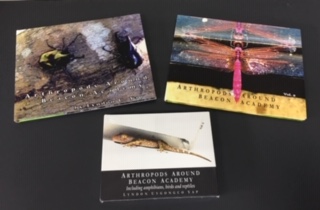
Collection Development: Arthropods Around Beacon Academy

As I was out of campus last week, I did not receive the books that one of our students donated to the library. Good thing my staff was present to acknowledge and to be at the donor's ceremony. Such an event is special and is honored in the community. Having written a book is a milestone and there are good reasons to celebrate it.

Arthropods Around Beacon Academy by Lyndon Yap
Through books, one's thinking is made visible. And by one I mean a collective, a group, a team who collaborated in making it. The library as its recipient or place for curation increases its worth and preserves the creators' knowledge and skill. In a library, the authors and his or her partners find an audience who engages with them. In the process, the cycle of creation continues and more knowledge is added up to the existing status quo.

Arthropods Around Beacon Academy is written by Lyndon Yap, grade 12, nature enthusiast and photographer. The three volume series began as a passion project which Lyndon started in grade 10. Through the Personal Project, he was guided and mentored by his supervisor in creating a field guide as requirement for the completion of his Middle Years Program certificate. He was really dedicated on the book project and because he was doing a project of interest, he was able to finish it in time - something many young researchers are challenged to do.

 He continued on. Documenting. Recording. Taking pictures of the insects, reptiles and birds he sees around school. He did research as well and even interviewed an Ichthyologist to determine the validity of his own studies. Last year, he finished volume 2 and this year, volume 3 of the series.

Now, the library is a proud owner of his Personal Project and Creativity Action and Service outputs. The library is indeed a growing organism!

Wednesday, January 30, 2019

Library Bulletin Board: We Are All Fish!


We set up our library bulletin board this month and we stay true to our themes of inclusion, diversity and empathy.


Our table's book spread offers recommendation for readers. Two of the books displayed were already borrowed. Yay!


There are some missing fishes though. Well, there will always be outliers. Now, we are off to find Nemo!

Friday, January 18, 2019

Christmas Reading Passport 2018

In December 2018, I launched the library's annual Christmas Reading Passport.There were four students who availed of the passport. Three came back completely filled out. Hurrah!


Monday, November 5, 2018

Book Reviews: The Demon Haunted World and Other Books on Disciplined Thinking

For the month of October, we sent this out to the community: a list of new titles and recommended books with my reviews.


A recommended title from the list is Carl Sagan's The Demon Haunted World (Ballantine Books, 1996). Sagan encourages the reader to make intelligent and informed decisions by turning to logic, reason and scientific research. His essays reflect his joy of debunking myths and pseudoscience with scientific explanations from years of  disciplined thinking across subject areas. On the one hand, he admits the limitations of scientific thought by saying that "it cannot advocate courses of human action but it can illuminate possible consequences of alternative  courses of action" (page 27). He weighs in scientific thinking with discipline and imagination positioning that both are essential to its successful application in the arts, mathematics, sciences and humanities.


Interestingly, this list of new acquisitions include Michael Michalko's ThinkerToys (Ten Speed Press, 2006) where the reader can access and acquire a host of creative thinking exercises and how it can push him/her to critical analysis; and then, there is the book Little Quick Fix: Research Question (Sage, 2018) by Zina O'Leary, emphasising the decision making skills that can be learned when preparing and identifying sources, reading them, documenting information and how a well crafted research question can lend focus and direction to students working on his/her academic paper.


Visit the blog for more book reviews and my sharing of wonderful titles in our library's collection!

Thursday, September 13, 2018

Library Treasure Hunt 2018

Two weeks ago, I had a library treasure hunt with our grade 9s. This is already in the running for three years with the help of the Comparative Religions (CRe) teacher. We have made improvements since then. Sharing with you my reflections on the experience.

1. The session was a good follow up to the library orientation given to grade 9 students during Foundation Week. They had hands-on activities on the use of the OPAC and the three IB recommended databases that we are subscribed to. Each form of media was introduced as access to sources and information. I also mentioned that their academic integrity increases when they use library resources because these are selected based on reviews and recommendations from teachers who are knowledgeable of the IB and DepEd curriculum. 

2. Students had hands-on activities on the use of search terms(keyword) and Boolean strategy on the databases, OPAC and different search engines. They were asked to evaluate Google with another search engine based on three criteria, namely design, navigation and search engine results page. Unlike the two search strategies, this was not further discussed during the session when we talked about their answers.

3. Citation exercises were provided to students using web apps and citation builders. During the second session, the five fundamental bibliographic data were introduced: author, title, publisher, place of publication, copyright/year of publication, plus, format (print, digital, etc.) as key elements of a citation. The students were given books to locate these information. These books were all taken from 200-299 division of the General Collection. In library work, these five plus one data are a librarian's basis for OPVL. It leads a librarian to pursue further questions on the document's origin, history and relevance.

I think, what's good about this experience is the provision for schema development and activation, and priming of skills. Before doing research on a CRe topic, students were given an experience of the library as a learning environment where formal and non-formal instruction on research and IL skills happen. As a librarian, I am part of the students' learning journey. I am a partner and "sidekick" to the teacher who plans her lessons and sets out to deliver the learning objectives. 

Going back to two years ago, the English teacher asked me to do a session on search strategies and narrowing of topics for her grade 9 English class. We did mind mapping, keyword and Boolean searching. I was able to re-introduce our subscriptions as well as other media formats like maps, photos, paintings, kits, games posters, infographics, podcasts and the like as sources of information. It was only in passing that I told the class that each media format needs a set criteria when evaluation its purpose and credibility and that, these sources can be used in specific topics, research question or academic task.

Here are links to related posts:
Related Posts Plugin for WordPress, Blogger...