 | ||
| Sis Zyra, Sis Zarah, Sis Lucy, Mother Superior Soledad, Sis May and Sis Jang |
Friday, November 30, 2012
Librarian as Nun


Alfred, Ambeth and Andres Bonifacio
30 November is a national holiday being the commemoration of Andres Bonifacio's 149th birth date. A bio pic, Supremo, produced by Alfred Vargas will be shown on 30 November at SM Fairview cinemas. The same movie is included in the line-up of indie films in this year's Cinemanila at Bonifacio Global City, Taguig. Festival date begins on 5 December and ends on 11 December, 2012.
Here's the trailer of the movie.
Producer, Alfred Vargas, also plays Andres Bonifacio. He's a very good looking Andres Bonifacio, if you ask me. In the book cover of Prof. Ambeth Ocampo's Looking Back 5: Rizal's Teeth Bonifacio's Bones, the Great Plebeian looks more like Apeng Daldal than a handsome revolutionario. I grew up knowing and recognizing this artist's rendition of Bonifacio that littered many history textbooks I used in school.
Who is the artist of this Bonifacio illustration? Another iconic image I am curious about that's related to Bonifacio is the cedula ripping one where Katipuneros wear red pants and white shirt. The red pants is a dead giveaway in battle. Why use the ominous color? More questions surface as I read Prof. Ocampo's article on Bonifacio. He was home schooled and read voraciously. Where did he get his books? Gifts from friends? Donations? Is Bonifacio a book thief? Now that would make a good story in speculative fiction genre, ano? The librarian in me wonders. The writer in me is tempted to begin this story out and see how it develops.
In 2013, the nation celebrates Bonifacio's 150th birth year. PBBY's Salanga Prize will be given to a story on Andres Bonifacio come July as we celebrate the 30th National Children's Book Day. Let's prepare early for this historic event.
Here's the trailer of the movie.
Producer, Alfred Vargas, also plays Andres Bonifacio. He's a very good looking Andres Bonifacio, if you ask me. In the book cover of Prof. Ambeth Ocampo's Looking Back 5: Rizal's Teeth Bonifacio's Bones, the Great Plebeian looks more like Apeng Daldal than a handsome revolutionario. I grew up knowing and recognizing this artist's rendition of Bonifacio that littered many history textbooks I used in school.
Who is the artist of this Bonifacio illustration? Another iconic image I am curious about that's related to Bonifacio is the cedula ripping one where Katipuneros wear red pants and white shirt. The red pants is a dead giveaway in battle. Why use the ominous color? More questions surface as I read Prof. Ocampo's article on Bonifacio. He was home schooled and read voraciously. Where did he get his books? Gifts from friends? Donations? Is Bonifacio a book thief? Now that would make a good story in speculative fiction genre, ano? The librarian in me wonders. The writer in me is tempted to begin this story out and see how it develops.
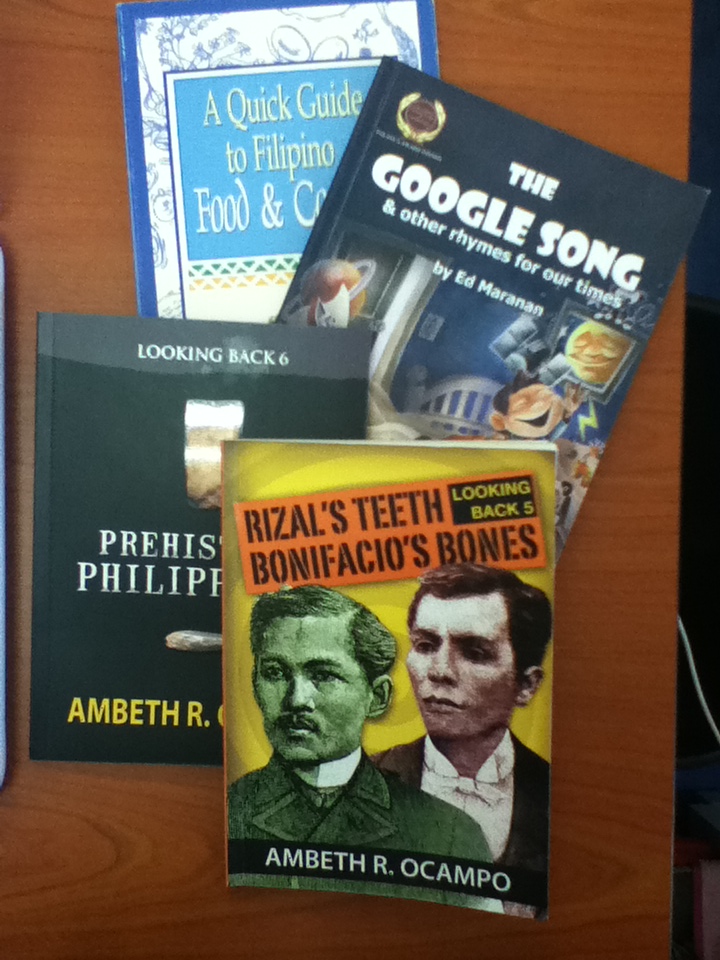 |
| Books bought from the NBDB initiated book exhibit at SM Megatrade Hall |
In 2013, the nation celebrates Bonifacio's 150th birth year. PBBY's Salanga Prize will be given to a story on Andres Bonifacio come July as we celebrate the 30th National Children's Book Day. Let's prepare early for this historic event.
Thursday, November 29, 2012
Wednesday, November 28, 2012
Q & A on Supplementary Materials in the Classroom
With permission from the interviewer, I'm posting the set of questions she sent and my answers.
1. Why is it important for a teacher to use supplementary materials in the classroom?
Information and knowledge are not confined in textbooks. Supplementary materials (to me, it would mean teaching tools, instructional materials, AV teaching aids, etc.) offer a wide range of ideas, concepts, perspectives and ways of creating and communicating information and knowledge. Using supplementary materials challenges teachers and students to go beyond the prescribed curriculum. So, it's like putting into practice the learned concepts, skills and values in real life.
There are many sources of information and knowledge and these come in various formats. I think teachers need to continuously learn how to use these formats and media in teaching, as well as, identify effectively information and knowledge they can use in instruction.
You may look for this longitudinal study online, What Reading Does for the Mind by Anne E. Cunningham and Keith Stanovich, that discuss the effects of providing a variety of instructional materials (print, non-print, AV, online resources, social games, etc.) to students. One of the results is that, by exposing students to different learning and instructional resources would lead to the development of strong verbal and linguistic skills. Language is a cognitive process, so thinking skills are strengthened when teachers use many tools for teaching alongside sound pedagogy.
I use this research often in my talks among librarians to encourage them in building a collection that adheres to different learning styles and providing library services and programs to teachers that would challenge their pedagogical beliefs, assuming that, teachers still subscribe to old and routine methods.
2. What guidelines/criteria should a teacher follow in choosing which ones to use?
a. Knowledge of student/learner - Teachers must know who their students are. And they need help to be able to know them - parents, guidance counselor, school leaders. It takes a village to raise a child, so goes the African proverb.
b. Curriculum and context of the learning community - This will help the teacher, and those helping him/her teach well, get in touch with internal resources and external ones.
c. Pedagogy - There are specific instructional aids and teaching tools that match a particular teaching approach, technique, method and strategy.
3. What are the today's limitations to your choices of supplementary materials available today in your subject area?
As a school librarian, budgetary constraint is a limitation. To remedy this problem, I source out from outer libraries in the academe, public, corporate and government agencies. Interlibrary loan and library consortia are ways to fill the resource gap as well. There are many online resources, but students need models and guides to use them responsibly and effectively. I still feel that, we need more print materials in the mother tongue and local knowledge. For example, our school is in Binan, Laguna. I am building a Filipiniana collection, but I feel I need to start developing a collection that has info and knowledge on Binan as a city and Laguna as a province. Our school may be an IB World School, but global education and international mindedness begin with an understanding of local history and local knowledge. The issues and problems that affect the world are the same in the local and national levels.
This would mean, I need to develop a strategy to start a library collection that touches on these concerns. By collection I mean physical, virtual and intellectual kinds.
4. What are your particular favorites among supplementary materials you have used?
Print format - I like recommending to teachers good fiction that has the theme of their unit of study. I also suggest creative non-fiction to ease big concepts in the content areas. Literature mirrors life :-)
Online formats - EBSCO and Project Muse are current favorites
I'm using Prezi for my presentations in class. I think I'll be a Mac user forever because the apps and ease of use that it offers is just right for a busy person like me.
1. Why is it important for a teacher to use supplementary materials in the classroom?
Information and knowledge are not confined in textbooks. Supplementary materials (to me, it would mean teaching tools, instructional materials, AV teaching aids, etc.) offer a wide range of ideas, concepts, perspectives and ways of creating and communicating information and knowledge. Using supplementary materials challenges teachers and students to go beyond the prescribed curriculum. So, it's like putting into practice the learned concepts, skills and values in real life.
There are many sources of information and knowledge and these come in various formats. I think teachers need to continuously learn how to use these formats and media in teaching, as well as, identify effectively information and knowledge they can use in instruction.
You may look for this longitudinal study online, What Reading Does for the Mind by Anne E. Cunningham and Keith Stanovich, that discuss the effects of providing a variety of instructional materials (print, non-print, AV, online resources, social games, etc.) to students. One of the results is that, by exposing students to different learning and instructional resources would lead to the development of strong verbal and linguistic skills. Language is a cognitive process, so thinking skills are strengthened when teachers use many tools for teaching alongside sound pedagogy.
I use this research often in my talks among librarians to encourage them in building a collection that adheres to different learning styles and providing library services and programs to teachers that would challenge their pedagogical beliefs, assuming that, teachers still subscribe to old and routine methods.
2. What guidelines/criteria should a teacher follow in choosing which ones to use?
a. Knowledge of student/learner - Teachers must know who their students are. And they need help to be able to know them - parents, guidance counselor, school leaders. It takes a village to raise a child, so goes the African proverb.
b. Curriculum and context of the learning community - This will help the teacher, and those helping him/her teach well, get in touch with internal resources and external ones.
c. Pedagogy - There are specific instructional aids and teaching tools that match a particular teaching approach, technique, method and strategy.
3. What are the today's limitations to your choices of supplementary materials available today in your subject area?
As a school librarian, budgetary constraint is a limitation. To remedy this problem, I source out from outer libraries in the academe, public, corporate and government agencies. Interlibrary loan and library consortia are ways to fill the resource gap as well. There are many online resources, but students need models and guides to use them responsibly and effectively. I still feel that, we need more print materials in the mother tongue and local knowledge. For example, our school is in Binan, Laguna. I am building a Filipiniana collection, but I feel I need to start developing a collection that has info and knowledge on Binan as a city and Laguna as a province. Our school may be an IB World School, but global education and international mindedness begin with an understanding of local history and local knowledge. The issues and problems that affect the world are the same in the local and national levels.
This would mean, I need to develop a strategy to start a library collection that touches on these concerns. By collection I mean physical, virtual and intellectual kinds.
4. What are your particular favorites among supplementary materials you have used?
Print format - I like recommending to teachers good fiction that has the theme of their unit of study. I also suggest creative non-fiction to ease big concepts in the content areas. Literature mirrors life :-)
Online formats - EBSCO and Project Muse are current favorites
I'm using Prezi for my presentations in class. I think I'll be a Mac user forever because the apps and ease of use that it offers is just right for a busy person like me.
Monday, November 26, 2012
Preview of a New Book Project
 |
| Ink studies by Bernadette Solina Wolf |
 |
| The same illustration in water color |
Friday, November 23, 2012
Online Readings: Curiosity and Teaching with Technology
Did you ask a good question today? This idea may be the only sure way to educational reform, so "they" say. Read Curiosity Here There Everywhere
Connect. Create. Explore. Steps to global education begin with connectedness Global Connections.
Sound pedagogy, admin support and a strong IT backbone remain the awesome threesome in successfully integrating tech in instruction. Be a 21st century teacher by being a 21st century learner
Happy reading! Happy weekend!
Connect. Create. Explore. Steps to global education begin with connectedness Global Connections.
Sound pedagogy, admin support and a strong IT backbone remain the awesome threesome in successfully integrating tech in instruction. Be a 21st century teacher by being a 21st century learner
Happy reading! Happy weekend!
Thursday, November 22, 2012
The Story of Our Libs
Nothing thrills me more than to hear news of younger librarians carrying on the storytelling torch for others to follow the path, or better yet, pave new roads for more librarians to conduct regular storytelling sessions in their learning communities. Ann Grace Bansig and Darrel Manuel Marco, school librarians of De La Salle Santiago Zobel, will be conducting a storytelling workshop on December 8, 2012 at the Quezon City Public Library.
Details in this poster below:

Details in this poster below:

Quality Books Exhibit
I got an invitation from the National Book Development Board via email --
I got the invite from the chair of the NBDB herself so I feel compelled to go. I'll think I shall enjoy myself.
DepEd and NBDB Set Quality Books Exhibit--open to everyone, no entrance nor registration fees.
In celebration of Philippine Book Development Month, the Department of Education and the National Book Development Board are holding a first-ever exhibition of Highly Recommended Supplementary Materials on Nov 27-28 at 10am -5pm at the Mega Trade Hall 1. SM Megamall. The exhibiton will feature about 1600 awardwinning book titles and other books endorsed by the NBDB. About 20 publishers are participating.
These were gathered from the National Book Award winners and finalists, National Children's Book Awards, Gintong Aklat Award winners and finalists, Madrigal-Gonzalez First Book Award winners, Carlos Palanca Memorial Award winners, MAN Asia Literary Prize Filipino winners and finalists, NBDB Quality Seal Textbooks, and Highly Recommended Books selected by the Metrobank Foundation Network of Outstanding Teachers and Educators (NOTED). Copies of the list of quality books which will be updated yearly will be available.
The event is meant to help teachers and administrators from both public and private schools in selecting Philippine titles for supplementary reading and library collections. There will also be lectures on Textbook Development in the Mother Tongue, Translating Textbooks, Teaching with a Local Cultural Perspective, and Choosing Supplementary Materials and other related topics. National Artist Virgilio Almario leads the roster of speakers. DepEd will be represented by Sec. Armin Luistro and Usec Francis Varela.All are welcome to attend. The exhibit and the workshops are free of charge.
I got the invite from the chair of the NBDB herself so I feel compelled to go. I'll think I shall enjoy myself.
Wednesday, November 21, 2012
An Early Christmas Gift to Self
 |
| Monkey and Turtle by Bernadette Solina Wolf |
And, for an early celebration of the 30th National Children's Book Day (July 2013).
Reading Choices
 |
| Browsing the books on display |
I am patient. What I can do for them now is to provide them with the reading materials and a literacy rich environment. This is not easy but, it is included in the word, parenting.
Their school had a book fair recently. What an opportune time to exercise this choice of reading, and yes, buying. So, after both kids asked of their book budget they set off to the rows and rows of books displayed by National Bookstore.
At the book fair, they met classmates and friends who were there for the book party. I also met my kids' high school librarian, Mr. Marlon Salinas, who invited me last week for a talk and mini-workshop on Creative Writing with grades 9 and 10. More on that next post.
 |
| With HS Librarian, Mr. Marlon Salinas |
Nico picked up Rick Riordan's Percy Jackson and The Olympians: The Lightning Thief, while Zoe bought two activity books on puzzles. Last night, Nico told me, "Ma, the book is better than the movie."
Of course. It has always been that way.
Thursday, November 15, 2012
A Start Up Bibliotherapy Collection

I visited the Adamson University Library last month and, lo and behold, discovered their Bibliotherapy Collection. This shelf has books on self help, Psychology and Philosophy. There are fiction books as well that carry themes of personal success and struggles.
Reading the poster attached on the shelf, I suppose the collection is a spring board for readers to explore more books. This way, readers are invited to engage in ideas and information that will lead them to a deeper understanding of life and, as the poster puts it, to cultivate a culture of research.
I pulled out one book. Coelho's By the River Piedra I Sat Down and Wept is a favorite. The piece of paper that's inserted in the book happens to be a feedback and response form. The reader fills this out and submits this to the librarian. For doing this, the reader has a chance on winning a prize.

Browsing the book I came upon the page where a line goes "To fall in love is risky..." Written beside it, in blue ink is the word: SOBRA. In English, the word means, too much.
Tuesday, November 13, 2012
Monday, November 12, 2012
Citing of Sources and In-Text Citations
Information Literacy Session: Citing Sources and In-Text Citations
Grade 11 TOK (Theory of Knowledge)
Schedule:
15 November - TOK Class A
16 November - TOK Class B
*Both 1st periods
What idea do I want the 11s to bring with them after the session:
Avoid plagiarism by citing your sources and citing in-text
What IL skill do I want the 11s to apply across subject areas: Engagement and extraction of relevant information from sources (read, listen, view, take notes, reflect, summarize)
Procedure (for Teacher Librarian to do):
1. Present IL topics: Citations and In-Text Citation
2. For students: Generate as many questions as you can about the topic. Focus on what you want to know about the topics.
3. Show Cite is Right video - http://www.youtube.com/watch_popup?v=pSQH9OTOLBs
4. Game: Plagiarism Quiz - http://library.camden.rutgers.edu/EducationalModule/Plagiarism/plagiarism_quiz.swf
5. Go back to the questions generated by students at the start of class and check if these questions were answered by the activity they just finished doing (video and game).
6. Put on parking lot unanswered questions.
7. Short lecture on in-text citation: Ten Things to Remember when Citing In-Text (from MLA Handbook)
8. Show samples of in-text citations.
9. Distribute handout on in-text citation.
10. Go back to parking lot and check for questions that were answered through the short lecture
Instructional Materials:
MacBook / LCD / post its / Parking Lot photo / In-Text Citation Handout
References:
Cite is Right Video - http://www.youtube.com/watch_popup?v=pSQH9OTOLBs
Plagiarism Quiz - http://library.camden.rutgers.edu/EducationalModule/Plagiarism/plagiarism_quiz.swf
The Modern Language Association. MLA handbook for writers of research papers. New York: MLA, 2009.
Prepared by Zarah C. Gagatiga / Teacher Librarian 8 November 2012
Grade 11 TOK (Theory of Knowledge)
Schedule:
15 November - TOK Class A
16 November - TOK Class B
*Both 1st periods
What idea do I want the 11s to bring with them after the session:
Avoid plagiarism by citing your sources and citing in-text
What IL skill do I want the 11s to apply across subject areas: Engagement and extraction of relevant information from sources (read, listen, view, take notes, reflect, summarize)
Procedure (for Teacher Librarian to do):
1. Present IL topics: Citations and In-Text Citation
2. For students: Generate as many questions as you can about the topic. Focus on what you want to know about the topics.
3. Show Cite is Right video - http://www.youtube.com/watch_popup?v=pSQH9OTOLBs
4. Game: Plagiarism Quiz - http://library.camden.rutgers.edu/EducationalModule/Plagiarism/plagiarism_quiz.swf
5. Go back to the questions generated by students at the start of class and check if these questions were answered by the activity they just finished doing (video and game).
6. Put on parking lot unanswered questions.
7. Short lecture on in-text citation: Ten Things to Remember when Citing In-Text (from MLA Handbook)
8. Show samples of in-text citations.
9. Distribute handout on in-text citation.
10. Go back to parking lot and check for questions that were answered through the short lecture
Instructional Materials:
MacBook / LCD / post its / Parking Lot photo / In-Text Citation Handout
References:
Cite is Right Video - http://www.youtube.com/watch_popup?v=pSQH9OTOLBs
Plagiarism Quiz - http://library.camden.rutgers.edu/EducationalModule/Plagiarism/plagiarism_quiz.swf
The Modern Language Association. MLA handbook for writers of research papers. New York: MLA, 2009.
Prepared by Zarah C. Gagatiga / Teacher Librarian 8 November 2012
Sunday, November 11, 2012
Saturday, November 10, 2012
Library Display: The Reading Table

Apart from sending recommended reads to the school community, I set up a table by the circulation counter. This table has selected readings from the Teacher Resource collection. Book covers have a special appeal. Then again, never judge the book by its cover thus, the annotated list of suggested good readings for the term.
Another book display I worked on last term was the graphic novels table. The low table in the reading area where couches for easy reading are stationed has graphic novels splayed over it. Twice a month, the graphic novels are replaced by newer ones or those up on the shelf. Students read them at the library. And yes, they borrow the graphic novels too.

Friday, November 9, 2012
Take Time to Read
Teachers will always say they have no time to read. Some alibi, right?
I'd rather take the excuse, so many books, so little time to read because it means that the interest to read is present in the person saying so. We are in a day and age when reading, like library use, needs promotion.
Promote reading by creating interactive library bulletin boards and displays. Use Twitter and FB to post quick reading responses on books read. Regularly send out short but substantial emails to the faculty of new titles and recommended reads. Below are five titles from our library's Teacher Resources.
1. Why the Universe is the Way it Is? by Hugh Ross - examines the complexities of the universe and ties them with the Scriptures. More philosophy than physics, it would lead readers to reflect on the purpose of humanity.
2.The Excellent 11: Qualities Teachers and Parents Use to Motivate, Inspire and Educate Chidlren by Ron Clark - is intended to inspire teachers, parents and allied professionals who work with children. Eleven stories that speak of the essential 11s are featured in the book.
3. Positive Discipline: A Teacher's A-Z Guide - The title says it all :-)
4. Thinking Fast and Slow by Daniel Kahneman - Our brains are capable to do both kids of thinking as identified by Kahneman, but when to use fast thinking and slow thinking is the highlight of the book.
5. A New Culture of Learning by Douglas Thomas - a book on educational technology for today's teacher on instructing and facilitating learning to the net generation.
Thursday, November 8, 2012
Ebook Collection Development for School Libraries
Before jumping on the ebook bandwagon, think things over and draft a strategy for developing an ebook collection for your school library. I am sharing what I've whipped up for starting out an ebook collection in the library.
Why an ebook collection?
1. Experiment on a new business model in acquiring digital content for the library that adheres to a required budget allocation.
2. Offer new services to a market that is young, fickle, media induced and tech savvy.
3. Expand the library’s collection, thereby, addressing the clamor on information access for all and at all times (as possible).
What to consider?
1. License agreement containing terms and agreement, restrictions and scope of access.
2. Business model may be by lease or perpetual access.
3. Fees/budget may vary according to choice of business models: one book/one user, subscription, multi-user, simultaneous unlimited use, print on demand, pay per use.
4. Purchase by consortia. Plus: increase buying power. Minus: libraries have different needs
5. Evaluate vendors and analyze cost, especially among and between vendors
Ebook vendors / Third party solution:
FolletShelf - http://www.aboutfollettebooks.com/follettshelf.cfm
EBSCO - http://www.ebscohost.com/ebooks/schools
OverDrive - http://www.overdrive.com/Solutions/Schools/K12/SDL/
Project Muse - http://muse.jhu.edu/#3
* FolletShelf and EBSCO can provide demos. With the changing landscape in epublishing and new business models that publishers implement, it is good to request for demos as needed. Schedules of demo are indicated in the websites.
* Project Muse orders on ebooks can be made but, license agreement must be checked and referred to for further study and evaluation.
* Tech requirements for ebook access via ereaders ℅ Tech Dept. and Finance (purchase and insurance matters).
* Ereaders (Kindle/iPad) can be used as storage devices for ebooks. Allot one ereader for a collection: References, General Collection, Fiction and Teachers Resources
* Explore other means of developing a digital collection: file server where pdfs can be saved, organized and retrieved / Google Docs as database for pdfs / collection of web resources.
* Draft a set of rules and guidelines for ereaders use / ebook selection and purchase must be reflected in the collection development program and policy.
Wednesday, November 7, 2012
IFLA 2013: Call for Posters on Intergenerational Literacy
WORLD LIBRARY AND INFORMATION CONGRESS:
79th IFLA General Conference and Council: Future libraries: Infinite Possibilities
Singapore, August 17-23, 2013
CALL FOR PROPOSALS
Programme: Intergenerational Literacies: textotechno
The IFLA Literacy and Reading and Information Literacy Sections are seeking proposals for a joint programme to be held at the IFLA Conference in Singapore in August 2013.
The challenge of new information and learning landscape can lead to all sorts of information gaps. One of them is a gap between texto and techno generations which can cause intergenerational isolation and separation. The program will showcase innovative and effective library programmes that intend to bridge this gap.
Proposals are requested for as many as ten tabletop presentations which will be given simultaneously. After an opening plenary keynote address, audience members will rotate to three different fifteen-minute presentations of their choice. Presenters will therefore be asked to repeat their presentation three times for three different sets of people.
Proposals chosen for presentation will be specific about how libraries and/or associations have tackled issues related to texto and techno literacies in their particular setting, thus developing intergenerational literacies, dialogue, digital inclusion and social cohesion. They should be grounded in theory, research, and/or practical applications. Because these projects will be presented in an informal, small group setting, speakers should plan some visual accompaniment such as a poster that can be set up on the table. Presenters may also want to bring brochures or flyers to hand out. People submitting successful proposals will be asked to write a brief paper summarizing their library programme or project for publication in the IFLA Proceedings. All chosen presenters will be listed in the official Conference programme.
Proposals in English are required, and should provide the following information:
Name and institution of speaker(s)
Brief biographical information
Proposal title
Brief (300 to 500 word) description of project and presentation format
Language of presentation
Proposals should be sent to Elena Corradini (Secretary of the Literacy and Reading Section) at HYPERLINK "mailto:ecorradini67@gmail.com"ecorradini67@gmail.com by November 30, 2012. Please indicate "IFLA Proposal WLIC 2013" on the subject line. Finalists will be notified by December 15, 2012, and will be expected to submit final versions of their papers in one of the official IFLA languages by May 15, 2013.
For more information, please contact Leikny Haga Indergaard (Chair of Literacy and Reading Section) at: HYPERLINK "mailto:Leikny.Indergaard@bergen.kommune.no"Leikny.Indergaard@bergen.kommune.no
Please note that it is the speakers’ responsibility to find funding for their participation.
79th IFLA General Conference and Council: Future libraries: Infinite Possibilities
Singapore, August 17-23, 2013
CALL FOR PROPOSALS
Programme: Intergenerational Literacies: textotechno
The IFLA Literacy and Reading and Information Literacy Sections are seeking proposals for a joint programme to be held at the IFLA Conference in Singapore in August 2013.
The challenge of new information and learning landscape can lead to all sorts of information gaps. One of them is a gap between texto and techno generations which can cause intergenerational isolation and separation. The program will showcase innovative and effective library programmes that intend to bridge this gap.
Proposals are requested for as many as ten tabletop presentations which will be given simultaneously. After an opening plenary keynote address, audience members will rotate to three different fifteen-minute presentations of their choice. Presenters will therefore be asked to repeat their presentation three times for three different sets of people.
Proposals chosen for presentation will be specific about how libraries and/or associations have tackled issues related to texto and techno literacies in their particular setting, thus developing intergenerational literacies, dialogue, digital inclusion and social cohesion. They should be grounded in theory, research, and/or practical applications. Because these projects will be presented in an informal, small group setting, speakers should plan some visual accompaniment such as a poster that can be set up on the table. Presenters may also want to bring brochures or flyers to hand out. People submitting successful proposals will be asked to write a brief paper summarizing their library programme or project for publication in the IFLA Proceedings. All chosen presenters will be listed in the official Conference programme.
Proposals in English are required, and should provide the following information:
Name and institution of speaker(s)
Brief biographical information
Proposal title
Brief (300 to 500 word) description of project and presentation format
Language of presentation
Proposals should be sent to Elena Corradini (Secretary of the Literacy and Reading Section) at HYPERLINK "mailto:ecorradini67@gmail.com"ecorradini67@gmail.com by November 30, 2012. Please indicate "IFLA Proposal WLIC 2013" on the subject line. Finalists will be notified by December 15, 2012, and will be expected to submit final versions of their papers in one of the official IFLA languages by May 15, 2013.
For more information, please contact Leikny Haga Indergaard (Chair of Literacy and Reading Section) at: HYPERLINK "mailto:Leikny.Indergaard@bergen.kommune.no"Leikny.Indergaard@bergen.kommune.no
Please note that it is the speakers’ responsibility to find funding for their participation.
Tuesday, November 6, 2012
Trese 5 Book Tour
 |
| Trese 5 is part of the Trese series by Budjette Tan and Kajo Baldisimo published by Visprint. |

Photo source: http://www.facebook.com/TreseComics
Subscribe to:
Posts (Atom)
