Showing posts with label educational technology. Show all posts

Tuesday, February 23, 2021

The Lighthouse Diary Entry #27: Academic Integrity and Turnitin

I attended a webinar yesterday morning. Yes, another webinar. The local distributor of Turnitin, APAC Marketing organized a 2 hour webinar on Academic Integrity at the heart of teaching and learning processes. There is less talk of the Turnitin app and more of practices in teaching and learning. 

One takeaway I have from the webinar is the 70-30 approach in online distance learning. This means, 70% is allotted for asynchronous learning and 30% for synchronous learning. This may imply that the design of instruction for asynchronous learning will lean towards student agency, engagement and independent learning. Skills teaching is paramount. Synchronous learning would entail follow up, following through, tutorial type sessions, show and model strategies. Concepts and content, especially those that cover a prescribed curriculum may need to be revisited.

I appreciated the input session of Dr. Michael Dino on Academic Integrity. I was holistic, historical and culturally relevant to our teaching practices. The live online forum that followed right after the product demo of Gradescope was engaging. Gradescope helps teachers manage and administer grades and assessments. Pegged as easy to use, it generates data that may help inform teachers on skills and concepts that have been learned and would need improvement on.

During the open forum, there were many questions about plagiarism and citations. I had to involve myself on this topic. I just cannot. So, I gave some suggestions on citation processes and the necessity of following a citation format to guide students and researchers in the responsible use of information and varied media formats.

This led me to another insight on Academic Integrity. It is about relationships. Knowing the learner, first of all, and the teacher recognizing and seeing himself or herself as a learner too, are factors to building a caring and respectful relationship necessary for learning honestly and with integrity.

Turnitin is neat app to detect plagiarism, thereby upholding Academic Integrity. But at the end of the day, it is a tool. We need to make these tools work for our advantage and not the other way around.

Saturday, July 4, 2020

Teacher on Center Stage: Francis Jim Tuscano (2 of 2)

Here is part 2 of the interview with Francis Jim Tuscano. He has five tips for teachers and school leaders who are moving into the new normal in the field of education.

2. There seems to be a mad scramble to get things in order, to be ready and to transition to Blended Learning. What are five important key concepts that school leaders and teachers need to be aware of when applying the BL approach?

So, to answer this, I just want to make a clarification. Blended learning approach can be understood in two ways: first, as an instructional approach where there is a combination of face-to-face learning and independent use of technology in the classroom (physical); and second as a modality to deliver remote learning, which means that there are certain days when students and teachers are in the physical classroom and the rest of the days of the week are meant for home-based (online or print-based) distance learning. 

I certainly believe that blended learning might be the new normal. We think of this as when teachers and students are now flexible enough and possess adaptability skills to switch from one mode of learning to another, especially when new waves of pandemic arise that can cause prolonged school closures. To enable this, I have the following main principles for blended learning:

a. Ensure equitable access to learning devices and Internet among students and teachers. Adoption of Edtech should always be anchored on the idea of equity so that everyone gets to enjoy and reap the benefits of tech integration. To do this, understand the context of students and teachers, whether they have learning devices or reliable internet connection at home. 

b. Prepare the students and teachers. Teachers will need to learn new digital skills to teach with technology. There should be relevant and meaningful professional development to ensure that they are well equipped to design, implement, and sustain a class with Edtech integration. We also need to make sure that the student are equipped with enough digital skills to navigate an online learning environment. Orienting them as well as teaching them with the needed ICT skills can greatly help. For parents of young students, involving parents is important so that they can extend guidance and support for their children in using technology tools

c. Sound pedagogy before technology as the main principle in designing learning experiences. Teachers should anchor pedagogy on student-centered or student-driven learning. The use of technology should enable or support the achievement of the learning goals. Educators should not design a learning experience around a technology. 

d. Digital citizenship matters more that ever because students are now moving in an online learning environment. Students must be taught how to safeguard themselves from digital threats such as cyberbullying, digital identity theft, and many more. Moreover digital citizenship also reminds students to practice self-discipline and control as they balance the use of technology for studying, leisure, entertainment, or even family connection. Schools must always ensure that there is a digital citizenship program that teachers and students can implement and follow.

3. What should classroom teachers look out for on the first day of school under the the ”new normal”?

Before starting any academic activity or learning experience, I would recommend that teachers get to know their students first so that they can start building an online community. Build a sense of trust and belonging with students. Build class routines and “rituals” that would make students feel comfortable and familiar with one another. It really matters that teachers understand the context of their students even before starting their class. 


4. What keeps Jim Tuscano awake at night? 

Right now, I will not deny that I am undergoing and experiencing episodes of anxiety due to the pandemic. I think of work to be done while at home, but I also fear for my safety and of my family’s well-being, too. So, it is challenging to focus but I try to acknowledge these challenges so that I can better face them. I take time breath and rest so I can also recharge myself. But I am also excited to see how things would unravel in the are of education as well as think of how I can continue contributing to the bigger education system. 

Jim Tuscano is the host of empowerED, an online show that talks about matters pertaining to teaching and learning in this day and age. To quote from the FB Page, empowerED seeks to elevate the teaching profession, celebrate the Filipino teacher, and guide teachers to become agents of change. More specifically, empowerED aims to: Provide relevant professional learning opportunities that focus on teaching skill development and well-being Share inspiring stories of the most innovative and dedicated teacher to the world Guide teachers in designing sustainable education projects for the school, community, and society. 

To know more about empowerED, go here: https://www.facebook.com/empowerEDwithJimTuscano

Thursday, July 2, 2020

Teacher on Center Stage: Francis Jim Tuscano (1 of 2)

Francis Jim Tuscano is an EdTech advocate too!
The blog is glad to have this interview with Global Teacher and Distinguished Apple Educator, Francis Jim Tuscano. He talks about technology in education, makes a distinction on Blended Learning as approach and modality, and shares strategies for teachers who will be teaching remotely in this coming school year.

1. All of a sudden, Educational Technology and Instructional Design are thrown into the forefront of education. What do you think of this phenomenon given the circumstances and how is PH education responding to the change and challenges in teaching and instruction?

What’s happening right now is definitely and undeniably accelerating the adoption of technology in teaching and learning. Before the pandemic, a lot of schools did not see Edtech as a priority because we have never imagined the possibility of school closures that will not allow face to face teaching and learning. It was a very remote scenario that a lot of us never considered in our wildest dreams. But unfortunately, we are in a public health emergency right now and distance education or remote learning is the only viable option to continue learning and teaching, aside from homeschooling. The accelerated adoption is so obvious right now as seen in the rapid adoption and purchase of learning management systems and the rise of webinar workshops or talks on technology integration. 

Personally, I am excited with this because people now realise the importance of technology, its possibilities in elevating or raising the bar of learning. For now, my fear is that schools and educators overlook their core reason for adoption. I mean, right now, the core reason is to answer the negative effects of the pandemic but that can be very short-sighted. I hope that despite the quick transition that is happening in many schools right now, they see, invest, and hope to sustain with a long-term vision. It is not something that you invest now and then terminate once the pandemic ends. The investment on infrastructures, devices, and professional development of teachers cost much, so it is important that school leaders are able envision technology and embed it naturally in their vision and mission as a school community. They should have a bigger why that will guide their tech adoption even beyond the pandemic. 

In terms of its adoption then, the current situation in the Philippine education system show us the haves and have nots, the digital divide which has been present before. The pandemic has just made it more obvious and this is the case in a lot of countries. So, we are again playing catch up, accelerating things, racing against time to put more devices in the hands of teachers, partnering with local government units for donations of devices to students who do not have access, and training teachers to learn more ICT skills. There was a big misconception that online learning was the way to go and I would like to temper this. 

Despite being an advocate for Edtech, I always cautioned educators and school leaders to be more careful in making decisions regarding Edtech or online learning adoption. While we want to push the agenda for better ICT access and infrastructure in the country, such quick decisions right now puts families, parents, and students in a very difficult situation. Context of the learner should always be considered. If there is inequitable access, then do not at all adopt online distance learning. ICT or Edtech should always be a tools to bridge the gap in education, as envisioned by UNESCO. But, reality has shown us that it is a two-edge sword. It can bridge and widen the gap at the same time. In the end, we do not want Edtech adoption especially in school communities with equity issues to be the wall that bars students from accessing education. 

Wednesday, May 27, 2020

BA Library Online for the Month of March 2020

Since quarantine began, I have created links, directories and resources for our learning community in the Academy. Using Workplace, I regularly posts resources and helpful links there. I use the blog to compile them into an archive.

As the academic year draws to a close, here is a monthly listing of blog posts on online learning, tech integration and school library services in the time of COVID-19. This is culled from actual practice and may prove beneficial for further research and study on the role of libraries and the leadership roles of school librarians.

Learning in the Time of COVID-19 - from a Facebook post, I was able to generate opinions and "think-alouds" from practitioners in the field of educational technology and instructional design.

The School Library is a Vital Support System  - a reflection on the school library's vital role as support system and communicating to the learning community the commitment to serve in the time of COVID-19.

Google Classroom and Eric Curts - Tech tips and exert advice in using Google Suite.

The Flow and Structure of MOOCs - sharing a personal experience in participating in the 23 Mobile Things (2014). It is still a useful resource and example of an online learning module.

Reflective Teaching in the Time of COVID-19 - More reflections focusing on assessment, building relationships and connecting humanity with the use of technology for teaching and learning.

A Heart Map: An Online Bibliotherapy Session - An activity for mental health and well-being that children and adults can participate in.

Free eBooks and Audio Books - a list / directory of freebies

The Lighthouse Diary: An Ongoing Reflection on Remote and Online Learning - Thinking about professional practice never ends.

Wednesday, May 13, 2020

Pathfinder: Blended Learning


Pathfinder: EdTech, Instructional Design and Blended Learning
The BA Library received a request from the MYP Coordinator  on Blended Learning. We came up with a Pathfinder focusing on the topic and related subjects and disciplines.

The provision of curated content and the selection of sources for your class, learning resource packs, professional readings, personal growth and development are services that the BA Library facilitates. You can send your request for assistance via email (teacherlibrarian@beaconacademy.ph) or Workchat. I can also facilitate a one-on-one session for you or for your class if needed. Content curation involves skills in locating, accessing, organizing and documenting sources. It may come in handy when working on long essays and research projects.

BONUS information: EBSCOHost and World Book Online both have curation apps embedded in their portals and e-learning platforms.

Key words: blended learning, online learning, instructional design, educational technology, internet teaching

BA Library Resources
It is recommended that you begin your search using the BA Library’s databases and online subscriptions.

World Book Online (WBO) - www.worldbookonline.com
Username: *****
Password: *****
Articles in WBO are lexiled

Explora in EBSCO - http://search.ebscohost.com
Username: *****
Password: *****
Selected articles in Explora are lexiled

BA  Library Online Public Access Catalog - http://beaconacademylib.com/webopac/webopac.asp

Recommended Open Educational Resource: http://www.merlot.org
MERLOT (Multmedia Educational Resource for Learning and Online Teaching) – register an account and download articles on edTech, tech integration, create folders of resources for your own collection, link with other professionals and share resources. This is a good source and web channel to introduce the idea of a digital commons.

IN BROAD STROKES: theories, studies, research, approaches and strategies

What is Distance Education?
Defining distance education and the different forms of delivery (PDF)
by Maria Christina D. Padolina, UP Open University (UPOU)

Free Ebook on ELearning – with a chapter on Blended Learning

Key Issues in Instruction, Teacher Professional Development, and ICT in Basic Education edited by Dina Ocampo (Convenor) and Kathrina Lorraine Lucasan of the UP CIDS Education Research Program (ERP)

Helping Schools Transition Post-COVID19 Times by Ani Rosa Almario PhD and Reagan Austria https://drive.google.com/file/d/1uB47AOX-GV34o2eg7WM0Z_RSuXrE-n4E/view?usp=sharing

Teaching New Literacies – with discussions on the dual theory of the internet for teaching and learning, emerging roles of teachers, research based practice on Online Reciprocal Teaching and a recommended framework and rubric on TPACK, a teaching strategy for Online/Internet Reciprocal Teaching (this may prove helpful for Vic, Motie and Francia) https://teachnewliteracies.wordpress.com/what-are-new-literacies/

On Blended Learning
Fundamentals of Blended Learning by Education Elements (video) – defines what Blended Learning is, includes instructional models and the changing roles of teachers in a blended learning classroom. https://www.youtube.com/watch?v=3xMqJmMcME0&feature=youtu.be
TEDX: Monique Markoff presents different models of Blended Learning as gleaned from professional practice and provides emphasis on teaching and learning using technology. https://www.youtube.com/watch?v=3xMqJmMcME0&feature=youtu.be
Scholastic: Blended Learning 101 – Models and framework https://edublog.scholastic.com/post/blended-learning-101#

LEARNING FROM COLLEAGUES: Pinoy Teacher Techies and Instructional Tech Learning Communities
Francis Jim Tuscano’s empowerED- https://francisjimtuscano.com/
Galvin Radley Ngo (ADMU SALT) - https://twitter.com/galvinradleyngo

Wednesday, April 22, 2020

empowerEd Podcast Channel: "Global Voices: Pondering Over Education and the COVID-19 Pandemic,"

I just had an interview with Francis Jim Tuscano for an episode in his podcast channel, empowerED. The theme for this season is "Global Voices: Pondering Over Education and the COVID-19 Pandemic".  It aims to tell the stories of educators around the world at this time of the pandemic- challenges, hopes, and reflections. 

I am honored to be a guest in his podcast channel. This is my first podcast recording with a distinguished educator such as Mr. Tuscano. I first met him through a paper he wrote on integrating information technology and finally, shaking his hand and seeing him face to face last year in the Reading Association of the Philipines DemoFest and Mid-Year Conference in Iloilo. Our paths crossed in a field of discipline that I often traverse outside Library and Information Science. We also share the Xavier School experience since he is a faculty member and I, a former librarian in the Greenhills, San Juan campus. 


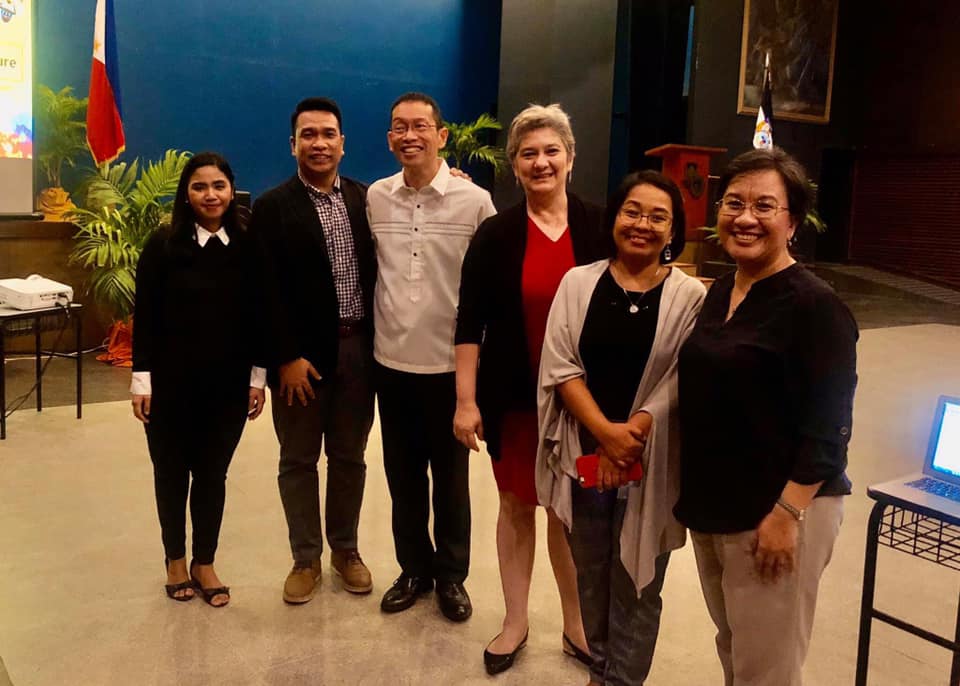
Jim Tuscano (second from left) with RAPpers in Iloilo City
Life is indeed strange and beautiful!

For the interview, Mr. Tuscano sent me these guide questions:


What challenges in terms of literacy are we seeing or anticipating at this time of school closure?
How can teachers continue to foster literacy despite school closure?How can the home help in ensuring that kids continue to love and appreciate reading?What have been the most important learnings that you got at this moment? 

I have notes as answers to his questions but the interview didn't turn out the way I thought it would - which is pretty cool. I will post my answers to the questions for the blog, but I do encourage you to visit Mr. Tuscano's podcast channel not just on the day of my interview, but right now. The ideas, insights and sharing of experiences among professionals and practitioners in the field of educational technology in empowerEd are awesome sauce. Also, issues on teaching and pedagogy are discussed. 

Follow these links  To know more about empowerED Podcast Channel, you may visit our channel on Apple Podcasts: https://apple.co/2kHX53u or Spotify: https://spoti.fi/2kEpabQ. Our empowerED Podcast is produced and distributed for FREE to educators globally. 

Friday, March 20, 2020

BA Library Online: Points for Reflection

And we survived a week of online learning. Yay!

Because we were able to pull through, below are the articles I shared to our faculty and support staff in school.

Teaching Through A Pandemic: A Mindset for This Moment by Stephen Merrill - I like this article because it keeps things real. Educators from countries that have closed their schools share their stories of coping, survival and keeping faith and hope alive in a time of uncertainty.

True Pedagogy  by Steve Wheeler  - a good read for when you need to reflect, review and re-examine teaching practices. Most of the time, we get  side tracked by the administrative work that goes along with teaching, the prescribed standards of the program as well as the required assessments. Revisiting the purpose for teaching helps in identifying effective processes old and new.

Tips in Instructional Design for Online Classes - the article begins with an emphasis on the alignment of content with learning objectives and assessment. Number 4 tip 
 is a discussion on Cognitive Loading reminding teachers of the importance of pacing, chunking and taking short pauses in between for rest and reflection.

From Nick Peachy, who offers more practical advice to teachers when teaching online.

Hardware and Software - this is all tech stuff and the gadgets you will need for online classes
6 Tips for Moving Your Class Online - the article has practical tips for setting up a work space at home to ensuring tech support

Friday, March 13, 2020

Learning in the Time of COVID-19: Where is Teaching in Online Learning?

As of writing, the World Health Organization (WHO) has declared that COVID-19 is a pandemic. Countries have locked down. Celebrities and public figures have been tested. Here in the Philippines we scramble for meaning amidst an incomprehensible mandate from the president of a community quarantine. What a wonderful time it is to live and to learn!

One of the many things we can all learn from all these is the transition to online learning. I am proud to say that our learning community has dealt with this change in a well thought out manner. More on that in another blog post. For now, I am sharing a Facebook exchange I had with friends from the Edtech and Instructional Tech disciplines.

I posted the question, where is teaching in online learning? 

Here are the interesting replies:

Johann Frederick A. Cabbab I'd say in the constantly provided feedback towards the outcome initially set.
Johann Frederick A. Cabbab Which is why whether synchronous or asynchronous means easily understood and applicable feedback must be given.

Jamie Bautista Johann Frederick A. Cabbab Agree. Also, if doing a live stream or even a video lecture, the ability for students to give immediate feedback as well (similar to how we react in social media to content) may allow teachers to also adjust their content for better comprehension or more engagement either mid-lecture or for the next session. Difference is this can be done discreetly and simultaneously, unlike in a live class where someone would have to raise their hand and can just be addressed one at a time. Watching how YouTubers do love streams with live chats is enlightening in this regard.

Galvin Radley L. Ngo I think it can be in a couple of things: The careful curation and creation of resources, the design of activities to process the resources and make meaning/ and the sequence of activities (most specially for novice learners), and yes, I agree, in the feedback that students get in both synchronous and asynchronous environments. However, the assumption here (most specially in asynchronous activities) is that the learner themselves would be able to "teach" themselves - so the learner plays a new role - and I think that's quite crucial. If in case it helps, we wrote an article to help guide students :) Hope this helps! https://ateneosalt.org/a-quick-guide-for-first-time.../

Jamie Bautista Imagine also a class discussion, but done as a chat or message thread. It would be a discussion untethered by time where every question can be addressed even a day after it was asked, where the pressure of having to speak in public doesn’t hold back students from asking questions, and visual aids are not fleeting and can be returned to by students without having the whole class stop. The teaching comes in the facilitation of the online discussion.


Maria Criselda Santos Ang plano ko po ay gamitin ang existing FB group namin para doon maglabas ng lecture, in script format, para accessible kahit sa walang data. Q&A sa comments. Worksheets uploaded at pwedeng i-email for submission.

This is going to be a running post given the rise and the demand for online learning methods, pedagogy and resources. Other than COVID-19, I have another series to maintain. Yay! The reason to keep blogging in the time of social media goes on.

Thursday, December 26, 2019

A Six Sentence Christmas Story by Jamie Bautista

Jamie Bautista had a neat activity for Christmas in Facebook! This post was on his timeline last December 24, 2019.


 Post any photo as a reply to this and say a genre. I'll write a 6 sentence max (genre) Xmas story for the first 10 today.
Jumping into his challenge, I replied with this photo:

Taken on December 12, 2019 between 5.45 PM - 6PM at the Beacon Academy campus using an iPhome 6s.
 Below is Jamie's story which he posted as a reply to my photo and genre, which is Gothic.


 ”Is that seriously the tree you want?” Lord Habershenk asked his wife, Lady Trudy, as the couple stared at the bare and craggly old tree, the moonlight casting web-like shadows on their faces.

“It’s perfect, darling,” Lady Trudy exclaimed. “I can already picture us putting it in the east wing of the manor, hanging all this tinsel and aluminium balls on it and putting on top that glorious gold-leaf star we got during that trip to Bangkok.”


“Isn’t that the tree where Margaret Goldmore hung herself five years ago?” Lord Habershenk asked, sounding almost hesitant to bring up this dark history.

“Darling, I want a Christmas tree that took a life, so I can try to bring life to it. Isn’t that what this season is all about?” Lady Trudy laughed with an unsettling giddiness in her voice.
Now this is how you engage readers in story creation using social media tools. 

More about Jamie Bautista's works featured in the blog:
Jamie Bautista in Sagada
Private Iris on YouTube

Tuesday, May 21, 2019

Tips, Tools and Tech for the Busy Teacher: Online games, Citation apps and Curation Tools

Because sharing is caring!

Kahoot is an online game and mobile app that you can use for defining terms, improving vocabulary and reviewing concepts learned in the different content/subject areas.  https://kahoot.com/ 

Cited is a mobile app that guides you in following different citation formats for various resources and sources of information. It is free in the iTunes App store.    https://itunes.apple.com/us/app/cited/id630292792  

Remember the bookmarking tools in the late 90s and early 2000? Really Simple Syndication (RSS),mailing lists and list sers? Well,  Scoopit is all that and more. It is a curation tool that you can manage per topic of interest. The free web app has a limit of articles and content for curation so if you are serious in sharing curated info and knowledge, consider getting the premium account. Scoopit is also a tool to brand and market your expertise or grow a professional learning network.  https://www.scoop.it/ 

How can you annotate or take notes while watching a video on YouTube of Vimeo? Use VideoNotes. It can be an extension app in Google Chrome so, your notes can be saved and shared on Google docs.    http://videonot.es/ 

Friday, November 23, 2018

Tips, Tools & Tech for the Busy Teacher: Asking Questions & Human Rights Education in Math

Our library is subscribed to the digital and print format of Mathematics Teaching Middle School (MTMS) and Mathematics Teacher (MT), publications of the National Council of Teachers of Mathematics (NCTM). Of course, these resources were requested by our Math teachers a few years back and since then, they have been using the magazines and journals for teaching and instruction. What I like about MT and MTMS is that it has articles that discuss mathematics conceptually.

Take for example the issue of MT last October 2018. It has a discussion on human rights, human rights education and how allocation of resources like food production can be taught through math. Food is an experience common to all, likewise the access to food supply is a basic human right. Food shortage is a global problem. In an article by Blair Izard, Teaching Human Rights Through Mathematics, these personal and global issues on food are discussed with matching equations to show data and numbers that establish reason, logic and clarity. Honestly, my comprehension reached a bottle neck when Izard presented a set of equations. I leave that to the Math teachers!


What really piqued my interest was Izard's methods of discussion before engaging students in the equations she shared in the article. She began with the question: When will a community first experience a shortage of food? This led her students to wonder and ask for more information like, population and the amount of food a country produces. This led her to draw out more questions from her students and even added hers to the discussion such as,  what is one way a country could potentially run out of food? and what information would you need to know to determine whether a country might run out of food?

Allowing her students to understand the needed information to answer the questions, she provided the information on population and food supply. After which, she presented the equations so they can solve for answers together. There is further explanation on her methods and how in the middle and at the end of the class, they were still in discussion of their answers. There are concepts in the lesson as well as mathematic skills, drills and cooperative and collaborative experiences for students.

Asking questions and techniques to facilitate this experience in a math class is also a featured article in MTMS as the October Issue highlights three best practices on teaching inquiry. These are: funneling, focusing and IRE.

Funneling is the technique teachers use through sequencing questions to lead students to a specific answer or conclusion. Focusing is a strategy where the teacher listens to students and their questions, helps them think through their questions and encourages them to press on the important ones so that their thinking is guided towards answering or finding solutions to it. IRE is an acronym that stands for Inquire, Respond and Evaluate. Teacher inquires on a topic, a concept, a math equation and students respond by answering the teacher through discussions, drills, models and even more questions. Teacher then evaluated the response using a pre-determined criteria or standards.

These are higher order thinking skills that need to be done on a regular basis. Integrating this in class as a thinking routine or a method of inquiry that will help build students' critical thinking skills as well as their emotional stamina. Note that the teacher is always present in the strategies,  techniques and methods presented. This only goes to show that teachers do teach concepts and skills, but they are companions of students in the journey of inquiry and thinking processes.

Now I am beginning to look at Math from a different perspective!

Sunday, October 15, 2017

Teacher Techie of the Month: Winona Yapit-Diola

The blog's Teacher Techie of the month is none other than, Winona "Teacher Winnie" Yapit-Diola. 

Teacher Winnie joined De La Salle Zobel School in 1994 and handled diverse Science classes in Junior Prep, Grades 1 to 6 levels. She was recognized as DLSZ’s Outstanding Instructional Leader in 2014. Ms Winnie is an Apple Distinguished Educator, Class of 2015, a Distinguished Lasallian Leader Awardee, Certified Apple Teacher, Apple Accredited Professional Learning (PL) Consultant and Trainer, Certified Google Educator Level 1 and was named one of the winners of the 2016 Search for Outstanding Teachers by the Metrobank Foundation.

If I were not a teacher, I would be either a factory worker or a nurse

How did you bridge or overcome the challenges of learning new technology for classroom instruction? 
In the implementation of Next Generation Blended Learning Program in De La Salle Zobel School, I was among the senior teachers who accepted the challenge to become innovators of the program and to teach with iPad as a tool for learning. I was quite hesitant at first but as the saying goes “If you can’t beat them, join them”. I joined the bandwagon of teachers who are willing to give it a try and implement the use of mobile devices inside the classroom. I attended tedious training on how to use a mobile device (iPad), deepened my understanding of the blended learning pedagogy, and prepared modules that combine both face to face activities and electronic/online learning. And together, we prepared rules on the proper use of mobile devices in class and explored mobile applications that can be useful to my students. For me, it is a two-way learning process as I guide my students learn the content, creativity, cooperation, and collaboration in my subject area. I also learn from them different apps, tricks and tips on the use of mobile devices. Then, I started to see myself as a facilitator of learning who allows students to learn in unconventional ways as they accomplish tasks that are previously inconceivable.

Some teachers fall for the idea of putting technology inside the classroom and making them available for use without having a clear pedagogy and specific ideas on how to incorporate them to improve student learning. So they end up facing challenges/ difficulties on when to use or how to manage the use of technology in class. Teachers should put in mind the importance of providing activities that are driven by pedagogy and not by the mere presence of technology.

Teacher Winnie with family meeting  DepEd Secretary Briones and President Duterte after being awarded the as Metrobank's Most Outstanding Teacher of 2016.
What is the recipe for a successful integration of technology in education/instruction?
The recipe for a successful integration of technology in education lies on the ability of the teachers to innovate and to foster creativity. A teacher who understands the pedagogy that responds to the learning styles of students and learning modalities that would help students simulate real world environment as they use different available technology.
As facilitators of learning, teachers should ask themselves this question- “How do I use technology to develop the skills needed by 21st century learners so they become successful adults?” And if the needed skills of digital learners are addressed and student learning is improved with the use of technology, then we can say that the technology integration is successful.

What would help teachers’ transition from traditional tech use to digital tech use?
Transforming from traditional use of technology to digital technology use does not happen overnight. The greatest challenge to us, teachers, is to learn to use technology to teach effectively and to inspire student learning and creativity- to get out of the comfort zone to see the unknown of having a transformative blend of instruction while using available technologies.
Teachers must be willing to unlearn, learn, and relearn different pedagogy, skills needed by digital learners, teaching modalities, and effective F2F teaching strategies for effective classroom instruction. They should not focus on how to use technology in the classroom. Rather, they need to put more emphasis in providing student-centered activities to amplify students’ potential to become lifelong learners who are reflective, competent, creative, critical thinkers and problem- solvers. 
Teachers should combine innovative strategies and various technology tools to promote the 4Cs of 21st Century Learning- Collaboration to produce outputs whether offline or online, Communication with peers and/or experts through diverse environment, Critical thinking to solve problems, and Creativity in building new knowledge as they connect learning to real world situations and involves practical work. When teachers and students focus more on achieving their goals and skills to master, the use of technology comes in handy.

Teacher Winnie is online. Go find her and make a connection!

Ms. Winnie Diola’s Online Portfolio- https://sites.google.com/dlszobel.edu.ph/diolawy/home
Twitter: diolawy
Facebook: winniediola

Here are Teacher Winnie's upcoming workshops.

October 18-19, 2017 - Seminar- Workshop: De la Salle Zobel Santiago School’s SparkEd 2017: Transforming Education Through Technology and Next Generation Blended Learning

December 7-8, 201 -Department of Education’s 1st ICT Summit
Related Posts Plugin for WordPress, Blogger...