Wednesday, May 7, 2025

Perspective Taking on the HOTS Concert Experience: A reflection from the line where we stood.

I’ve been thinking about grace a lot lately, in the context of fangirling in general and in light of Hobi’s Hope on the Stage concert tour; how people describe it, claim it, and carry it.

After J-Hope’s HOTS concert, I saw fans say they were “blessed by the universe,” “sumakses”, Lady Luck smiled at them, and that it was “grace” that led them to be there. And truly, witnessing a moment like that, to breathe the same air as someone you’ve loved and followed through years of growth, pain, the uncertainty of military service and silence, is a blessing. I won’t deny that.
But it got me thinking about grace that isn’t just about being chosen. It’s also about how we show up and who we show up for.


Many of us stood in long, glitching lines. We clicked and waited. We wept after losing tickets we fought for honestly. We faced scams and scalpers, unfair systems, and the silence of those in power and with leadership positions in fanbases who could’ve helped, but didn’t. Still, we stayed. We cheered from the sidelines. We held the light for Team Loob and Team Labas.
So when joy is posted like a trophy, when it flexes without honoring the ones still grieving missed chances, it doesn’t feel like grace. It feels like erasure and exclusion.
And maybe that’s what hurts most: that while ARMYs were expectant, hoping their peers, leaders and friends in the fanbases would carry the banner of loyalty through BTS’ enlistment, some chose to stay quiet. Then came back only when the music and lights returned, claiming fate and favor. As if the hard part never happened.
This isn’t to shame joy. Joy is sacred. But real joy remembers. It honors the community that held the silence, the ones who kept the faith, and the ones who never stopped loving even when there was nothing to gain.
So no, I’m not bitter. I’m just present. I see the gaps. I remember the waiting.
And I’m writing this not to take anyone’s happiness away, but to ask: can we hold joy and accountability in the same hand?
Because I believe grace isn’t just about being there. It’s about how you get there. And what you do with the light once it’s yours.

With love and fire,
Tita Zee 💜

Tuesday, May 6, 2025

Reading Halfway: Wayang Alimagnum

Dumating last week ang press kit ng Wayang Alimagnum, ang bagong aklat ni Joel Jacob Donato Ching. Published ito ng Adarna House at si Ian Sta. Maria ang nag-drawing. Ang daming freebies! 


Nasa Chapter 11 pa lang ako pero, aliw na aliw na ako kay Waya pati na sa mga ali-mech-sag sa paligsahan ng Lakapati. Na-imagine ko ang ingay, tunog at hitsura ng mga ito habang nagtatrabaho sa pitak ng palayan. Sana magkaroon ng animated version kase, visually worthy na makita ang mga mechs bilang karakter na extension ng mga natatanging tauhan. 

Nagustuhan ko din ang relayson ni Waya sa madrasta niya. Hindi ma-drama! How refreshing! Bukod dito, natakam ako sa pagpapakilala at pag-describe ng mga pagkain. Oo, @chimeracupkeyk, naglaway ako sa nilupak!

Higit sa lahat, hindi ko bet ang steampunk. But this one is an exception.

Tatapusin ko muna ang aklat para mas ma-articulate ko kung bakit.

Book Review: “Coming of Age in Second Life” (Princeton University Press, 2008)

Sunday, May 4, 2025

My New Books on the Block!

Thursday, May 1, 2025

The Lighthouse Diary #73: Exploratory Essay: Working on Feedback & Creating a Research Pathway

This is an update on the Exploratory Essay I wrote as model text for our grade 11 students. Not only are we modeling writing as technique and strategy to teach and learn, we are also simulating the process involved in academic writing. To read Part 1 and Part 2 click the links.

 I asked the help of my co-teacher, who read my essay and then, she gave feedback. 

Here is what I did with her feedback. This text will become a teaching and learning material for our grade 11s who are navigating the academic writing process for the first time. 

Title of Exploratory Essay: Understanding Intertextuality as Literary Theory and Strategy in Selected Songs and Music Videos of BTS

Context: After writing my exploratory essay on songs of BTS and Intertextuality, I asked Ms. Locsin to read it, mark it using the rubric/criteria and give feedback. Here is the feedback which is copy-pasted from my email.

Hi Zarah,

An A on all criteria! My only comment is that from your discussion of the examples, it seems that you have the answers to the questions you ask - so medyo 'luto' na yung research findings.

How do we encourage our students to express authentic questions that are answerable through research? How do we get them to envision a process and lay out a possible pathway for exploration without being sure of the outcomes? I believe kasi that if the question is genuine, authentic, and fairly specific, it will be harder for AI to answer.

(So in the case of this paper, would that question instead be - is the use of intertextuality a modus of 'borrowing' themes and ideas and therefore merely recursive, using it as a way of ensuring some kind of timelessness - rather than a creation of a new? and then that would require a definition of new).

 What I gather from Ms. Locsin’s feedback

My essay aims to justify and confirm, not inquire and inspire me to ask genuine questions. Although I have a research question, it does not allow me to think beyond what I know when research is all about risk taking and accommodating room for complex and open-ended thinking. By doing the later, my skills in identifying and utilizing sources of different kinds and variety will be applied and my patience stretched. An opportunity to strengthen my character!

At this point of exploring my topic and what it consists, its parts and interdisciplinary issues, I am to discover things—old and new, rather than proving and justifying what already is in existence. In this case, it is BTS’ use of intertextuality in their contents and music. I am prompted towards writing about intertextuality as innovation and transformation vs. a mere resurgence of old tricks by the literary masters to pay homage.

What do I do with this feedback/information/knowledge?

My current research question is strong but it leans to confirm and conform rather than inquire and discover.

How does BTS use intertextuality as both a literary theory and creative strategy in their songs and music videos to challenge cultural norms, explore identity, and engage in global discourse?

Through Ms. Locsin’s feedback, I am revising my research question to:

Does BTS’ use of intertextuality reflect a form of creative originality or a technique of borrowing from sources ensuring familiarity, continuity and the timelessness of literature?  

My paragraph that holds my research question is written this way:

BTS makes use of Intertextuality as a theory and creative tool to examine themes of justice, freedom and identity. By deriving materials and borrowing texts from literature, folklore and other forms of media, BTS’ songs and music videos are powerful storytelling strategies that challenge socio-cultural norms, promote artistic expression and provide the connection between idols and fans deeply. Given these statements, the working research question for this academic paper is: how does BTS use intertextuality as both a literary theory and creative strategy in their songs and music videos to challenge cultural norms, explore identity, and engage in global discourse?

This is now the revised paragraph:

BTS makes use of Intertextuality as a theory and creative tool to examine themes of justice, freedom and identity. By deriving materials and borrowing texts from literature, folklore and other forms of media, BTS’ songs and music videos are powerful storytelling strategies that challenge socio-cultural norms, promote artistic expression and provide the connection between idols and fans deeply. It does appear that BTS’ is creating something new. What remains to be explored is whether the use of intertextuality is a strategy that fosters transformation and innovation or a means to establish symbolic permanence of the arts and the humanities. The working research question of this paper is: does BTS’ use of intertextuality reflect a form of creative originality or a technique of borrowing from sources ensuring familiarity, continuity and the timelessness of literature? Given this research question, I will examine the source texts namely Snowpiercer, The Ones Who Walked Away from Omelas and Demian; annotate fan and audience analysis of Spring Day and Blood, Sweat and Tears; and analyze essays, articles and academic papers that discuss and evaluate contemporary pop culture storytelling to account what is defined as “new” or “novel”.

My next steps is to report to Ms. Locsin my progress with a timeline showing my working outline and references. This is a task I will bring with me in the summer. 😊

 Ms. Zee

05.01.2025


Tuesday, April 29, 2025

Day 1 Recap of the 43rd PASLI National Conference and General Assembly

Day 1 Recap | #43rdPASLICon

Theme: Digital Shifts – Ensuring Access and Equity in the 21st Century The 43rd PASLI National Conference opened with an inspiring message from the PASLI President, reaffirming librarians’ vital role in providing inclusive access to information. Her message emphasized the continued relevance of librarians as enablers of equity in an increasingly digital world. The keynote speech by Dr. Sonia Gementiza set a reflective and forward-looking tone. She highlighted the auspicious opportunities that technology brings—as tools for innovation, accommodation, and expanded access. She discussed how library resources now cater to diverse learning needs through a variety of formats and services. However, she also pointed out the digital divide between the haves and have-nots, positioning libraries as crucial agents in bridging this gap. Dr. Gementiza further challenged library professionals to pursue collaboration and partnership across sectors, calling for an interdisciplinary and systematic approach to filling access gaps. She presented actionable strategies to empower librarians, stakeholders, and community leaders in building sustainable, inclusive, and tech-enabled futures. Following the keynote, Mayor Edward Carranza of Silang, Cavite welcomed participants to the municipality. He regaled everyone with personal stories of growing up and discovering the ever-changing world around him, reflecting on the value of lifelong learning and access to knowledge—principles deeply rooted in the library community. What followed was a sharing of best practices and concrete examples of library programs and services geared toward ensuring access for all by our capable speakers, Candy May Schijf and Annaliza Aviles. These real-life initiatives showcased how libraries can successfully engage and empower communities through inclusive projects and outreach efforts. The day ended on a hopeful note with the nomination of new PASLI officers, facilitated by former PASLI President Ching Basagre, setting the stage for continued leadership and advocacy in the years ahead.

Saturday, April 26, 2025

Step by Step With Teacher Zee: Inquiry-Based Learning

My grade 8 student and I are exploring a unit on Basketball and NBA legend, Kobe Bryant. It is a sport he is eager to learn and takes interest in understanding the life of a professional basketball player. I took this as an opportunity to engage him and learn skills in reading, writing and metacognition.

Here is a snippet of our recent activity involving the viewing of Bryant's short film, Dear Basketball.


Let me unpack this simple activity based on pedagogy and teaching strategies.

Pedagogy: Inquiry-Based Learning

Curiosity and critical thinking are fostered by encouraging students to ask their own questions. Instead of feeding them information, guiding them to discover meaning themselves, empowers deeper learning and personal connection to the material. Teaching Strategies:
1. Active Viewing • Students are not passive watchers of the film. They are given a purpose for watching—to find answers to their own questions which makes the viewing more intentional and analytical.
2. Question Generation (Metacognition) • Asking students to come up with their own questions encourages them to think about their thinking. It helps them process what intrigues or confuses them, and it activates prior knowledge and emotional engagement.
3. Scaffolded Reflection • The follow-up task of finding answers, writing them down, and paraphrasing supports comprehension and builds confidence in expressing ideas independently.
4. Personalized Encouragement (Positive Reinforcement) • Your feedback to Lonzo (“These questions show your engagement…”) reinforces participation and effort, building a positive learning environment and student-teacher rapport. This activity blends emotional engagement (through the inspiring story of Kobe), cognitive processing (via questioning and paraphrasing), and autonomy (student-directed inquiry).

Tuesday, April 22, 2025

Monday, April 21, 2025

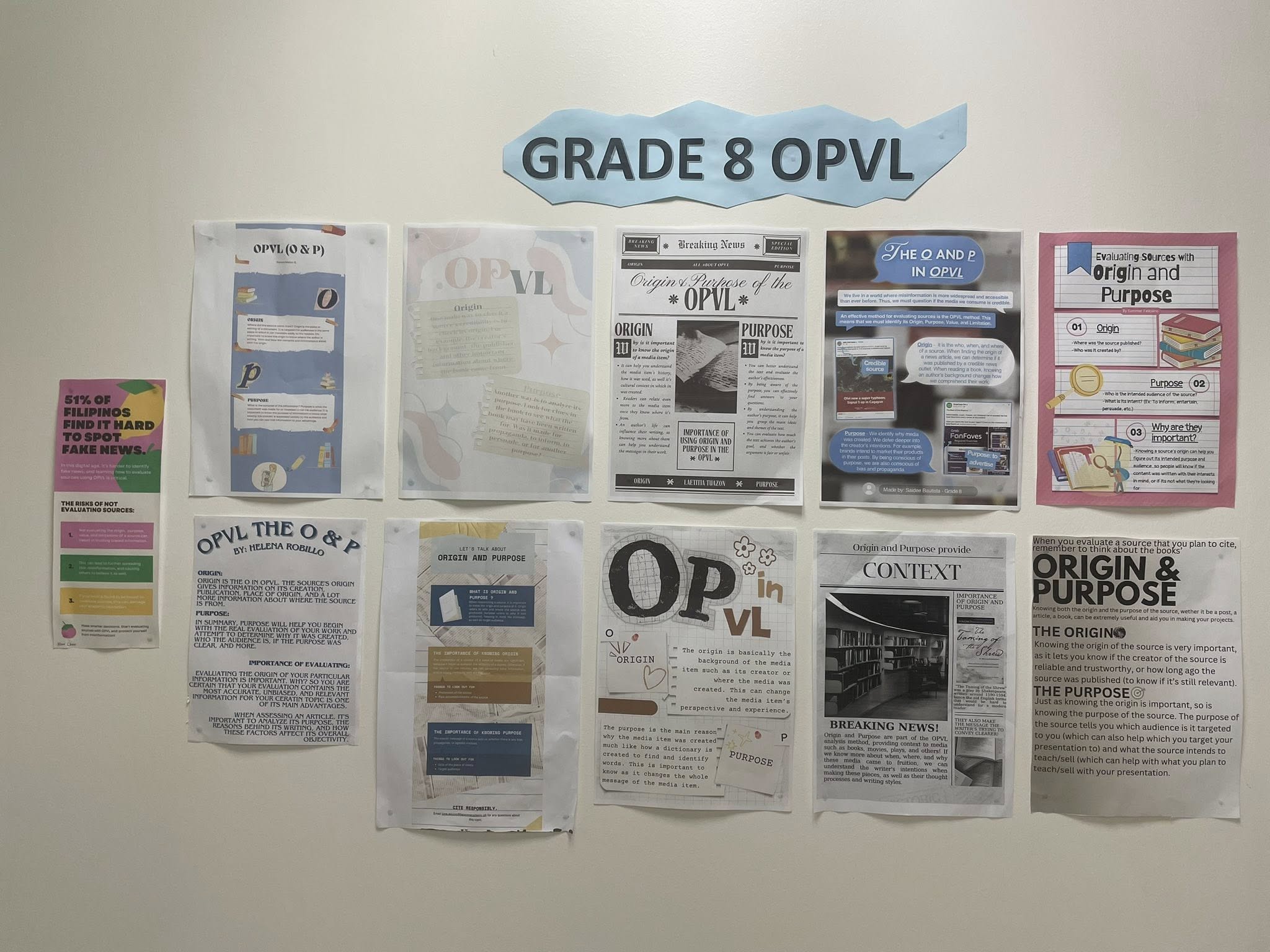
The Lighthouse Diary #71: Research Skills: Source Evaluation and OPVL (1 of 3)

In November 2024, our Grade 8 students had a library and research skills session on the OPVL. The OPVL is a strategy for evaluating sources—specifically, historical sources. Nonetheless, it can also be used to analyze the validity and reliability of information and sources we encounter everyday. Focusing on Origin and Purpose, I asked my students to evaluate information from both online and print sources. I prepared a variety— books, magazines and journals, posters and calendars, labels of kits, games and the like. And of course, social media posts. Working in pairs, they were able to come up with a review of their assigned source. They took away valuable insights on the importance of source analysis, along with the skills necessary to understand historical documents, their context, and their reason for being.

I often tell students that documents are alive. And that history is something we make every day.

A week before the Holy Week break, I met them again to discuss Value and Limitation in the OPVL framework. To identify these aspects in historical sources, it was important that we reviewed primary and secondary sources. This is actually prerequisite knowledge for source analysis and information evaluation. In a time when fake news has become inevitable for consumption, knowing the kind of source, its origin, and its intent is crucial. Applying Value and Limitation is very much connected to Origin and Purpose.


The most interesting part of our session was deep diving into the context of historical documents. They were tasked to determine the Value and Limitation of excerpts from Anne Frank’s Diary and Martin Luther King Jr.’s I Have A Dream speech. Their written output revealed a thoughtful approach to understanding the era in which these documents were written, and how the authors’ biases influenced their perspectives. Needless to say, the relevance of a source—as well as the truth it carries—is consequential to the reader.

FanSafetyPH: A Campaign for a Safer and Fairer Concert Experience


Related Posts Plugin for WordPress, Blogger...