Showing posts with label OPVL. Show all posts

Monday, April 21, 2025

The Lighthouse Diary #71: Research Skills: Source Evaluation and OPVL (1 of 3)

In November 2024, our Grade 8 students had a library and research skills session on the OPVL. The OPVL is a strategy for evaluating sources—specifically, historical sources. Nonetheless, it can also be used to analyze the validity and reliability of information and sources we encounter everyday. Focusing on Origin and Purpose, I asked my students to evaluate information from both online and print sources. I prepared a variety— books, magazines and journals, posters and calendars, labels of kits, games and the like. And of course, social media posts. Working in pairs, they were able to come up with a review of their assigned source. They took away valuable insights on the importance of source analysis, along with the skills necessary to understand historical documents, their context, and their reason for being.
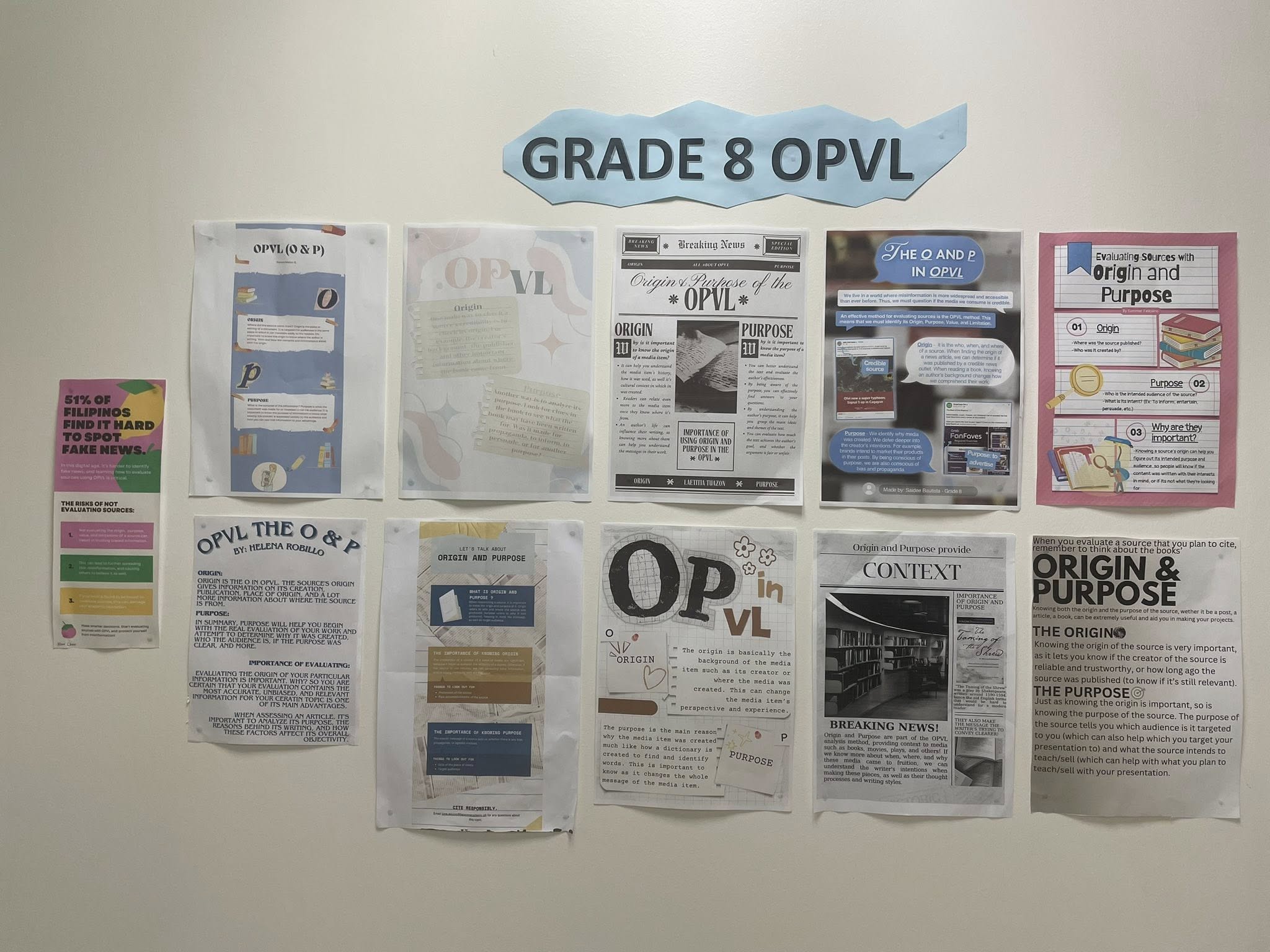
I often tell students that documents are alive. And that history is something we make every day.

A week before the Holy Week break, I met them again to discuss Value and Limitation in the OPVL framework. To identify these aspects in historical sources, it was important that we reviewed primary and secondary sources. This is actually prerequisite knowledge for source analysis and information evaluation. In a time when fake news has become inevitable for consumption, knowing the kind of source, its origin, and its intent is crucial. Applying Value and Limitation is very much connected to Origin and Purpose.


The most interesting part of our session was deep diving into the context of historical documents. They were tasked to determine the Value and Limitation of excerpts from Anne Frank’s Diary and Martin Luther King Jr.’s I Have A Dream speech. Their written output revealed a thoughtful approach to understanding the era in which these documents were written, and how the authors’ biases influenced their perspectives. Needless to say, the relevance of a source—as well as the truth it carries—is consequential to the reader.

Friday, November 8, 2024

The Lighthouse Diary #64: Direct Instruction in Teaching Research Skills and MIL

Here is a key takeaway from yesterday’s library skills and research class: 

The OPVL was used as a method for analyzing and evaluating sources. Source evaluation must be taught explicitly. Direct instruction is a teaching approach that can be used to facilitate the learning of research skills.

Direct instruction is a teaching approach where the teacher leads the lesson in a structured, straightforward way, typically involving clear explanations, demonstrations, and guided practice. In this model, the teacher is the primary source of information, presenting new material in small, manageable steps, with checks for understanding and immediate feedback along the way.

The core components of direct instruction include:

1. Clear Objectives: The teacher sets specific learning goals and communicates them to students.

2. Modeling: The teacher demonstrates the skill or concept, often by thinking aloud to show the thought process.

3. Guided Practice: Students practice the concept with support from the teacher, who provides feedback and corrects mistakes.

4. Independent Practice: Once students are confident, they practice on their own to reinforce learning.

5. Assessment and Review: The teacher checks for understanding through questioning, assessments, or reviews.

Direct instruction is often effective for teaching foundational knowledge, procedural skills, and step-by-step processes, especially in subjects like math or grammar as well as academic writing and research. It is sometimes associated with explicit teaching methods and contrasts with student-centered approaches like inquiry-based or discovery learning, where students explore topics more independently.

Thursday, February 13, 2020

MIL Lesson: OPVL (1 of 2)

OPVL is a techniques used for the evaluation of sources in the humanities. It is an acronym that stands for Origin, Purpose, Value and Limitations. The IB has published guides on its use and many teachers and librarians have created handouts and worksheets.

Last year, our Personal Project Coordinator requested for a session on the use of resources and its evaluation. Since our grade 10s already know the use of OPVL, I thought of using Visible Thinking to assist them in reflecting through their selected sources. Below is the presentation slides I used in my session with them.

Related Posts Plugin for WordPress, Blogger...